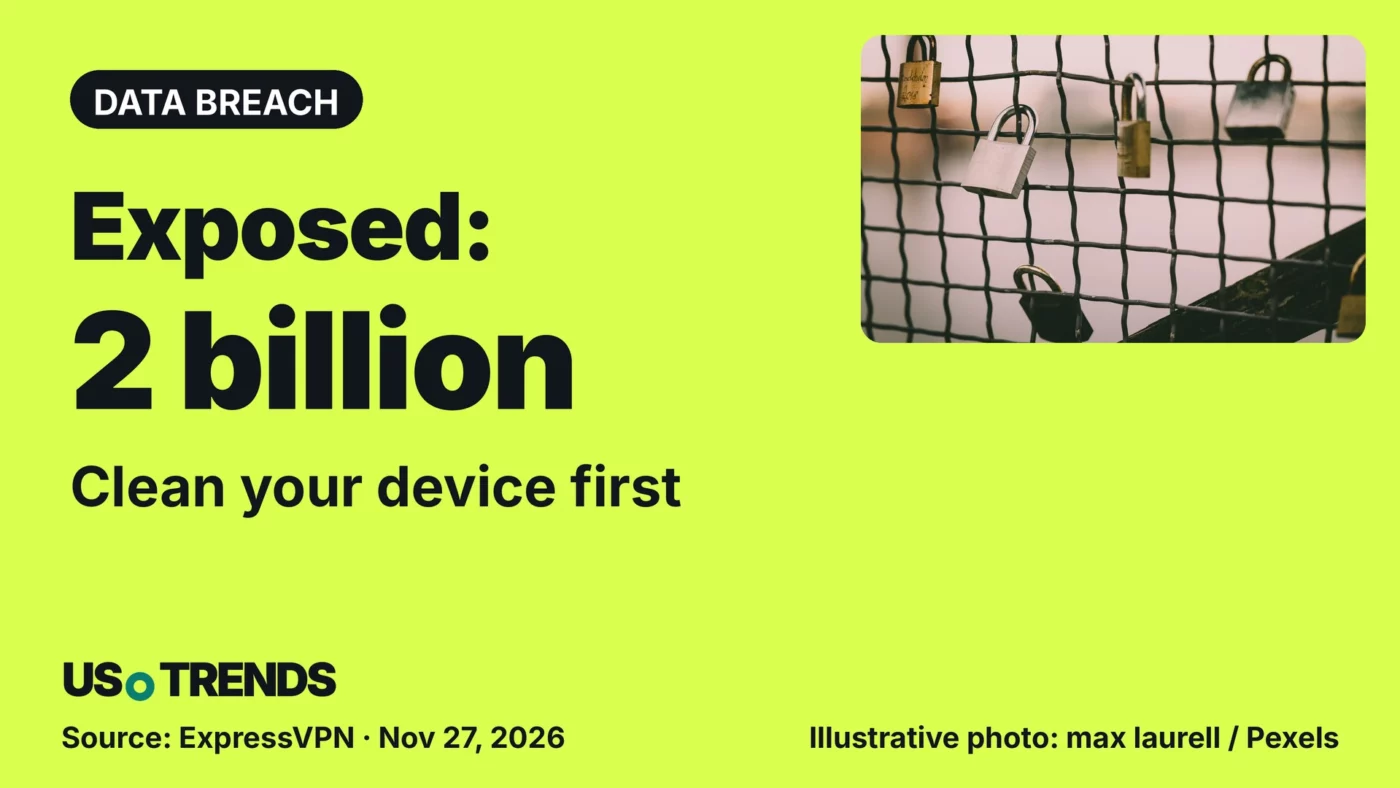
A researcher found a database with about 2 billion logins. How many people are affected is unknown, but the fixes are clear.
Key points
- Researcher Jeremiah Fowler found an unprotected, unencrypted database holding about 2 billion credentials; ExpressVPN published his findings on November 24, 2026.
- Fowler traces the records to infostealer malware and suspected cybercriminal sources. Who ran the database is unknown.
- 2 billion records are not 2 billion victims: duplicates and old data are included.
- Changing a password does not help while malware is still active on the device.
A security researcher found an open database holding about 2 billion stolen credentials. How many Americans are affected is not known, but the steps to protect your accounts are the same either way.
The figures come from Fowler himself, as published by ExpressVPN. We have not been able to verify them independently. What the report does make clear is the order of the fix: clean the device first, then change passwords, then switch on a second sign-in step.
What was in the open database
According to Fowler, the database was neither protected nor encrypted. It held email addresses, login names and passwords in plaintext, plus session tokens, cookies, other authentication data, device information and application identifiers. Some logs also contained autofill data and cryptocurrency wallet data.
The data sits in 8,471 folders. Around 400,000 documents appear to come from more advanced malware that creates a separate folder for each victim. Fowler says the find is more than 13 times larger than an earlier exposure of 149 million logins.
He reported the exposure right away, and public access was restricted several days later. Fowler did not download the files. The owner and purpose of the database remain unknown.
Records are not people
The 2 billion figure counts records, not individuals. Fowler warns that duplicates are included and that one infected device can hold many accounts, so the number should not be read as 2 billion victims.
Some files were grouped by country, with file names using abbreviations such as US, UK, FR, DE, ES and MX. The report gives no per-country counts, so there is no way to say how many US accounts are in the data. Claims that a particular service is affected are not backed up by what has been published.
Why a new password is not enough
Fowler attributes the records to infostealer malware, which copies logins from infected devices. That matters for the fix. If the malware is still running, it can capture the new password as well, and session tokens and cookies can let an attacker in without any password at all.
Fowler’s advice is to remove the malware or factory reset the device before changing any passwords. If you suspect an infection, disconnect the device, scan it, and then use a clean device to change passwords and revoke active sessions.
What it means for US accounts
The Cybersecurity and Infrastructure Security Agency (CISA) says a password alone is not enough protection. On its multifactor authentication page, CISA states that “any MFA is better than no MFA”, and that phishing-resistant MFA, the widely available form being FIDO/WebAuthn, is the standard to aim for. It lists email, financial services, social media and online stores among the places to turn it on first.
Passwords are not the only exposure risk. Because some logs held autofill data, it is worth reviewing what your browser has saved, such as addresses and payment cards, and checking your statements.
The report does not say that Social Security numbers are in the data. A credit freeze is therefore an optional extra here, not a response to a confirmed exposure. The Federal Trade Commission (FTC) explains that a freeze stops anyone from opening a new credit account in your name, that it is free to place and lift, and that you have to contact all three bureaus: Equifax, Experian and TransUnion. The FTC page says a freeze “is always a good idea” and matters more when your Social Security number has been exposed.
Check whether your email appears in known leaks
The report does not name a lookup for this particular find. Have I Been Pwned, a breach search service, lets you search an email address against known leaks. Its homepage lists 1,055 pwned websites and 17,863,315,853 pwned addresses.
We have not checked whether Fowler’s find is already in that database. No hit is therefore not an all clear, and a hit in an older breach says nothing about whether this one affects you.
What to do now
The advice from Fowler and CISA points the same way: device first, then accounts, then a second sign-in step. The checklist puts those steps in order, because doing them out of sequence leaves the malware in place.
What to do now
- Update your device and run security software
Keep the operating system, browsers and apps current, and remove browser extensions you do not recognize.
- Remove malware or factory reset an infected device
A new password does not help while the malware is still running.
- On a clean device, set unique passwords
A password manager can create and store them.
- Turn on multifactor authentication
Start with email, banking and shopping accounts. Phishing-resistant options such as FIDO/WebAuthn are the standard to aim for.
- Sign out active sessions and connected devices
- Check your email addresses at Have I Been Pwned
No hit is not an all clear.
- Optional: place a free credit freeze
Contact Equifax, Experian and TransUnion.
If your email account is the one that was taken, change the password for any service linked to it as well, because a reset link sent to that inbox can open the other accounts.
Frequently asked questions
Is my account part of the leak?
That cannot be said for certain. The report gives no count of affected people and no breakdown by country or service. Check your email at Have I Been Pwned and secure your key accounts as a precaution.
Is changing my password enough?
Not always. Fowler says a password change does not help while malware is active on the device. Clean the device first, then set new passwords and sign out active sessions.
What kind of data was in the database?
Per Fowler: email addresses, logins, plaintext passwords, session tokens, cookies, authentication data and device information, spread across 8,471 folders. Some logs also held autofill and cryptocurrency wallet data.
Do I need a credit freeze?
The report does not say Social Security numbers were exposed. The FTC says a freeze is free and “always a good idea”, so it is an optional extra step.
Your view: Do you use a password manager, and if not, what has held you back? Tell us in the comments.
Sources and date
As of: November 27, 2026
- ExpressVPN: Research report by Jeremiah Fowler (published November 24, 2026)
- Cybersecurity and Infrastructure Security Agency: Multifactor authentication (information page, accessed November 27, 2026)
- Federal Trade Commission: What to know about credit freezes and fraud alerts (consumer advice, August 2025)
- Have I Been Pwned: Homepage (website, accessed November 27, 2026)
Transparency note: AI-assisted tools were used in researching, structuring and writing this article. The sources used are listed in the article. Publication takes place only after manual editorial approval.
Share this article
Read next

Your curiosity
Our next story
Bring your ideas for AI and digital media
Discover open positions Research
 ▶ Reel