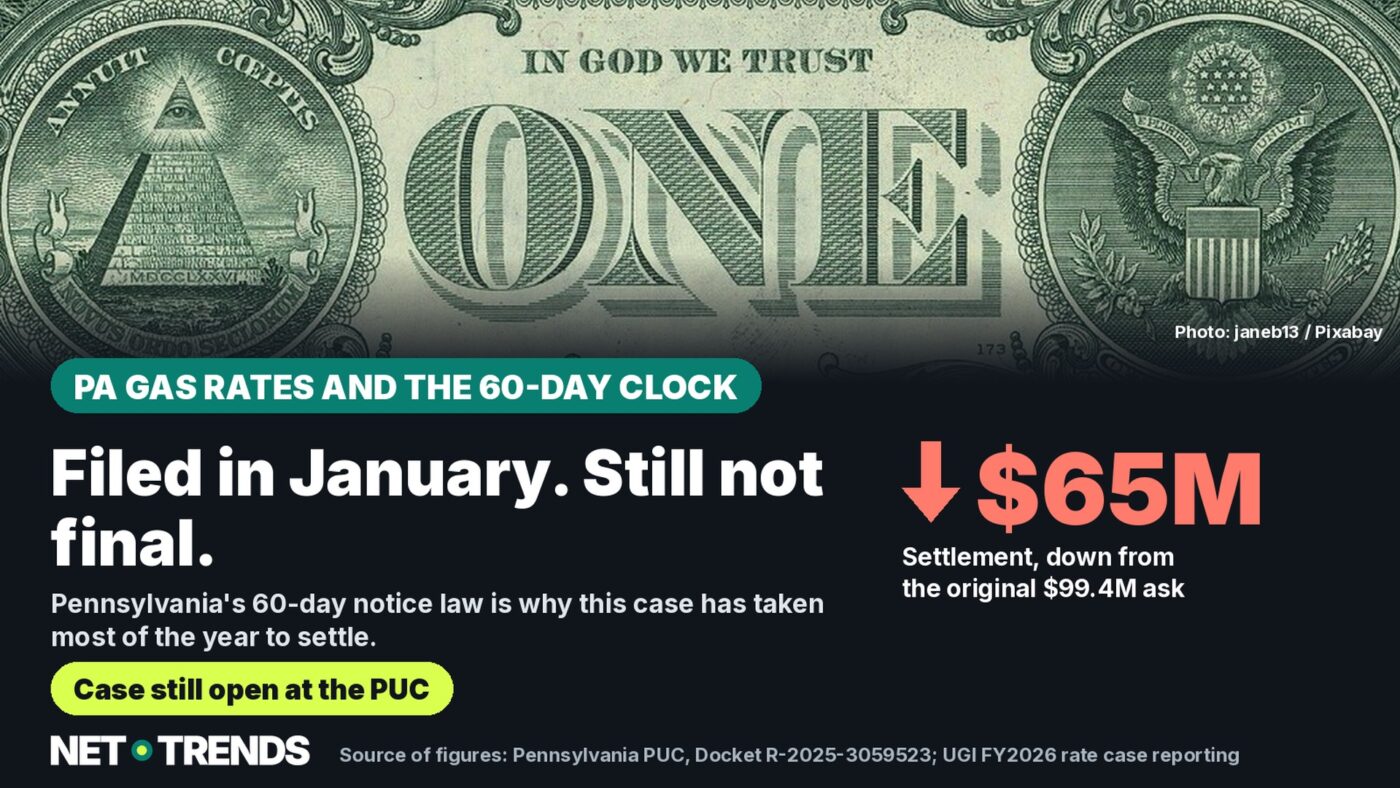
A Pennsylvania law gives utilities 60 days’ notice before a rate change takes effect – UGI’s current natural gas case shows what that timeline looks like in practice
Key points
- Under 66 Pa. Code § 1308, a utility must give the Pennsylvania Public Utility Commission (PUC) at least 60 days’ notice before changing its rates – and the PUC can then suspend a general rate increase for up to seven months while it investigates.
- UGI Utilities’ gas division filed for an 8.05% ($99.4 million) revenue increase on 28 January 2026; the PUC voted 5-0 on 19 February 2026 to suspend and investigate it, affecting about 690,000 customers in 46 Pennsylvania counties.
- Administrative law judges recommended a settlement on 31 July 2026 that cuts the increase to about $65 million, phased in two stages – $40 million from October 2026, a further $25 million from October 2027 – with UGI expecting a final Commission decision no later than October 2026.
Pennsylvania does not set one statewide gas price the way some countries regulate household energy. Instead, each utility has to ask the PUC for a new rate, give 60 days’ notice, and survive a months-long investigation before a single bill changes.
Germany’s electric and gas utilities face a comparable duty: a supplier changing its “Grundversorgung” price must announce it at least six weeks ahead under § 5 of the StromGVV and GasGVV, or the new price is delayed by a month. Pennsylvania’s process runs longer and is public from the first filing, but the underlying idea – customers, and the regulator, get a guaranteed runway before a new rate bites – is the same.
The 60-day notice law
Section 1308 of the Pennsylvania Public Utility Code requires any utility that wants to change an existing rate to give the PUC at least 60 days’ written notice stating the proposed change and the date it would take effect; the Commission can waive that period only for good cause. For an ordinary rate change the Commission may then suspend the new rate for up to six months while it reviews it, plus a further three months if it needs more time to decide – up to seven months in total for a general rate increase under subsection (d). If the Commission still has not issued a final decision once that period runs out, the proposed rate takes effect anyway, but the Commission can later order refunds with interest if it finds the rate was too high.
Separate PUC regulations, including 52 Pa. Code § 53.45 on notice of new tariffs, require utilities to make the proposed change public, not just file it with the Commission – which is why Pennsylvania gas customers typically see a “notice of proposed rate change” insert with their bill once a case is filed.
UGI’s current case: from filing to settlement
UGI Utilities’ natural gas division filed its current base rate case with the PUC on 28 January 2026, asking for about $99.4 million, or 8.05%, in additional annual revenue – which would have raised the average residential bill, for a customer using 68.7 Ccf a month, from $113.64 to $123.55, an 8.7% increase. On 19 February 2026, the PUC voted 5-0 to suspend the filing and open a full investigation, Docket No. R-2025-3059523, covering roughly 690,000 customers in 46 counties.
That investigation followed the statutory path: evidentiary hearings before an administrative law judge, input from the state’s Office of Consumer Advocate and other parties, and ultimately a negotiated settlement. According to a report on the case, the assigned administrative law judges recommended approving that settlement without modification on 31 July 2026. The negotiated figure – about $65 million, roughly a third less than UGI’s original request – is split into two stages: $40 million in new revenue effective October 2026, and a further $25 million effective October 2027, alongside a commitment from UGI not to file another base rate case before January 2029. UGI’s own reporting said it expected a final Commission decision no later than October 2026; this article does not assume that decision has already been issued.
What the stages mean for a typical bill
Working through the case against the statutory clock
- 28 January 2026: UGI files for $99.4 million (8.05%) – the 60-day notice clock under § 1308 starts.
- 19 February 2026: PUC suspends the filing and opens Docket R-2025-3059523; the case can now run for up to seven months under § 1308(d).
- 31 July 2026: administrative law judges recommend a reduced settlement of about $65 million, in two stages.
- October 2026 / October 2027: the two stages, $40 million and $25 million, are set to take effect – if the Commission approves the settlement as recommended.
The gap between the original 8.7% residential bill increase UGI requested and the smaller, staged amount in the settlement shows what the investigation period is for: it gives the Commission, the Office of Consumer Advocate and other parties time to argue the number down before it reaches a customer’s bill.
Other states, other clocks
Pennsylvania’s 60-day notice and up-to-seven-month suspension are specific to this state; there is no single federal notice period for utility rate changes serving households. Other states run their own versions of the same idea under their own public utility codes and commissions – for example, California’s Public Utilities Commission reviews investor-owned utility rate cases under its own procedural rules. A customer in a different state should check that state’s commission, not assume Pennsylvania’s timeline applies.
What customers can do
Checklist during an open rate case
- Read the “notice of proposed rate change” insert that comes with your bill once a utility files – it names the docket number, the requested increase and how to comment.
- Check the docket on the PA PUC’s website for hearing dates and the current status before assuming the originally filed number is final.
- Remember a settlement can cut the requested amount substantially, as in UGI’s case – the first filed number is a starting point, not the final bill.
- The Office of Consumer Advocate represents residential customers in these cases at no direct cost to you; its filings are public on the same docket.
Frequently asked questions
Does the 60-day notice mean my gas bill cannot rise for 60 days?
It means the utility must notify the Commission at least 60 days before a rate change it proposes could take effect. For a general rate increase, the Commission can then suspend that change for up to seven months while it investigates, so the real wait for customers is usually much longer than 60 days.
Has UGI’s $65 million settlement definitely been approved?
As of the sources checked for this article, administrative law judges had recommended the settlement on 31 July 2026 and UGI expected a final Commission decision no later than October 2026. This article does not state that the Commission has issued that final decision.
Does this 60-day rule apply to electricity too?
Yes. Section 1308 of the Public Utility Code applies to “any public utility” changing an existing rate, which covers electric, gas, water, telephone and other regulated utilities in Pennsylvania, not only natural gas.
What happens if the PUC has not decided by the end of the suspension period?
Under § 1308(d), if the Commission has not issued a final decision once the suspension period for a general rate increase ends, the proposed rate takes effect – but the Commission can later order the utility to refund, with interest, any amount it decides was not justified.
Have you received a rate-change notice from your Pennsylvania utility this year, and did the final settlement match what was first filed? Share your experience in the comments.
Sources and status
- 66 Pa. Consolidated Statutes § 1308 (Voluntary changes in rates), accessed 8 November 2026.
- 52 Pa. Code § 53.45 (Notice of new tariffs and tariff changes), accessed 8 November 2026.
- Pennsylvania PUC: “PUC to Investigate UGI’s Natural Gas Rate Increase Request”, 19 February 2026.
- Report on UGI’s FY2026 outlook and the pending rate case settlement, referencing the 31 July 2026 ALJ recommendation.
Research and data as of: 8 November 2026.
Transparency note: AI-assisted tools were used in researching, structuring and writing this article. The sources used are listed in the article. Publication takes place only after manual editorial approval. Country edition researched for the United States (Pennsylvania), based on an article by Net Trends on the German notice period for electricity and gas price changes; the German case does not carry over directly, so US sources, rules and figures were researched separately. Featured image: own illustration based on a Pixabay photograph, see image credit.
Share this article