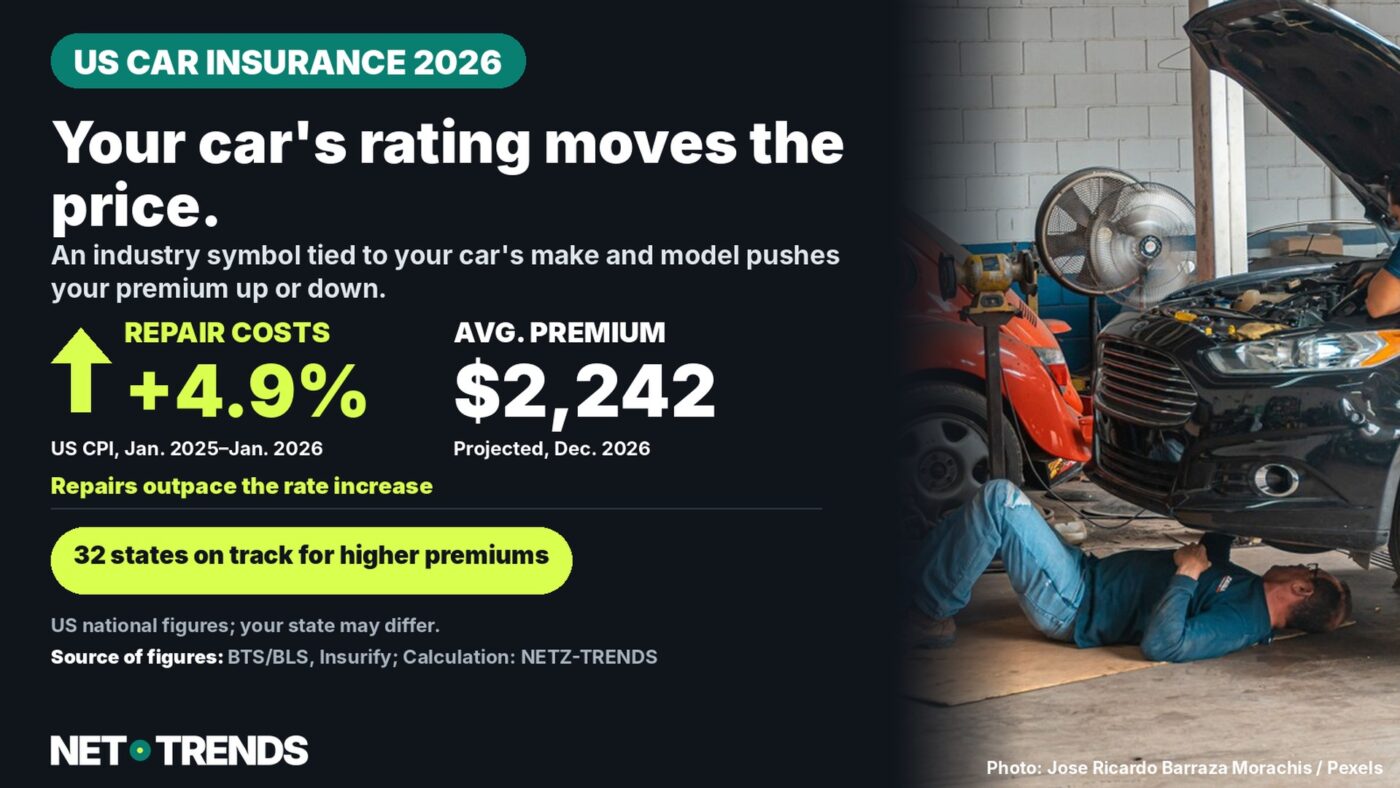
Vehicle repair costs rose 4.9 percent over the year to January 2026, and a little-known industry rating system still decides how much your specific car model costs to insure.
Key points
- The cost of motor vehicle maintenance and repair rose 4.9 percent in the year to January 2026, according to federal data — far faster than overall transportation costs, which fell 1.1 percent in the same period.
- The national average full-coverage car insurance premium stood at $2,237 in June 2026 and is projected to reach $2,242 by the end of the year, with 32 states on track for further increases, according to the comparison site Insurify.
- The US has no nationwide “Typklasse” system like Germany. Instead, most insurers price physical damage coverage using the ISO Symbol system, which rates each vehicle make and model from 1 to roughly 75 for repair cost, theft risk and crash damageability.
- There is also no single national cancellation deadline like Germany’s November 30: renewal, cancellation and nonrenewal rules are set state by state, with NAIC’s model minimums suggesting 20 days’ notice to cancel (10 days for nonpayment) and 30 days before a nonrenewal.
Car repairs got measurably more expensive in the US over the past year, and insurers are still raising full-coverage rates in roughly two-thirds of states. Unlike Germany’s Kfz-Versicherung, there’s no single nationwide system that resets everyone’s price at once — American drivers are priced by a vehicle-specific industry rating and a state-by-state rulebook.
The headline numbers come from two different sources: the Bureau of Transportation Statistics’ read of the government’s Consumer Price Index, and Insurify’s twice-yearly market report compiled from real quotes. Together, they describe a market where the cost of fixing cars is climbing faster than the price of insuring them — a dynamic very different from the German Kfz-Versicherung story about a 99 percent claims-cost ratio, which has no exact American equivalent.
Repair costs: up 4.9 percent in a year
The Bureau of Transportation Statistics’ Transportation Consumer Price Index release, published February 13, 2026 using Bureau of Labor Statistics data, shows that the Motor Vehicle Maintenance and Repair component of the CPI rose 4.9 percent from January 2025 to January 2026. That increase stands out because the broader Transportation CPI actually fell 1.1 percent over the same period, pulled down mainly by cheaper gasoline and airfares. In other words, the one line item that drives auto insurance claims costs is moving in the opposite direction from transportation prices generally.
The Texas Department of Insurance, in a consumer guide last updated September 1, 2026, names repair-cost inflation directly as one of the forces behind premium increases: “Inflation can affect the cost of new and used vehicles, car parts, and repairs,” and insurers may raise rates to cover “higher vehicle repair and replacement costs.” Texas regulates its own market and does not set nationwide prices, but the mechanism it describes — rising parts and labor costs feeding into premiums — applies across most states.
How insurers actually did in 2025
Here the American story diverges sharply from the German one. The GDV’s warning about a 99 percent claims-cost ratio describes an industry with almost no margin left. US auto insurers had the opposite experience in 2025: ratings agency AM Best, in a market report published February 23, 2026, put the entire US property/casualty insurance industry’s combined ratio at 95.0 percent for 2025, down from 97.1 percent in 2024 — meaning insurers kept more of every premium dollar than the year before. Personal auto was one of the segments AM Best described as showing “favorable trends,” part of what trade press called a decade-high profit rebound for the sector in 2025.
AM Best’s 2026 outlook is more cautious: the report expects “slightly higher underwriting ratios and slightly lower operating returns” for personal lines, meaning margins are likely to narrow somewhat even if they stay well short of the razor-thin numbers German insurers are describing for 2026.
The real US “Typklasse”: ISO vehicle symbols
Germany’s GDV publishes a public Typklasse for every car model. US insurers generally rely on a similar but less visible tool: the ISO Symbol system, built by the analytics firm Verisk/ISO and used as a baseline by many carriers. According to the New York State Department of Financial Services, which publishes a public explainer and sample list, every make and model gets separate comprehensive and collision symbols on a scale that has run from 1 to about 75 since 2011. “Higher symbol numbers reflect greater claim cost and, therefore, higher premiums,” the agency states. The rating folds in repair cost, theft record, how severely a vehicle tends to get damaged in a crash, and “damageability” — how much bumper and body damage it sustains in low-speed impacts.
| Model | Comprehensive | Collision |
|---|---|---|
| Subaru Outback 2.5i AWD | 26 | 10 |
| Jeep Wrangler JL Unlimited Hybrid AWD | 18 | 16 |
| Porsche 911 Carrera | 69 | 67 |
| Mercedes-Benz S580 Hybrid | 73 | 68 |
Source: New York State Department of Financial Services, sample 2025 ISO Symbol listing. Scale runs roughly 1–75; higher means costlier to insure. Selection, not a complete list.
Unlike the German GDV figures, these symbols are not published as one official national table consumers can look up by VIN — DFS itself calls its list only “a sample” and tells drivers to check with their own insurer for a quote. Symbols also “are subject to change periodically.” The Texas Department of Insurance adds that personal factors — claims history, location, age, and credit-based scoring where allowed — sit on top of the vehicle symbol, so two owners of an identical car can still pay very different premiums.
No national deadline: rules vary by state
Germany’s Kfz-Versicherung has one fixed date: cancel by November 30 or stay locked in for another year. US auto insurance has no equivalent nationwide cutoff, because each state licenses and regulates its own insurance market; there is no single federal insurance regulator setting renewal dates. What exists instead is a model framework states can choose to adopt: the National Association of Insurance Commissioners’ 1997 Automobile Insurance Declination, Termination, and Disclosure Model Act sets minimum notice periods of 20 days before a midterm cancellation (10 days if the reason is nonpayment) and 30 days before a nonrenewal, with cancellation limited to specific causes such as nonpayment, fraud, or license suspension.
Because it is a model act, not a federal statute, individual states can set longer notice periods, add extra consumer protections, or implement the rules differently — so the actual deadline that applies to a given driver depends on where that driver’s policy is written and regulated. A driver who wants to shop around for a better rate therefore cannot rely on one nationwide date the way a German driver relies on November 30; the right move is checking the renewal notice the insurer is required to send and the specific rules published by that state’s insurance department.
Why the repair bill matters more than it looks
- Repair-cost inflation, year to January 2026: +4.9 percent, per BTS/BLS data.
- Overall transportation costs, same period: −1.1 percent, per the same release.
Calculation: repair costs moved roughly 6 percentage points faster than transportation prices as a whole over the same 12 months. Since collision and comprehensive coverage are priced largely around expected repair bills, that gap is one reason full-coverage premiums are still edging up in most states even as other driving costs ease. This is a reading of two published indexes, not a forecast for any individual policy — an individual vehicle’s ISO symbol and a driver’s own state and record can move the result in either direction.
Checklist: before your next renewal
- Compare your renewal premium against at least two other quotes before it takes effect — rates for the same driver and car can vary widely between insurers.
- Ask your insurer for your vehicle’s comprehensive and collision rating, not just your personal driving record, if your premium jumped after a vehicle change.
- Check your state insurance department’s website for the exact cancellation and nonrenewal notice period that applies to your policy — it is not the same in every state.
- If you’re buying a different vehicle, ask for an insurance quote before you buy — a higher ISO symbol can add meaningfully to the cost of otherwise similar cars.
- Read the notice your insurer sends before a nonrenewal or rate change — state law generally requires insurers to state the reason in writing.
Your take
Has your car insurance premium gone up or down this year, and do you know your vehicle’s comprehensive/collision rating? Share your experience in the comments.
Frequently asked questions
Is there a US version of Germany’s Typklasse?
Not an identical public system, but a close parallel: the ISO Symbol system rates most vehicle makes and models for comprehensive and collision coverage on a scale of roughly 1 to 75, based on repair cost, theft risk and crash damageability. Unlike the German GDV table, it isn’t published as one complete public list.
Is there a national deadline to cancel my car insurance, like Germany’s November 30?
No. The US has no single federal deadline. Cancellation and nonrenewal notice periods are set state by state; NAIC’s model minimums are 20 days for a cancellation (10 for nonpayment) and 30 days for a nonrenewal, but your state may set different rules.
Why are US repair costs rising faster than other transportation costs?
Federal data shows motor vehicle maintenance and repair costs rose 4.9 percent in the year to January 2026, while overall transportation costs fell 1.1 percent, pulled down by cheaper gasoline and airfares. The repair-specific increase reflects parts and labor costs rather than fuel prices.
Were US auto insurers losing money in 2025, like German insurers expect for 2026?
No. AM Best reported the overall US property/casualty industry’s 2025 combined ratio at 95.0 percent, down from 97.1 percent in 2024, with personal auto among the segments showing favorable trends. AM Best expects margins to narrow somewhat in 2026, but not to the thin levels German insurers describe.
Sources and status
- Bureau of Transportation Statistics: “Transportation Consumer Price Index: January 2026,” published February 13, 2026, using Bureau of Labor Statistics CPI data
- Texas Department of Insurance: “How Are Your Auto and Homeowners Insurance Costs Calculated?,” updated September 1, 2026
- New York State Department of Financial Services: “Factors Impacting Physical Damage Coverage Premiums”
- National Association of Insurance Commissioners: Automobile Insurance Declination, Termination, and Disclosure Model Act (#725)
- AM Best: “Best’s Market Segment Report: Rate Actions, Investment Gains Drive US Property/Casualty Insurance Segments’ 2025 Results; Headwinds May Pressure Carriers in 2026,” February 23, 2026
- Insurify: “Car Insurance Costs Climb in the First Half of 2026” market report
Research and data as of: November 7, 2026.
Transparency note: AI-assisted tools were used in researching, structuring and writing this article. The sources used are listed in the article. Publication takes place only after manual editorial approval. Länderfassung auf Basis eines Artikels von Net Trends, für die USA recherchiert.
Share this article