iSeeCars data for September 2026: used EVs are now priced above gas cars for the first time, while the rest of the market holds nearly flat
Key points
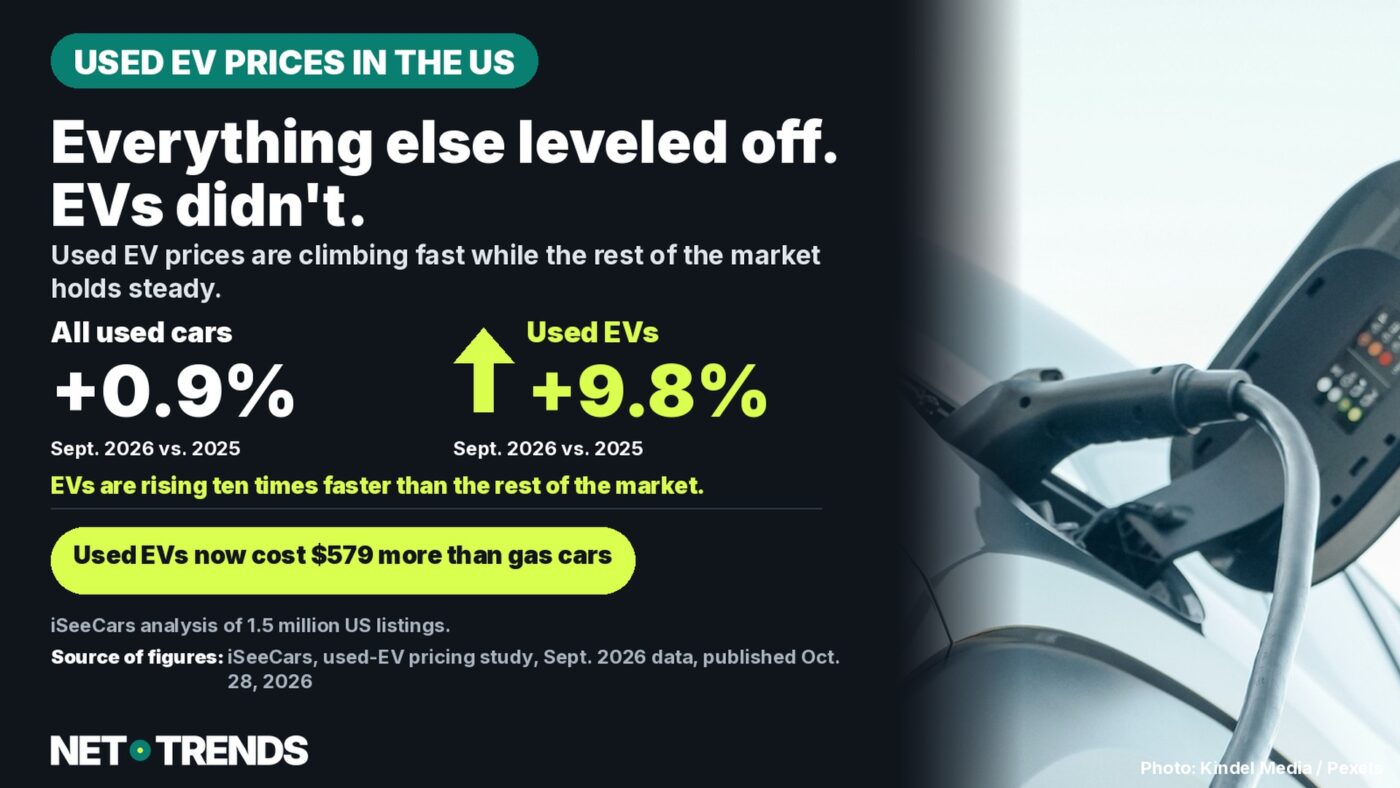
- Average asking prices for used electric vehicles in the US rose 9.8% between September 2025 and September 2026, to $32,533, according to new data from iSeeCars.
- For the first time in the study’s tracking, used EVs now cost more on average than used gas cars: $579 more, versus $2,227 less a year earlier.
- Used hybrids rose a more moderate 4.9% to $34,476, while gas car prices barely moved, up 0.3% to $31,954. The broader used car market averaged $32,096, up just 0.9%.
- Used EVs are also selling faster: 41.9 days on the market on average in September 2026, down from 46.6 a year earlier, while gas cars slowed to 54.8 days.
Buying a used EV in the US got noticeably pricier over the past year. Asking prices rose 9.8% between September 2025 and 2026, new data shows — far outpacing gas and hybrid cars.
According to a new analysis by the vehicle research firm iSeeCars, the average asking price for a used electric vehicle climbed to $32,533 in September 2026, up $2,896 from $29,637 a year earlier. Over the same period, the average price for a used gasoline-powered vehicle rose just 0.3%, to $31,954, and the used car market as a whole averaged $32,096, up only 0.9%.
The shift means used EVs, which were $2,227 cheaper than gas cars on average just a year ago, are now $579 more expensive — a reversal iSeeCars attributes to a mix of recovering demand and the end of the federal EV tax credit.
A study built on 1.5 million listings
The figures come from iSeeCars’ used-vehicle pricing study, published October 28, 2026. The company’s research team analyzed more than 1.5 million 1- to 5-year-old used vehicles listed for sale nationwide, comparing September 2026 asking prices with September 2025. As with any listing-price analysis, the figures reflect what sellers are asking, not necessarily what buyers ultimately pay after negotiation.
Prices by drivetrain: September 2026
Broken down by drivetrain, the pattern is clear: electric vehicles pulled far ahead of every other category, while gasoline models were essentially flat.
| Drivetrain | Avg. price Sept. 2026 | Year over year |
|---|---|---|
| All used cars | $32,096 | +0.9% |
| Electric (EV) | $32,533 | +9.8% |
| Hybrid | $34,476 | +4.9% |
| Gasoline | $31,954 | +0.3% |
Source: iSeeCars used-vehicle pricing study, September 2026 data, published October 28, 2026. Figures are average nationwide asking prices for 1- to 5-year-old used vehicles, not transaction prices.
Hybrids remain the most expensive used-car category in dollar terms, costing $1,943 more than EVs and $2,522 more than gas cars on average. But EVs are the fastest-moving number on the board: their 9.8% year-over-year gain was twice the 4.9% increase for hybrids and more than 30 times the 0.3% uptick for gasoline vehicles. Three Tesla models ranked among the five biggest year-over-year price gainers across all used cars tracked in the study, led by the Tesla Model S at 22.5%.
“The results reveal a market where EVs are appreciating in average asking price much faster than other drivetrains, while also spending less time waiting for buyers.”
Karl Brauer, Executive Analyst, iSeeCars
Used EVs are also selling faster
Selling speed tells a similar story. Used EVs averaged 41.9 days on the market in September 2026, down from 46.6 days a year earlier — a 10.1% improvement. Gas cars moved in the opposite direction, taking 54.8 days to sell on average, up 19.9% from 45.7 days. Hybrids landed in between, averaging 48.6 days, down slightly from 49.2.
A year ago, gas vehicles sold marginally faster than EVs. In September 2026, used EVs sold about 13 days faster than gas cars — a gap wide enough that iSeeCars described it as a “substantial shift” in the used-car market rather than a one-month blip.
What’s driving the reversal
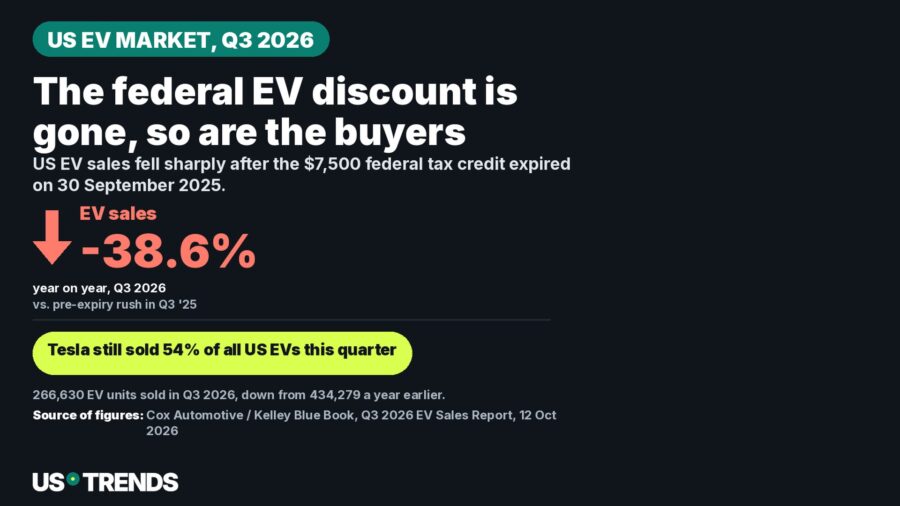
iSeeCars points to two overlapping causes. The first is the end of the federal clean-vehicle tax credit: under the Internal Revenue Service’s current guidance, the credit of up to $7,500 for a qualifying new EV and up to $4,000 for a qualifying used one is no longer available for vehicles acquired after September 30, 2025, following the One, Big, Beautiful Bill Act (Public Law 119-21) signed July 4, 2025. Demand that had been pulled forward to beat that deadline dipped afterward and has since been recovering, which tends to push asking prices back up.
The second factor, in the company’s own words, is fuel cost. “Ongoing higher fuel prices are likely driving the shift, though the EV segment has also recovered from the demand turbulence caused by the loss of federal incentives a year ago,” Brauer said in the report. Neither iSeeCars nor NET TRENDS can isolate exactly how much of the 9.8% increase comes from each factor — the study reports the combined result, not a breakdown between the two causes.
Model calculation: what the year-over-year jump means
- Average used EV price, September 2025: $29,637
- Average used EV price, September 2026: $32,533
Math: $32,533 minus $29,637 equals $2,896 more, a 9.8% increase in twelve months — more than ten times the 0.9% increase for the used car market as a whole. This describes the market average, not any single vehicle: model, battery health, mileage and trim still matter more for an individual asking price than the overall trend.
For shoppers, that means the market trend is useful context for a negotiation, but it is not a substitute for checking a specific listing against comparable vehicles.
Checklist for buyers and sellers
What to check before you buy or sell a used EV
- Compare several current listings of the same model and model year, not just the nationwide average.
- Have the battery’s state of health checked independently — it drives resale value for an EV the way engine condition does for a gas car, and it isn’t captured by the price averages above.
- These are asking prices, not transaction prices, and they don’t include state and local sales tax, which ranges from zero in states such as Alaska, Delaware, Montana, New Hampshire and Oregon to well over 8% in others — ask your dealer for the out-the-door price.
- The federal tax credit (up to $7,500 for a new EV, up to $4,000 for a qualifying used one) no longer applies to vehicles acquired after September 30, 2025. Some states and utilities still run their own EV rebates — check with your state’s taxation or motor vehicle department before you buy.
- With used EVs selling nearly two weeks faster than gas cars on average, be ready to move quickly once you find a listing that fits.
None of this tells an individual buyer whether now is the right moment to purchase — that still depends on the specific vehicle, its condition and the local market. What the iSeeCars data does establish is that the broad “EVs are getting cheaper” narrative of the past two years no longer matches what’s happening on used-car lots.
Frequently asked questions
How much does a used EV cost in the US right now?
According to iSeeCars, the average asking price for a used electric vehicle was $32,533 in September 2026 — up 9.8% from $29,637 in September 2025.
Are used EVs now more expensive than used gas cars?
Yes. Used EVs averaged $579 more than used gasoline vehicles in September 2026 ($32,533 vs. $31,954). A year earlier, EVs had been $2,227 cheaper than gas cars on average.
Why are used EV prices rising while gas car prices stay flat?
iSeeCars points to recovering demand after the September 2025 expiration of the federal EV tax credit, combined with higher fuel prices that make electric vehicles relatively more attractive. The study does not quantify how much of the increase comes from each factor.
Is the federal EV tax credit still available?
No. Per IRS guidance, the credit of up to $7,500 for a new EV and up to $4,000 for a qualifying used EV does not apply to vehicles acquired after September 30, 2025, following the One, Big, Beautiful Bill Act. Some states and utilities still offer their own EV incentives.
Sources and status
- iSeeCars: Used EVs Are Getting More Expensive While Selling Faster Than Gas Cars, published October 28, 2026.
- Internal Revenue Service: Credits for New Clean Vehicles Purchased in 2023 or After, including used clean vehicle credit termination date.
Research and data as of November 6, 2026.
Transparency note: AI-assisted tools were used in researching, structuring and writing this article. The sources used are listed in the article. Publication takes place only after manual editorial approval. Country edition based on an article from Net Trends, researched for the US.
Share this article