The average rate on new car loans at US commercial banks rose for a second straight quarter, Federal Reserve data show, as buyers face higher financing costs
Key points
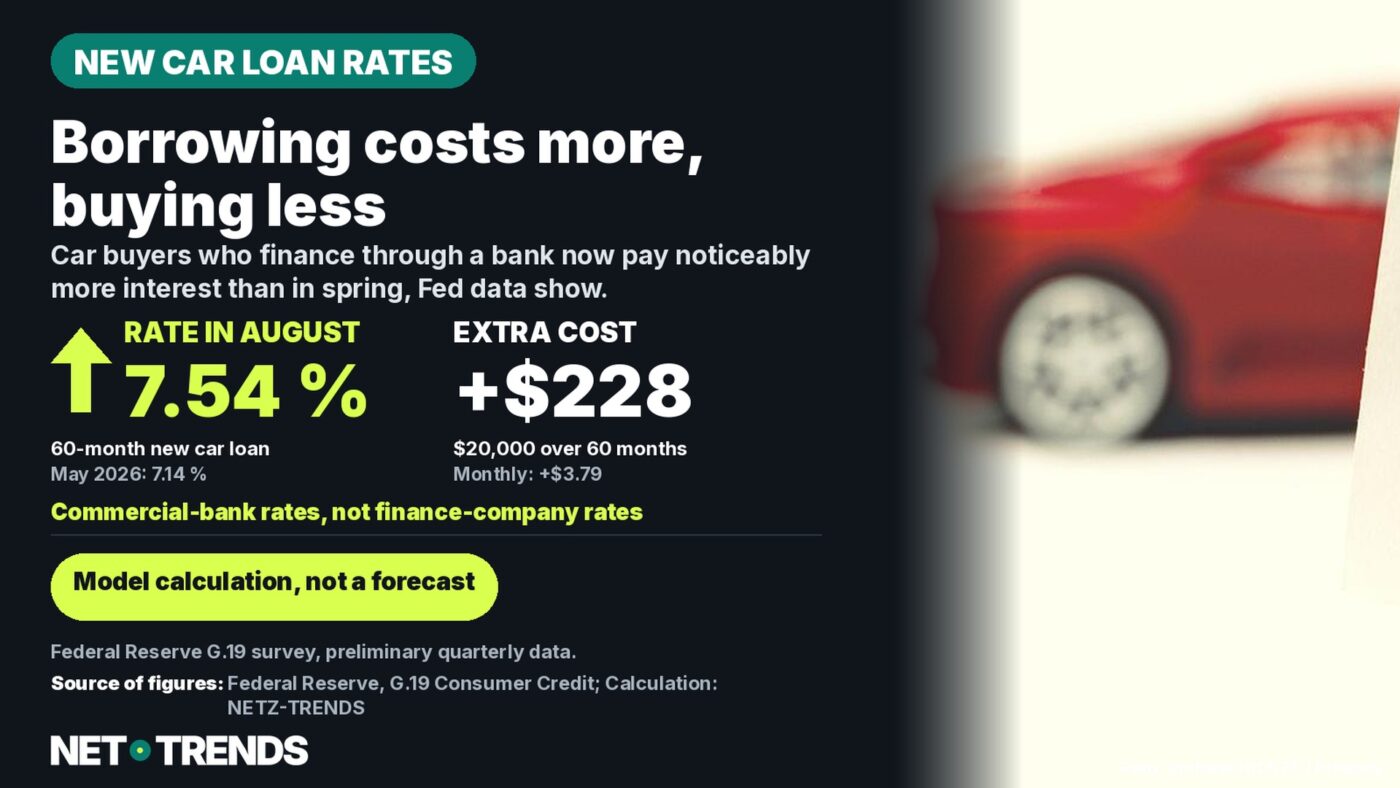
- The Federal Reserve’s G.19 Consumer Credit release shows the average rate on new 60-month car loans at commercial banks rising to 7.54% in the third quarter of 2026 (August data, preliminary), up from 7.14% in the second quarter (May data).
- On 72-month loans, the rate rose from 6.97% to 7.17% over the same period.
- On a representative $20,000 loan over 60 months, the rise adds about $228 in total interest, or about $3.79 a month.
Car buyers financing through a bank are paying noticeably more interest than earlier this year. Federal Reserve data show the average rate on new 60-month car loans at commercial banks climbed to 7.54% in the third quarter of 2026, from 7.14% in the second quarter.
The numbers come from the Federal Reserve’s monthly G.19 Consumer Credit statistical release, specifically its quarterly “Terms of Credit” table, most recently updated in the release published 7 October 2026. The Fed collects separate rates for commercial banks and finance companies, and does not break car-loan rates down by individual US state or lender.
Car loans are overwhelmingly the way Americans finance a new or used vehicle, whether through a bank, a credit union or dealer-arranged financing, making the Fed’s rate a widely watched benchmark – unlike Germany’s Bundesbank statistic, which covers all consumer credit rather than car loans specifically.
What the Federal Reserve figures show
The Federal Reserve’s G.19 release of 7 October 2026 puts the average interest rate on new car loans at commercial banks at 7.54% for 60-month loans and 7.17% for 72-month loans, both preliminary figures for August 2026 (the third quarter). In the prior release, covering May 2026 data (published 7 August 2026), the same rates stood at 7.14% and 6.97%.
At finance companies – a separate channel from banks, often used for dealer financing – the average new-car-loan rate was 6.3% for the second quarter of 2026 (revised), according to the same release series.
The Fed’s “Terms of Credit” table is based on a survey and is not seasonally adjusted, so quarter-to-quarter moves can reflect both genuine rate changes and shifts in who is borrowing, not purely a change in pricing.
What it means for car buyers
Total consumer credit grew at a seasonally adjusted annual rate of 1.9% in August 2026, with nonrevolving credit – which includes most car and student loans – up 4.1%, according to the same Fed release. That suggests Americans continued borrowing to buy cars even as rates rose, though the higher cost of financing eats into the budget available for the vehicle itself.
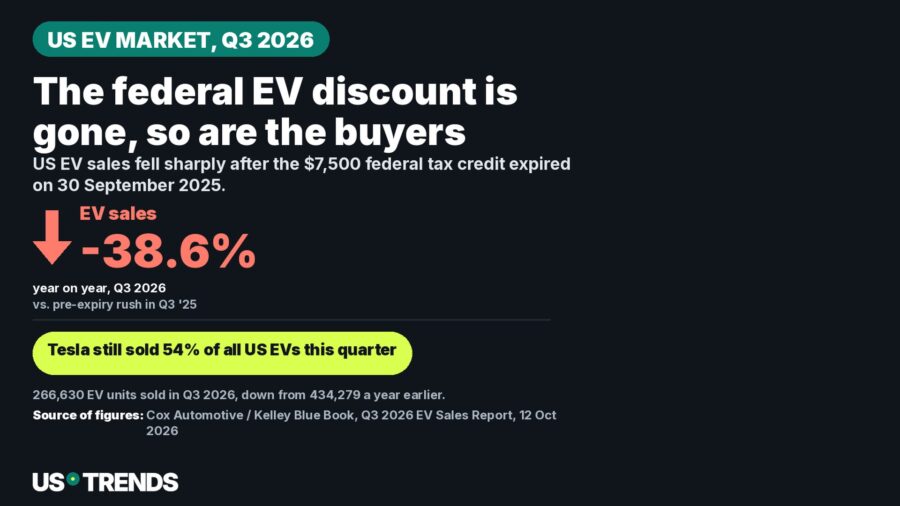
The rate rise comes as the EV market in the US has been volatile: EV sales fell 38.6% in the third quarter of 2026, a year after a federal tax credit ended – a reminder that financing costs are only one of several factors shaping what Americans are buying right now.
The rate by quarter
The table below summarises the most recent quarters from the Fed’s G.19 release, for 60-month new car loans at commercial banks:
| Quarter (reference month) | 60-month rate | 72-month rate |
|---|---|---|
| Q2 2026 (May, preliminary) | 7.14 % | 6.97 % |
| Q3 2026 (August, preliminary) | 7.54 % | 7.17 % |
Source: Federal Reserve, G.19 Consumer Credit, releases of 7 August and 7 October 2026 (Terms of Credit table, commercial banks, new car loans). Figures are preliminary and subject to revision.
The 60-month rate rose 40 basis points between the second and third quarter of 2026 – a faster pace than the roughly flat second quarter, when the rate matched the May monthly figure.
What the rise costs in practice
To make the rate change concrete, the editorial team modelled a representative $20,000 car loan over 60 months, once at the Q2 2026 rate and once at the Q3 2026 rate for commercial banks.
Model calculation: $20,000 car loan over 60 months
- At 7.14% (Q2 2026): monthly payment around $397.35, total repayment around $23,841, of which around $3,841 is interest.
- At 7.54% (Q3 2026): monthly payment around $401.14, total repayment around $24,068, of which around $4,068 is interest.
- Difference from the rate rise alone: around $3.79 more per month, around $228 more interest over the full term.
Net Trends calculation based on the Federal Reserve’s commercial-bank rates, as a standard amortising loan. Model calculation, not a forecast: actual offers depend on credit score, down payment, loan-to-value and lender, and will vary by state.
Buyers with a lower credit score typically pay well above these averages, since the Fed’s figures describe the overall market, not any specific borrower’s rate.
What to check before financing
The national average rate is outside any individual buyer’s control, but the specific deal is not.
Checklist: comparing car financing
- Get pre-approved by a bank or credit union before visiting a dealer, so you have a benchmark APR to compare against.
- Compare commercial-bank and dealer/finance-company offers – the Fed’s data show they can differ by more than a full percentage point.
- A longer loan term lowers the monthly payment but increases the total interest paid, and raises the risk of owing more than the car is worth.
- Check your state’s rules on sales tax and fees, which are added on top of the vehicle price and the loan.
- Ask whether early payoff is allowed without a penalty before signing.
None of this replaces checking the actual APR on a specific offer – the Fed’s survey shows only the national average, not what any individual lender will offer a given borrower.
Are you planning to finance a car in the coming months, and how are you dealing with higher rates? Let us know in the comments.
Frequently asked questions
Does the Fed break down car-loan rates by state?
No. The G.19 release gives a national average for commercial banks and finance companies separately, split by loan term (60 and 72 months), but not by state or by individual lender.
How much have rates risen since the second quarter of 2026?
The 60-month commercial-bank rate rose from 7.14% in Q2 2026 (May) to 7.54% in Q3 2026 (August) – a rise of 40 basis points, according to the Federal Reserve’s G.19 release of 7 October 2026.
What is the difference between commercial-bank and finance-company rates?
Commercial banks are traditional banks; finance companies are often affiliated with a carmaker or dealer network and may offer promotional rates on certain models. The Fed tracks both separately, and finance-company rates were lower (6.3%) in the most recent reading, for Q2 2026.
When does the Federal Reserve publish the next figures?
The G.19 release appears monthly, with the quarterly Terms of Credit table updated alongside it, typically about five weeks after the end of the reference month. Figures for September 2026 were not yet available when this article was researched.
Sources and status
- Federal Reserve: G.19 Consumer Credit, release of 7 October 2026
- Federal Reserve: G.19 Consumer Credit, release of 7 August 2026
- Deutsche Bundesbank: MFI-Zinsstatistik, press release of 1 October 2026 (in German), for the German comparison figure
Research and data as of: November 6, 2026.
Transparency note: AI-assisted tools were used in researching, structuring and writing this article. The sources used are listed in the article. Publication takes place only after manual editorial approval. Country edition based on an article from Net Trends, researched for the United States.
Share this article