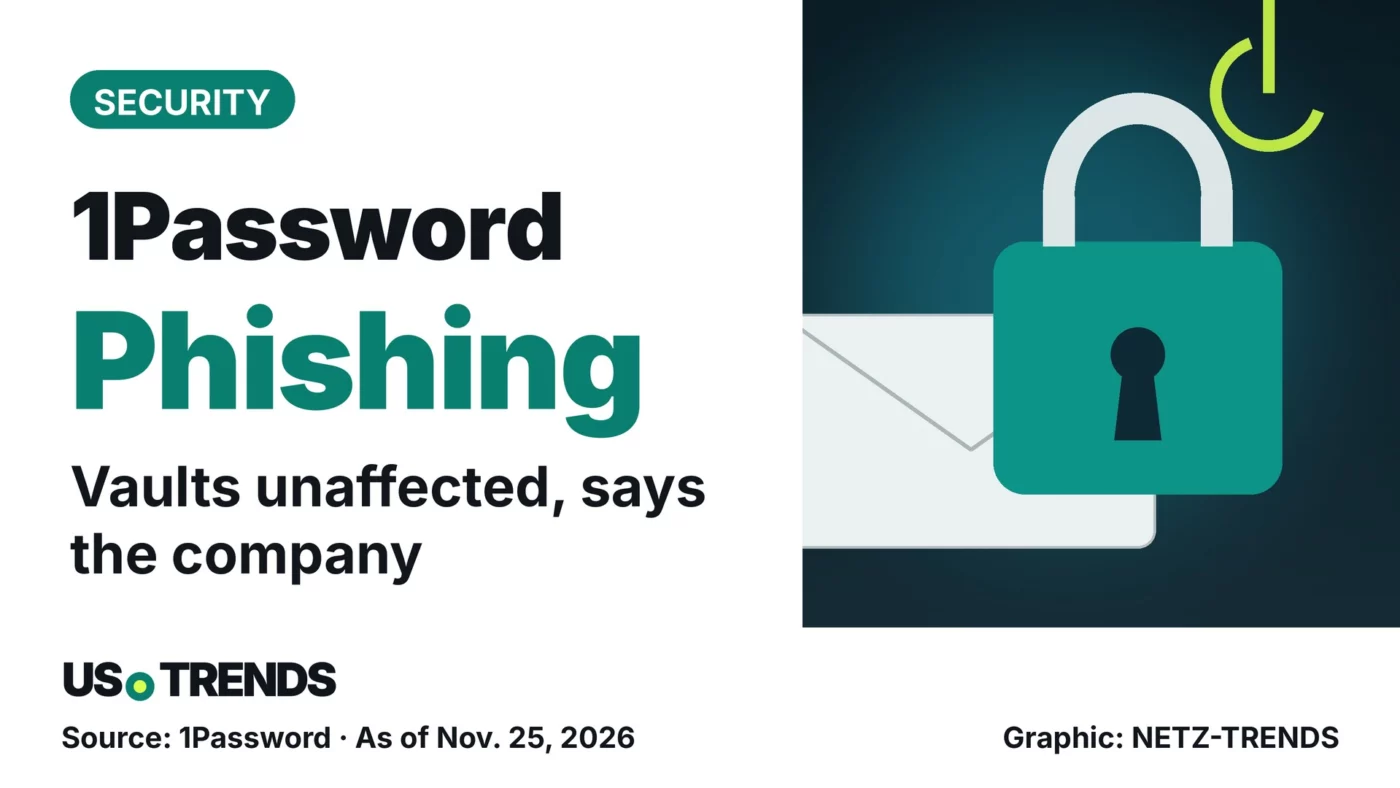
A hijacked GitHub account gave attackers a way into internal systems – for customers, the main danger now is phishing.
Key points
- On November 25, 2026, 1Password said an attacker had reached internal systems through an employee’s GitHub account.
- According to the company, account records for some customers were downloaded, including names and email addresses.
- Vaults, their contents and the keys protecting them were not affected, the company says.
- 1Password says customers don’t need to change anything in their accounts, but should be wary of emails, texts and calls claiming to come from the service.
1Password reported a break-in to its internal systems on November 25, 2026. Vaults were untouched, the company says, but names and email addresses of some customers were taken.
The password manager lays out the incident in its own blog post. That is the company’s account of events; we found no independent confirmation at the time of writing.
How the attacker got in
1Password says it began investigating on November 19, 2026, after spotting signs that an attacker had gained access to an employee’s GitHub account. Through that account, the attacker is said to have pulled source code and slipped malicious code into backend services, which then downloaded administrative customer data. According to the company, the source code contains no customer data or user secrets.
What was taken, and what was not
The downloaded account records cover some customers and include names, email addresses, account and user IDs, the dates of account creation and last sign-in, public keys, SRP parameters, and tokens found in certain email links for invitations and account recovery. 1Password says vaults and their contents, the keys protecting them, recovery keys, and its apps and browser extensions were not affected. A token alone isn’t enough to get in, the company says; the extra email code it requires has been lengthened from six to ten characters.
Why phishing is now the main risk
Anyone holding the names and email addresses of 1Password customers can send convincing fake invitations or account-recovery messages. The company doesn’t say whether such messages are already circulating. The Federal Trade Commission takes scam reports at ReportFraud.ftc.gov; when we checked on November 26, the site showed a notice that it was unavailable because of a government shutdown. 1Password itself asks customers to send suspicious messages to support@1password.com.
After the 1Password incident: what to check
- Open 1Password only through the app or an address you type yourself
Don't use links in emails or texts about invitations or account recovery.
- Never give out your account password or Secret Key on request
1Password says it never asks for them.
- Report suspicious messages
Send anything that mentions 1Password to support@1password.com; try ReportFraud.ftc.gov once it is back online.
- Check two-factor authentication on your email account
Whoever controls your inbox can intercept recovery emails.
Frequently asked questions
Are the passwords in my vault affected?
No. According to 1Password, vaults, their contents and the keys protecting them were not affected.
What data was taken?
The company lists names, email addresses, account and user IDs, timestamps, public keys and tokens from certain email links.
Do I need to change my master password?
1Password says customers don’t have to update anything in their accounts. It says it stores neither the account password nor the Secret Key.
How many customers are affected?
The company gives no figure and refers only to some customers.
Your view: Do you use a password manager, and would you switch providers after an incident like this? Tell us in the comments.
Sources and date
- 1Password: Update on a security incident involving 1Password’s backend systems (company statement, November 25, 2026)
- Federal Trade Commission: ReportFraud.ftc.gov (government site, checked November 26, 2026)
As of: November 26, 2026
Transparency note: AI-assisted tools were used in researching, structuring and writing this article. The sources used are listed in the article. Publication takes place only after manual editorial approval.
Share this article
Read next
Your curiosity
Our next story
Bring your ideas for AI and digital media
Discover open positions Research
 ▶ Reel