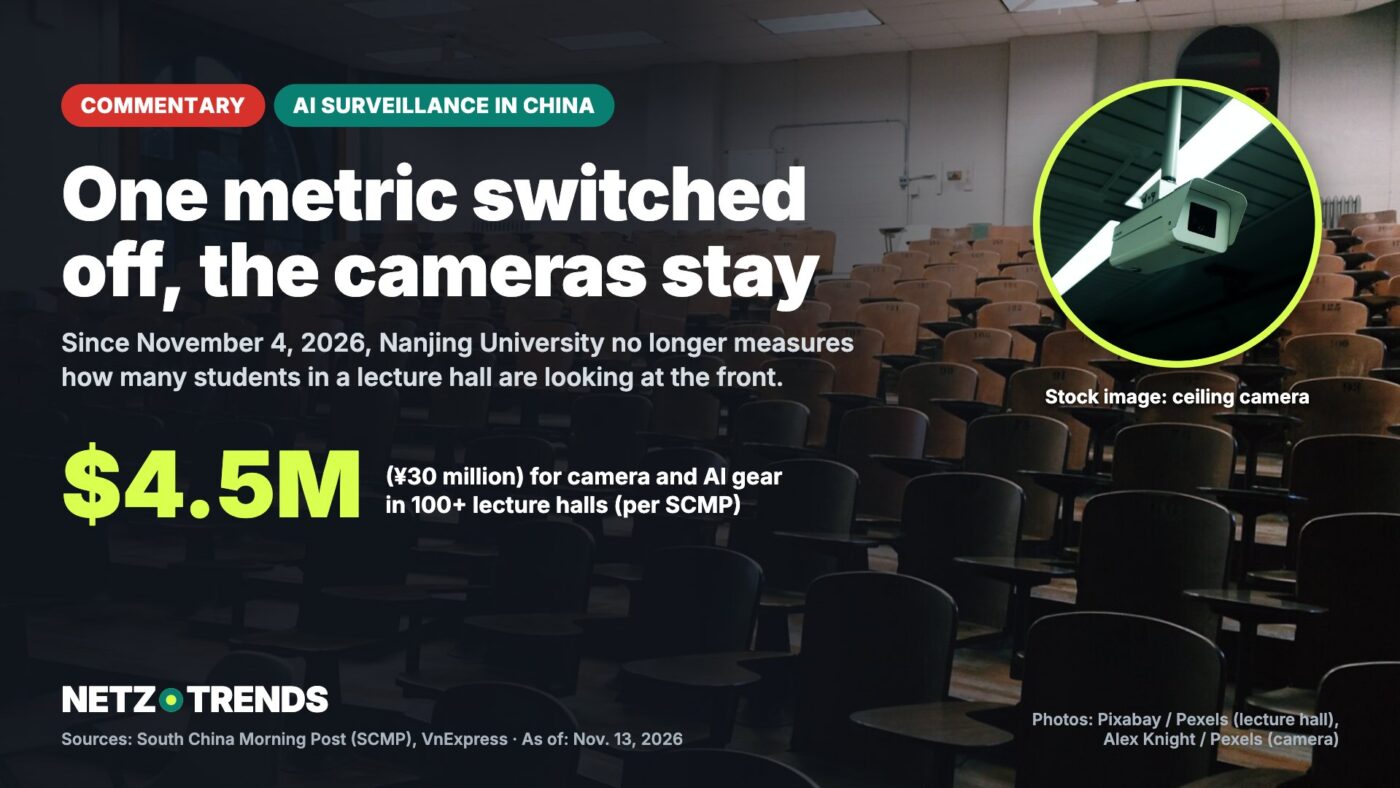
One of China’s top universities stopped tracking who looks at the front. The cameras are still there – and US schools face the same question
Key points
- What: Nanjing University in eastern China announced on November 4, 2026, that it would stop calculating the “head-up rate” of its students.
- Technology: AI cameras in more than 100 lecture halls tracked attendance, late arrivals and where students were looking. Cost according to the South China Morning Post (SCMP): more than ¥30 million, about $4.5 million.
- Trigger: Screenshots with live footage and real-time statistics from a trial in May spread online.
- US: There is no federal ban. New York State banned facial recognition in schools in September 2023, and Illinois requires written consent for biometric data.
Nanjing University switched off a single metric after a public outcry: how many students in a lecture hall are looking at the front. The cameras, worth about $4.5 million, stay – and that is exactly the problem.
A commentary by Juliane Wehrhahn, AI editor at Net Trends. It reflects the author’s opinion. The facts are taken from the sources linked below.
Nanjing University in Jiangsu province is one of China’s leading universities. It ranks sixth in the 2026 ShanghaiRanking of Chinese universities. That is why the way it handles cameras in its lecture halls is more than a footnote.
What Nanjing measured
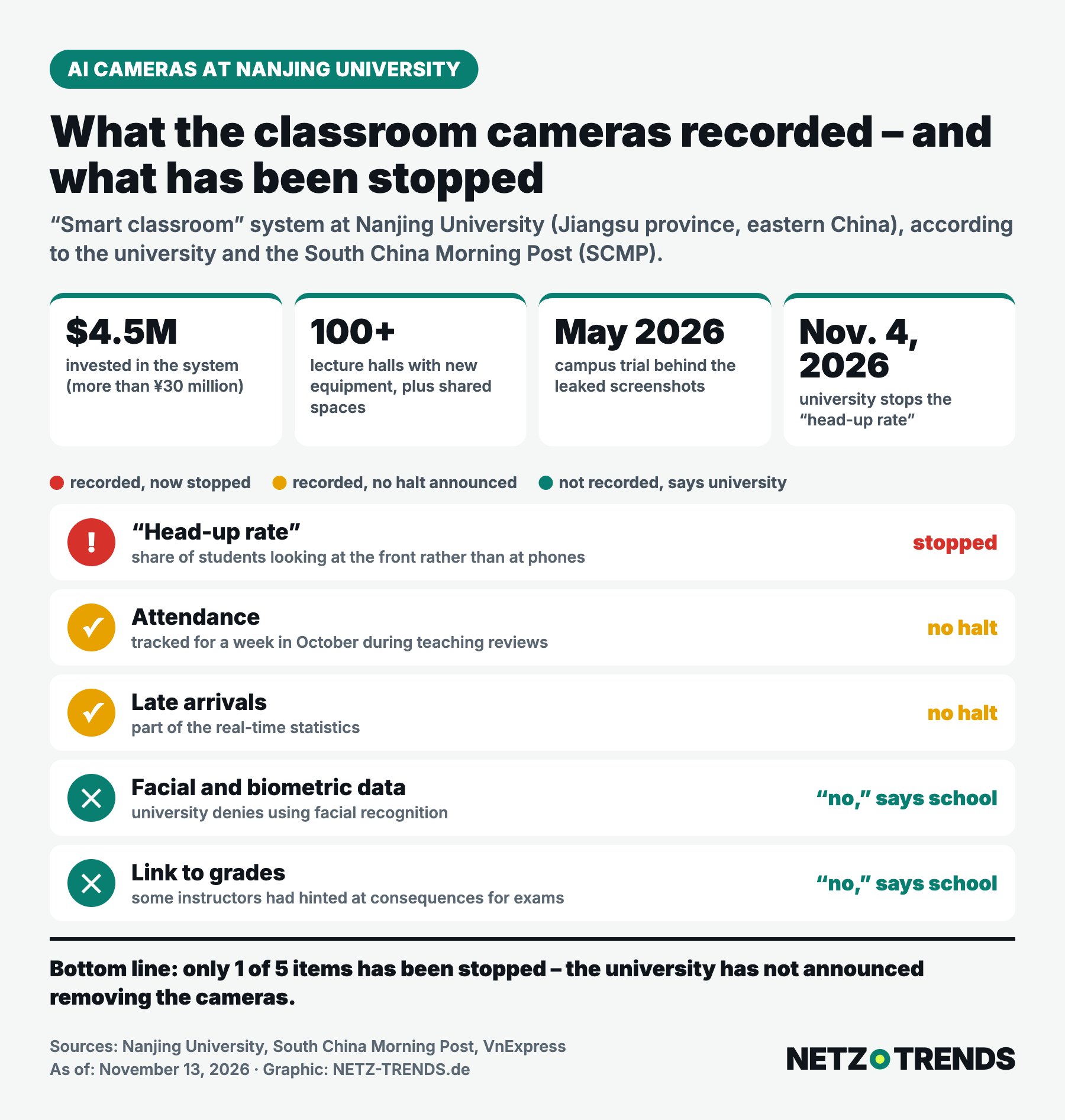
According to the South China Morning Post, the university spent more than ¥30 million, about $4.5 million, on a “smart classroom” system. Cameras and AI software are installed in over 100 lecture halls and several common areas. They count who is there, who is late and who is looking at the front.
That last number is known in Chinese as the “taitou lü,” roughly the “head-up rate.” It measures the share of students looking at the instructor rather than at their phone, laptop or desk. In October, the university said attendance would be tracked for one week as part of teaching reviews.
Then screenshots surfaced online: live images from lecture halls next to real-time figures on attendance, tardiness and attention. Some instructors reportedly warned that the data could affect grades or access to exams. On November 4, the university dropped the head-up rate.
Download graphic (JPG, 1,800 × 1,893 pixels)
The university insists the system does not collect facial or other biometric data – physical features that can identify a person, such as the face. It says there is no link to grades and that no higher authority ordered the reviews. The screenshots, it says, came from a trial on one campus in May.
The head-up rate measures obedience, not learning
You don’t need to be an education researcher to spot the flaw. Looking at the front does not mean learning. A student who takes notes, reads the slides or simply thinks lowers the rate – and may well learn more than the one dutifully staring at the board.
So the metric rewards posture, not understanding. It turns the lecture hall into a place where people feel watched. And it shifts the blame for dull lectures onto students rather than teaching.
To be fair, phones in class are a real problem. One instructor even told VnExpress the cameras mainly serve to evaluate faculty. That could be a legitimate goal. But it doesn’t require a statistic on where every single head is pointing.
Only one number has been switched off
The university’s U-turn is a win for the students who complained publicly. But it is smaller than it sounds. One metric is gone. The university has not announced removing the cameras or ending attendance tracking.
Anyone who spends $4.5 million on equipment is unlikely to let it sit idle. The infrastructure is in place. A new metric can be switched back on at any time without anyone touching a screw.
Nanjing isn’t an isolated case, either. Business magazine Caixin reports that several Chinese universities use similar systems, some of which also count how many front-row seats are taken. As early as 2018, Hangzhou No. 11 Middle School tested a Hikvision system that, according to Sixth Tone, logged six behaviors and seven facial expressions.
What US law says
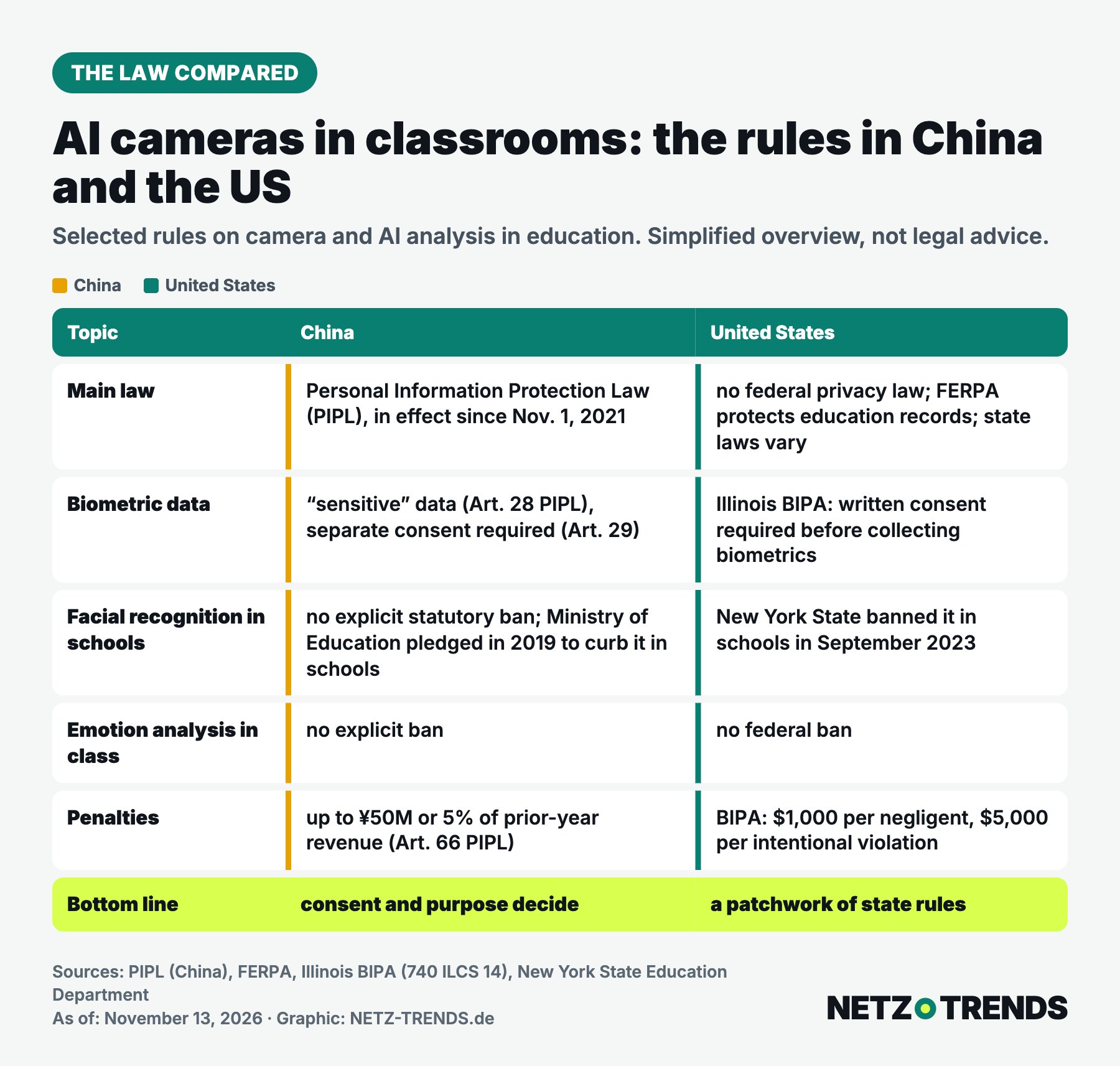
The United States has no federal law that bans emotion recognition or facial recognition in classrooms. The Family Educational Rights and Privacy Act (FERPA) protects education records, but it was not written with AI cameras in mind. The real rules come from the states.
Illinois’ Biometric Information Privacy Act (BIPA) requires written consent before biometric data is collected and lets individuals sue: $1,000 per negligent and $5,000 per intentional or reckless violation. In September 2023, New York State banned facial recognition in its schools after a state report found the risks outweigh the benefits.
Download graphic (JPG, 1,800 × 1,713 pixels)
Cameras on your own campus? What students in the US can do
- Ask: Which cameras run in lecture halls, for what purpose and who sees the footage?
- Check your records: Under FERPA, students can inspect their education records held by the school.
- Know your state’s law: In Illinois, biometric data may not be collected without written consent.
- Raise it: Student government and the campus privacy office are the first points of contact.
America should not dismiss Nanjing as a distant Chinese story. Remote exam proctoring software has been widely used at US colleges. The question of how much measurement a classroom can take arises everywhere.
What should happen now
A genuine fresh start in Nanjing would have three parts. First, disclose what data the cameras still collect and how long it is kept. Second, give students and faculty a say in what the technology is used for. Third, an independent audit of whether the system really does not analyze faces, as the university claims.
Trust does not come from switching off one number. It comes when the people affected can verify what is being measured about them.
Frequently asked questions
What is the “head-up rate”?
An AI metric measuring the share of students in a lecture hall who look at the instructor rather than at a phone, laptop or desk. Nanjing University stopped it on November 4, 2026.
Has Nanjing University removed the cameras?
No. Only the end of the head-up rate has been announced. According to the South China Morning Post, the gear for more than 100 lecture halls cost over ¥30 million, about $4.5 million.
Would such a system be legal in the US?
There is no federal ban. New York State banned facial recognition in schools in 2023, and Illinois requires written consent for biometric data under BIPA.
Does the system record faces?
The university denies it and says no facial or other biometric data is collected. This has not been independently verified.
The case shows how quickly teaching technology can turn into a tool for measuring behavior. Whether Nanjing will restrict the cameras further remains to be seen.
More on Net Trends
Sources and status
- VnExpress International: Nanjing University stops AI attention tracking, November 8, 2026 (based on reporting by the South China Morning Post)
- The Cool Down / Yahoo News: classroom screenshots, November 13, 2026
- Sixth Tone: Camera Above the Classroom, March 26, 2019
- JURIST: New York bans the use of facial recognition technology in schools, September 2023
- Illinois Biometric Information Privacy Act (740 ILCS 14)
- US Department of Education: Family Educational Rights and Privacy Act (FERPA)
- Personal Information Protection Law of the People’s Republic of China (PIPL), English translation by DigiChina, Stanford University
- Original article on Net Trends (in German)
Research and data as of: November 13, 2026.
Transparency note: AI-assisted tools were used in researching, structuring and writing this article. The sources used are listed in the article. Publication takes place only after manual editorial approval. Country edition based on an article by Net Trends, researched for the United States.
Share this article