The EU’s right-to-repair directive took effect across Europe on July 31, 2026 – the US has no federal equivalent, but a growing patchwork of state laws is already changing how phones get fixed.
The essentials
- There is no federal right-to-repair law in the US; Congress has not passed one.
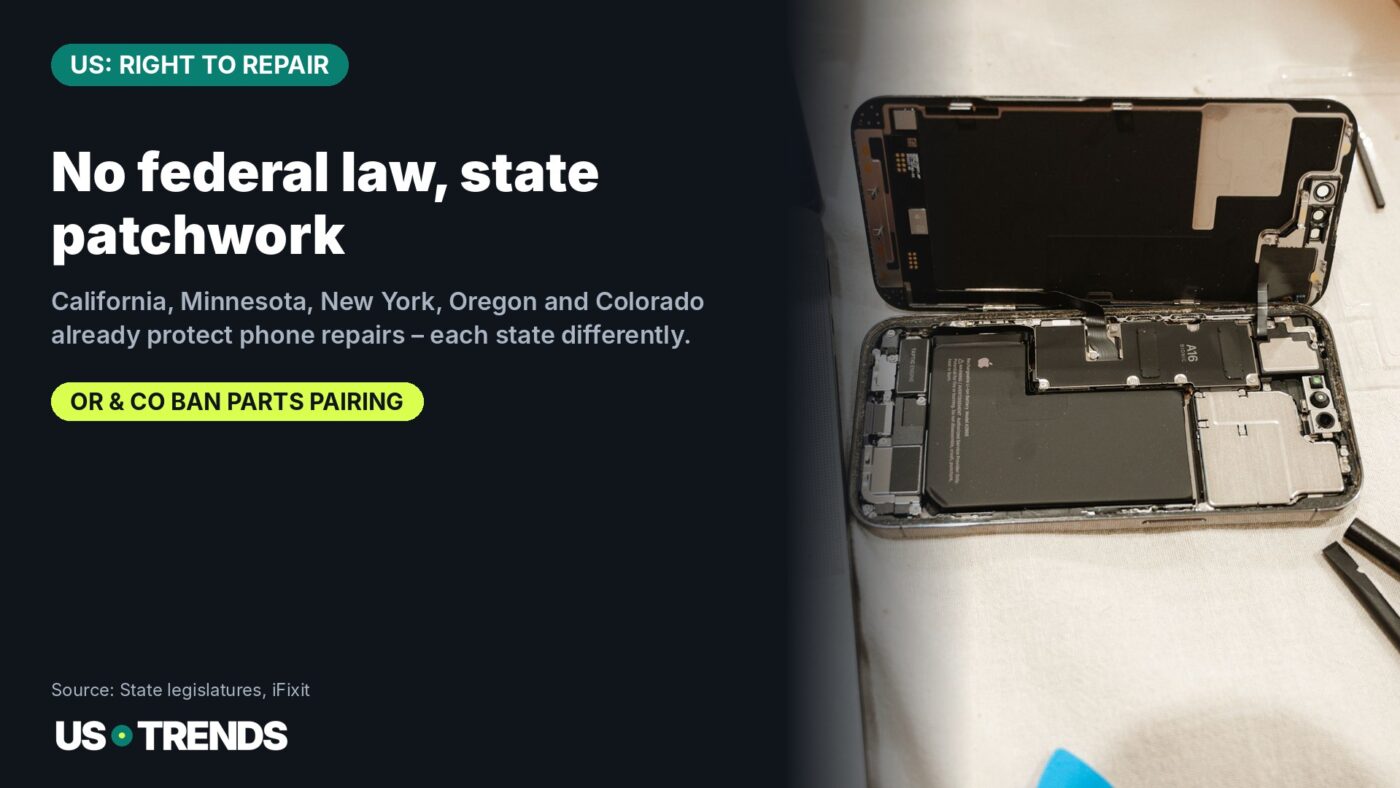
- States are filling the gap: California, Minnesota, New York, Colorado, Oregon and Washington all now have their own electronics repair laws.
- Oregon and Colorado go further than most other states by banning “parts pairing” – software locks that stop third-party replacement parts from working.
Smartphone owners across the European Union got new repair guarantees on July 31, 2026, when the EU’s Right to Repair Directive took effect. In the US, there’s no federal law doing the same job – instead, a state-by-state patchwork is building real repair rights one legislature at a time.
The EU directive (EU) 2024/1799 requires manufacturers to offer repairs at a reasonable price even after the statutory warranty ends, for products including smartphones. The US has no comparable national statute; the Federal Trade Commission has pushed back against anti-repair practices in individual enforcement actions, but there’s no general federal right to repair electronics on the books.
Why there’s no federal right-to-repair law
Federal right-to-repair bills have been introduced in Congress repeatedly in recent years but have not passed. Instead, momentum has shifted to the states, where more than 30 right-to-repair bills have been introduced since 2022, with a handful actually becoming law. The Federal Trade Commission has signaled support for repair rights in reports and individual cases against manufacturers over restrictive repair practices, but it has no authority to impose a nationwide repair mandate on its own.
The state patchwork, state by state
Several states now require manufacturers to make parts, tools, and repair documentation available to consumers and independent repair shops for electronics including phones and laptops:
- California – the Right to Repair Act applies to electronics and appliances sold after July 1, 2021, with parts-availability windows depending on the product’s price.
- Minnesota – the Digital Fair Repair Act has covered consumer electronics since mid-2024.
- New York – the Digital Fair Repair Act (as amended) requires manufacturers to provide parts, tools and documentation for digital electronics.
- Colorado – a digital-electronics right-to-repair law takes effect January 1, 2026, covering phones, laptops and other consumer electronics.
- Washington – a similar digital-electronics repair law also takes effect January 1, 2026.
- Oregon – its Right to Repair Act is already in force and is considered the strictest so far on anti-repair tactics.
Each law differs in which products, price thresholds and repair categories it covers, so the practical protection for a given phone can depend heavily on which state the customer lives in.
Parts pairing: the fight over locked-down parts
A central battleground is “parts pairing” – when a manufacturer uses software to recognize and reject a genuine replacement part (a screen, battery or camera module, for instance) unless it’s been authorized through the manufacturer’s own system, even if the part is otherwise fully functional. Oregon and Colorado have gone furthest by banning parts pairing outright for the products their laws cover, a step most other states have not yet taken. Repair advocates such as iFixit have pushed for other states to follow with similar bans.
What this means for you right now
Unlike EU consumers, who now have one directive applying the same minimum repair rights everywhere in the bloc, US consumers’ practical rights depend on their home state. Someone in Oregon or Colorado has a legal guarantee against parts-pairing lockouts; someone in a state with no right-to-repair law at all has no such legal backstop and depends entirely on the manufacturer’s own repair program and warranty terms.
Practical checklist
Before you get a phone repaired
- ☐ Check whether your state has a right-to-repair law in effect (California, Minnesota, New York and Oregon already do; Colorado and Washington follow on January 1, 2026).
- ☐ Ask an independent repair shop whether parts pairing could block a replacement part in your device, especially outside Oregon and Colorado.
- ☐ Compare the manufacturer’s official out-of-warranty repair price against a reputable independent shop before committing – prices quoted are typically before sales tax.
- ☐ Keep your purchase receipt; most state laws and manufacturer warranties still hinge on proof of purchase date.
Frequently asked questions
Is there a federal right-to-repair law in the US?
No. Several bills have been proposed in Congress, but none has passed. Right-to-repair protections in the US currently exist only at the state level.
Which states currently have the strongest phone repair protections?
Oregon and Colorado are generally seen as the strongest, since both ban “parts pairing” software locks outright, in addition to requiring parts, tools and documentation access like other state laws.
Does the EU right-to-repair directive apply to Americans?
No. It’s EU law and applies only within the European Union. US consumers are covered only by whatever right-to-repair law, if any, their own state has passed.
Sources
- EUR-Lex: Directive (EU) 2024/1799
- Claimlane: US State Right-to-Repair Laws overview
- iFixit: Washington passes right-to-repair bills
- JD Supra: Navigating the Right to Repair Landscape in 2026
Transparency note: AI-assisted tools were used to help research, structure and draft this article. Sources used are listed above. Publication only follows manual editorial approval. US edition prepared from an article on Net Trends, researched for the United States. Photo: symbolic image adapted for this edition.
Share this article