Arizona faces its own fight: Tucson’s “Project Blue” data center plan collapsed after residents cited Colorado River water losses of about 20%
Key points
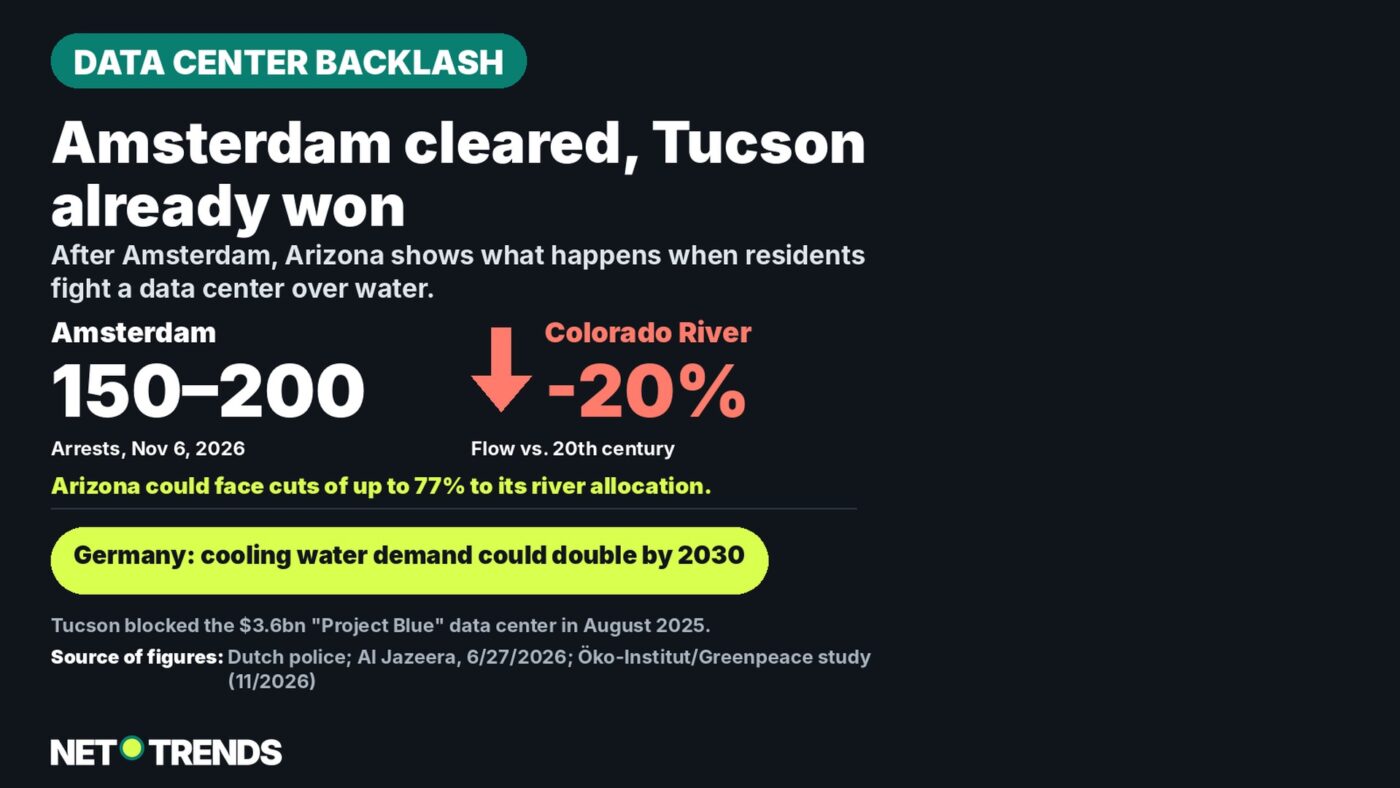
- Dutch police report 150 to 200 arrests after protesters occupied the construction site of a planned Microsoft data center in Amsterdam on November 6, 2026.
- Campaigners from the “Stop Dirty Data Centres” coalition held linked protests in at least 15 countries, part of a wider pushback that in the US has centered on Arizona and other Sun Belt states.
- In Tucson, a residents’ group called “No Desert Data Center” helped defeat a planned $3.6 billion data center after flagging falling Colorado River flows and rising utility rates.
Hundreds of activists occupied a Microsoft construction site in Amsterdam on Friday, and Dutch police reported 150 to 200 arrests. In the American Southwest, residents have already forced changes to data center projects over water and power concerns.
Dutch police said those detained were suspected of trespassing. Microsoft said it was aware of the demonstration, respected the right to peaceful protest, but would not tolerate unlawful acts or actions that endanger people.
Organizers described the Amsterdam protest as the opening of a two-day, Europe-wide campaign against the rapid build-out of data centers for cloud and AI services. For American readers, the underlying conflict — water and electricity for data centers versus local supply — has already played out this year in Arizona, where residents blocked one major project and are fighting another.
An occupied site, a crane, flares
In Amsterdam’s Sloterdijk district, several hundred protesters broke into the construction site of a planned Microsoft data center on Friday afternoon. Some climbed a construction crane and lit flares, and there were clashes with police. Officers cleared the site by late afternoon.
The action was organized by the Dutch group “Geef Tegengas” (“Push Back”). The umbrella campaign “Stop Dirty Data Centres” says around 100 organizations in 15 countries took part in coordinated weekend actions across Europe.
Tucson: “Not One Drop for Data Centers”
In Tucson, Arizona, the residents’ group No Desert Data Center organized against two large projects: a $3.6 billion data center proposal known as “Project Blue” on the city’s southeast edge, and a separate $5 billion project in nearby Marana. Member Marisol Winfrey Herrera said “water was a unifying theme” in the campaign, built around the slogan “Not one drop for data centers.” Hundreds of residents turned out at Tucson city council meetings; the council voted unanimously in August 2025 not to supply Project Blue with city land, water or power, after developer Beale Infrastructure had projected around $250 million in local and state tax revenue over ten years.
The water math behind the opposition: Colorado River flows have dropped about 20% since 2000 compared with 20th-century levels, according to figures cited in the campaign, and Arizona could face cuts of up to 77% to its river allocation. Pima County Supervisor Andres Cano, who opposed the project, said it “will have just about 100 jobs when it is done.” Sharon Megdal of the University of Arizona said data centers are not bound by the same water-replenishment rules as other industries: “So it adds a straw to the aquifer.”
“We are in the middle of a 30-year drought, which is now an extreme drought.”
Lisa Shipek, Watershed Management Group, Tucson
Not every Arizona project has stalled: utilities Tucson Electric Power and Trico have both raised rates since 2023, and campaigners say nearly half of TEP’s power still comes from fracked gas. Arizona Governor Katie Hobbs has separately told federal officials the state needs a larger share of Colorado River water for industries that include data centers — a sign the fight over allocation is far from settled.
Germany: 13 billion liters today, up to 27 billion by 2030
A similar debate is unfolding in Germany, where a parallel protest reached Berlin on the same day as the Amsterdam action. According to a short study published November 2, 2026, by the Öko-Institut for Greenpeace (in German), German data centers used around 13 billion liters of water for cooling in 2025 — comparable, the study says, to the drinking-water needs of about 275,000 people. By 2030, that figure could roughly double to up to 27 billion liters a year, driven by rising electricity demand from new AI facilities.
The German digital industry group Bitkom disputes the framing, saying water use per kilowatt-hour of connected capacity fell from 0.55 in 2023 to 0.4 in 2025 according to an EU register, with 65% of German data centers already showing “very low direct water use.”
What residents can check when a data center is proposed nearby
- What cooling technology is planned, and has an environmental review covered water use?
- How much power capacity (in megawatts) is proposed, and which water source would supply cooling?
- Is there a public hearing or zoning vote, and when does public comment close?
- What does the local utility or water authority say about capacity and drought risk?
Tell us in the comments what role water and power use should play when a data center is proposed in your area.
Frequently asked questions
Why did activists protest against the Microsoft data center in Amsterdam?
Protesters oppose the rapid expansion of data centers for cloud and AI services, especially their electricity and water use and the lack of public oversight. Dutch police reported 150 to 200 arrests for trespassing.
Did a US data center project actually get stopped?
Yes. Tucson’s city council voted unanimously in August 2025 not to provide land, water or power to the “Project Blue” data center proposal after sustained local opposition.
How much has Colorado River water dropped?
River flows are down about 20% since 2000 compared with 20th-century levels, and Arizona could face cuts of up to 77% to its allocation, according to figures cited by campaigners and reporting on the dispute.
How much water do German data centers use?
A short study for Greenpeace put 2025 use at around 13 billion liters, potentially rising to 27 billion liters by 2030.
Sources and status
- Öko-Institut for Greenpeace: short study on water use by German data centers, as of 11/2026 (in German)
- Bitkom press release, November 3, 2026 (in German)
- Dutch police and Microsoft: statements of November 6, 2026, on the occupation of the Amsterdam-Sloterdijk site
- Al Jazeera: With water cuts looming in Arizona, US locals fight data centres, June 27, 2026
Research and data as of November 7, 2026.
Transparency note: AI-assisted tools were used in researching, structuring and writing this article. The sources used are listed in the article. Publication takes place only after manual editorial approval. Country edition based on an article from Net Trends, researched for the US.
Share this article