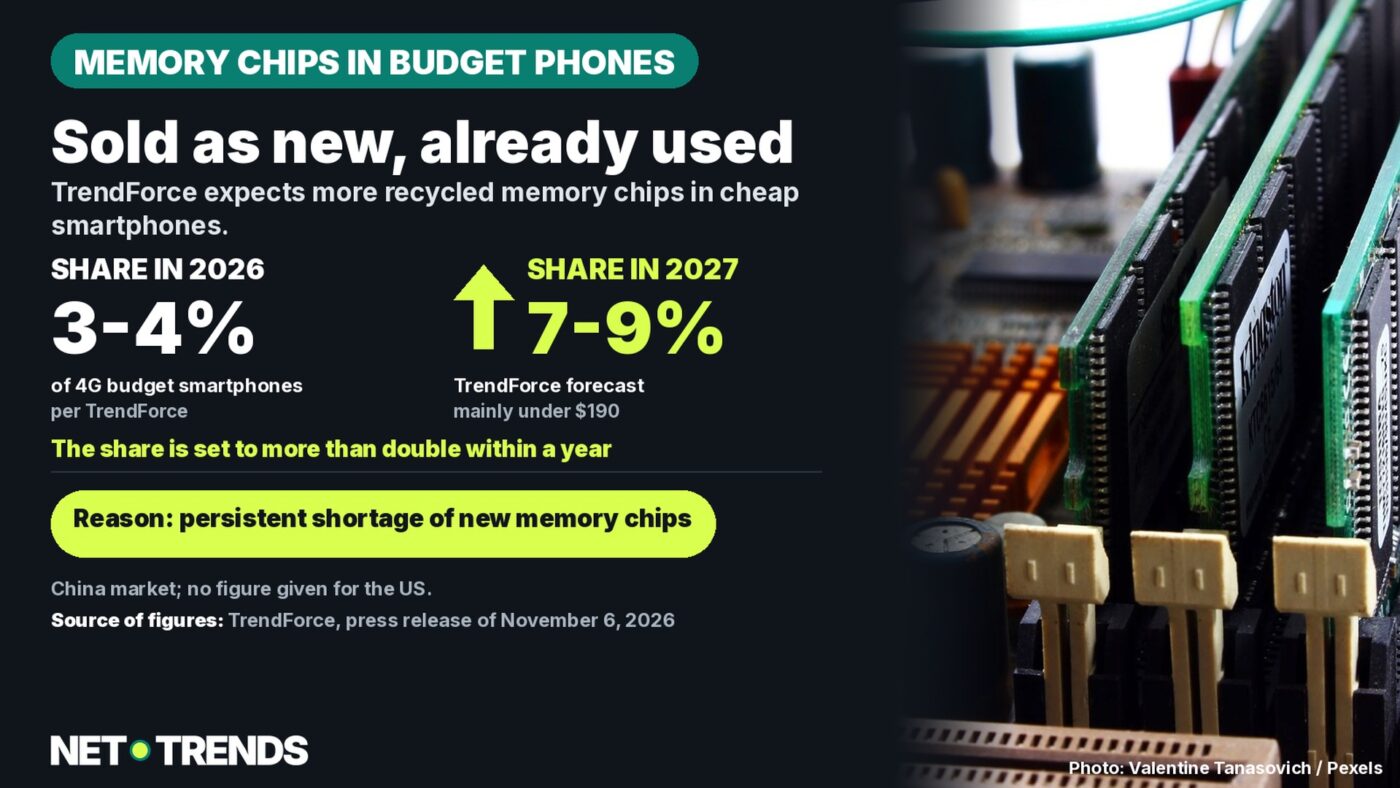
TrendForce expects the share of refurbished (“reballed”) memory chips in cheap 4G smartphones to rise from 3-4% in 2026 to 7-9% in 2027 – a consequence of the ongoing DRAM shortage.
Key points
- Taiwan-based market researcher TrendForce expects refurbished (“reballed”) memory chips to be used in 7-9% of cheap 4G smartphones in 2027, up from 3-4% in 2026.
- According to TrendForce, mainly 4G smartphones priced below roughly 1,299 yuan – about $195 at the ECB euro reference rate of November 6, 2026 – are affected, not pricier models.
- TrendForce itself names the risks: variable quality, shorter lifespans and potentially higher warranty and repair costs.
Because new memory chips remain scarce and expensive, makers of budget smartphones are turning more to refurbished chips, TrendForce says. Their share is set to more than double to 7-9% by 2027.
Why manufacturers reach for old chips
TrendForce published its assessment on November 6, 2026. At its center are so-called reballed chips: memory modules removed from old or decommissioned circuit boards, cleaned, re-soldered and installed again – usually LPDDR4X modules with 4 gigabytes, according to TrendForce.
For US buyers, the report is first and foremost a China story: TrendForce’s figures explicitly refer to the Chinese market for 4G entry-level devices. Whether, and to what extent, budget smartphones sold in the US by Chinese brands are affected is left open – TrendForce does not name individual manufacturers.
According to TrendForce, refurbished chips cushion the rise in bill-of-materials (BOM) costs without manufacturers having to raise the retail price of devices. That hits price-sensitive buyers in the entry-level segment hardest, where a few dollars can decide a purchase.
The calculation only works for manufacturers as long as new memory chips remain expensive. TrendForce says that is currently the case – with consequences reaching far beyond budget smartphones.
The memory crunch behind it
TrendForce has been watching the memory market with growing concern for months. In a statement on August 25, 2026, the company put the cumulative rise in contract prices for server DRAM in the second half of 2025 at 64%, and forecast a further roughly 270% rise for 2026. Enterprise SSDs were expected to become around 235% more expensive cumulatively in 2026.
TrendForce names the investment surge by large cloud providers into AI data centers as the main driver: their spending on memory chips is expected to account for 68% of total capital expenditure in 2027, up from 47% in 2026. Because manufacturers are steering production capacity toward this higher-margin segment, supply is falling short for simpler components such as LPDDR4X, used in older and cheaper smartphones – a shortfall that recycled chips are meant to partly offset.
| Metric | 2026 | 2027 (forecast) |
|---|---|---|
| Share of reballed memory in 4G budget smartphones | 3–4% | 7–9% |
| DRAM/NAND share of major cloud providers’ memory capex | 47% | 68% |
Source: TrendForce, press releases of November 6, 2026 and August 25, 2026.
The risks TrendForce names
TrendForce itself is fairly explicit about the drawbacks of refurbished components. Sourcing is complex, it says, because suitable old chips first have to be collected, tested and re-soldered. Quality varies more than with new parts, which can affect the reliability and lifespan of the components.
For manufacturers, TrendForce sees a knock-on risk: lower consumer trust, possible reputational damage, and rising warranty and repair costs if the fault rate increases. The statement does not name which specific brands or suppliers use such chips.
Converted: what 1,299 yuan comes to in dollars
- Threshold per TrendForce: 1,299 Chinese yuan (CNY)
- Exchange rate: 1 euro = 7.4407 yuan (mid-rate, November 7, 2026, 13:50 UTC); 1 euro = $1.1165 (ECB reference rate, November 6, 2026)
Working: 1,299 CNY ÷ 7.4407 ≈ €174.58; €174.58 × 1.1165 ≈ $194.92. According to TrendForce, this affects mainly 4G smartphones in the Chinese market priced up to roughly $195 – not a forecast for US retail prices, which include different taxes, duties, trade margins and, in most states, sales tax added at checkout.
What it means for buyers in the US
The TrendForce statement does not amount to a direct warning against specific devices – it names neither brands nor models, and refers to the Chinese domestic market. Still, several Chinese manufacturers also sell entry-level smartphones with 4G or basic 5G specifications in the US at broadly similar price points, including import goods bought directly from China through online marketplaces.
Anyone buying a conspicuously cheap smartphone cannot easily tell, according to TrendForce, whether it contains recycled memory chips – there is no federal labeling requirement for this. Some basic precautions remain sensible nonetheless.
Under the federal Magnuson-Moss Warranty Act, a seller offering a written warranty must honor its stated terms, but coverage, length and what counts as a defect vary by manufacturer and by state consumer-protection law; a smartphone bought directly from an overseas seller, outside that warranty, can be far harder to get repaired or refunded if a chip fails early.
Checklist when buying a cheap smartphone
- Prefer retailers based in, or with a US return address and support line – pursuing a claim against an overseas seller with no US presence is far harder.
- Compare technical specifications (RAM type, storage size) against independent reviews, not just the seller’s listing.
- For goods imported from outside the US: clarify the return policy and warranty handling before buying, not only once something breaks.
- Document any memory errors, stutters or crashes in the first few weeks promptly – this makes a later claim or chargeback easier to pursue.
Frequently asked questions
What are “reballed” memory chips?
Memory modules that are desoldered from old or decommissioned circuit boards, cleaned, fitted with new solder balls (“reballed”) and then installed again in a device, instead of newly manufactured chips.
Does this affect smartphones sold in the US?
That cannot be said with certainty from the TrendForce statement. It refers to the Chinese market for cheap 4G smartphones priced below roughly $195 and does not name individual brands or countries outside China.
Why are memory chips currently so scarce and expensive?
TrendForce attributes this mainly to sharply increased demand from large cloud providers for memory used in AI data centers. Their investment in DRAM and NAND flash is expected to make up around 68% of their total memory spending in 2027, up from 47% in 2026.
How can I tell if my smartphone contains recycled memory chips?
According to TrendForce there is no general labeling requirement for this, and the statement names no testing method for consumers. Conspicuous memory errors or unusually poor performance despite matching specifications can be a clue, but are not proof.
Sources and status
- TrendForce: “DRAM Prices Remain High, Boosting Adoption of Reballed Memory” (press release, November 6, 2026): trendforce.com/presscenter/news/20261106-13297.html
- TrendForce: “Memory Prices Soar; DRAM and NAND Flash to Account for 68% of Major CSP CapEx in 2027” (press release, August 25, 2026): trendforce.com/presscenter/news/20260825-13198.html
- European Central Bank: euro reference exchange rates, November 6, 2026 (retrieved November 7, 2026).
- Magnuson-Moss Warranty Act rules, Federal Trade Commission.
Research and data as of: November 7, 2026.
Transparency note: AI-assisted tools were used in researching, structuring and writing this article. The sources used are listed in the article. Publication takes place only after manual editorial approval. Translation of the German original on Net Trends.
Image note: AI-assisted tools were used to translate and rebuild the aufmacher card into English; the underlying photo is an unaltered press/stock photo (see caption for credit and licence).
Share this article