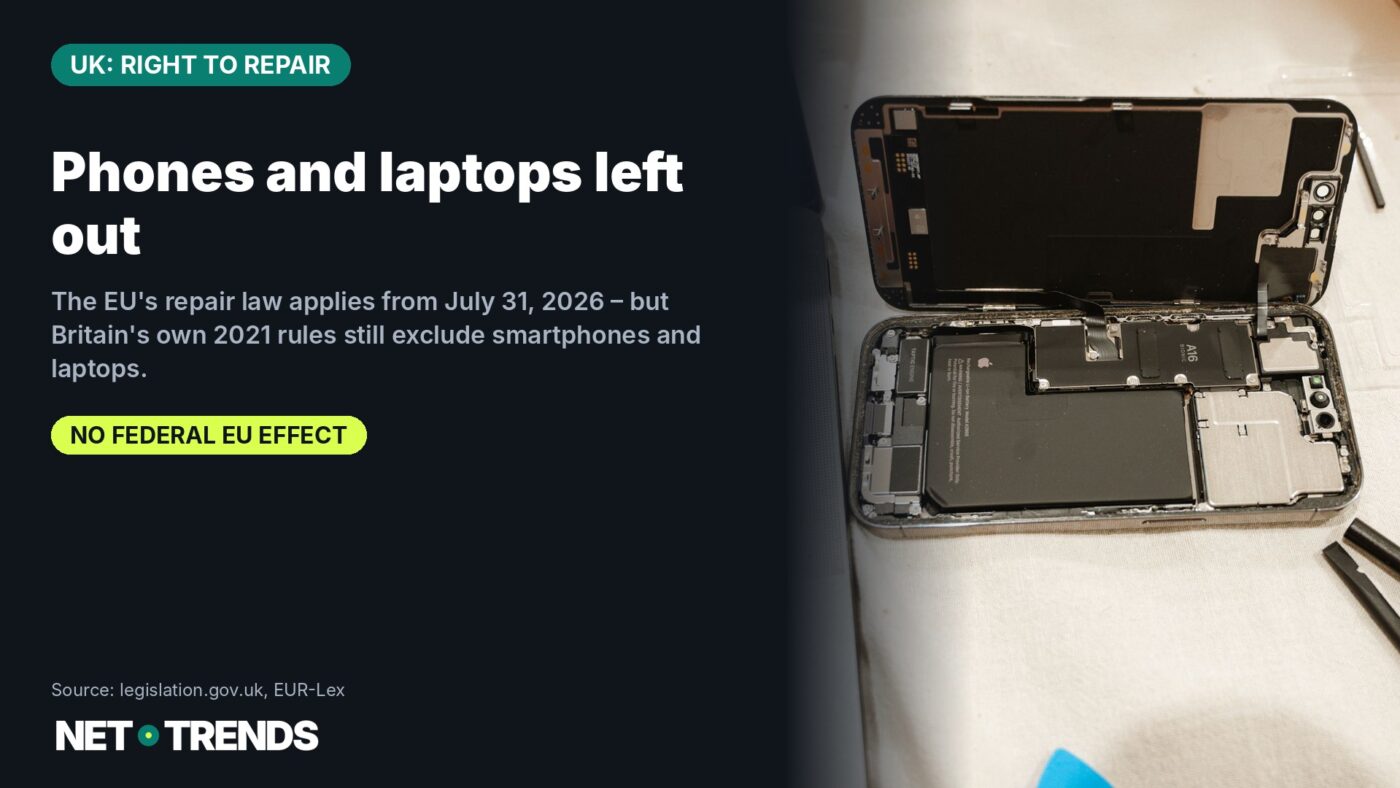
The EU’s new right-to-repair directive has applied since 31 July 2026 – but it has no effect in the UK, where existing rules from 2021 still explicitly leave phones and laptops out.
The essentials
- Since Brexit, EU directives such as (EU) 2024/1799 do not apply automatically in the UK – Parliament would have to pass its own law.
- The UK’s own right-to-repair rules (SI 2021/745) have been in force since 1 July 2021, but they explicitly exclude smartphones and laptops.
- For a broken phone, UK consumers mainly rely on the ordinary Consumer Rights Act 2015, not on a repair-specific right.
While the EU’s right-to-repair directive gives smartphone owners across the bloc new repair guarantees from 31 July 2026, nothing changes for UK consumers. Britain’s own right-to-repair law has been on the books since 2021 – and it was written to leave phones and laptops out.
The EU Right to Repair Directive (EU) 2024/1799 entered into application on 31 July 2026 across the European Union. It obliges manufacturers to offer repairs at reasonable prices, even outside the statutory warranty, for products including smartphones and tablets. Because the UK left the EU, this directive has no direct effect in British law, and the government has not announced plans to mirror it.
What the UK’s right-to-repair law actually covers
The UK introduced its own right-to-repair rules, the Ecodesign for Energy-Related Products and Energy Information (Amendment) Regulations 2021 (SI 2021/745), on 1 July 2021 – closely modelled on the EU’s earlier ecodesign rules for household appliances. They require manufacturers of certain products to make spare parts available to professional repairers for a set number of years, and to supply repair and maintenance information.
The products covered include washing machines, dishwashers, fridges and freezers, and televisions and other electronic displays. Manufacturers must supply parts such as door hinges, seals, drums, motors, thermostats and (for TVs) parts like connectors, capacitors and batteries, with minimum support periods of several years after a model stops being sold.
Why phones and laptops were left out
Unlike the EU’s 2024 directive, SI 2021/745 explicitly does not cover smartphones, laptops or most other portable electronics. Consumer and environmental groups criticised this gap at the time, pointing out that phones and laptops are among the largest sources of electronic waste, yet manufacturers face no legal duty in the UK to supply spare parts or repair documentation for them the way they must for a washing machine or a fridge.
No UK government has since proposed extending the regulations to mobile devices. With the EU’s much broader directive now in force on the other side of the Channel, the gap between the two regimes has become more visible: an iPhone bought in Dublin or Paris now carries stronger manufacturer repair obligations than the same model bought in London or Manchester.
What protection UK consumers actually have
For a faulty smartphone, UK buyers fall back on general consumer law rather than a repair-specific right. Under the Consumer Rights Act 2015, goods must be of satisfactory quality, fit for purpose and as described; if a fault appears within six months, it is presumed to have been there at the time of sale, and the consumer can ask for a repair, replacement or refund. After six months, the consumer typically has to show the fault was present at purchase.
This gives a route to a free repair or replacement for genuine manufacturing faults, but it is not the same as the EU directive’s explicit obligation to offer out-of-warranty repairs at a reasonable price, nor does it guarantee access to spare parts, tools or repair manuals for independent repair shops.
Pressure for reform
UK repair campaigners and environmental groups, including The Restart Project and groups cited by trade press covering e-waste policy, have repeatedly called for the 2021 regulations to be widened to include phones and laptops, for the exemptions for other appliance categories to be narrowed, and for rules on fair spare-parts pricing to be introduced – something the current regulations do not address at all. So far, these calls have not translated into a government bill.
What this means in practice
Checklist for a broken phone in the UK
- ☐ Check age of the fault: within 6 months of purchase, the burden of proof favours you under the Consumer Rights Act 2015.
- ☐ Contact the retailer first, not the manufacturer – your statutory rights sit with whoever sold you the phone.
- ☐ Don’t expect a legal right to subsidised out-of-warranty repair the way EU buyers now have – ask the manufacturer directly and compare independent repair shops.
- ☐ For washing machines, fridges, dishwashers and TVs, you do have a right-to-repair backed spare-parts guarantee under SI 2021/745 – keep that distinction in mind.
Frequently asked questions
Does the EU’s right-to-repair directive apply in the UK?
No. Since Brexit, EU directives such as (EU) 2024/1799 do not automatically become part of UK law. The UK would need its own legislation to introduce equivalent rules, and none has been announced.
Is there any right to repair for phones in the UK at all?
Not a repair-specific one. UK consumers rely on the Consumer Rights Act 2015’s general quality and fitness-for-purpose rules, which can get you a repair or replacement for a genuine fault, but don’t guarantee access to spare parts or repair manuals.
Which products does the UK’s right-to-repair law cover?
SI 2021/745 covers washing machines, dishwashers, fridges, freezers, and televisions/electronic displays – requiring manufacturers to supply spare parts and repair information for several years. Smartphones and laptops are explicitly excluded.
Sources
- EUR-Lex: Directive (EU) 2024/1799
- legislation.gov.uk: The Ecodesign for Energy-Related Products and Energy Information (Amendment) Regulations 2021
- legislation.gov.uk: Consumer Rights Act 2015
- Computer Weekly: Why the UK’s right to repair laws are in urgent need of an upgrade
Transparency note: AI-assisted tools were used to help research, structure and draft this article. Sources used are listed above. Publication only follows manual editorial approval. UK edition prepared from an article on Net Trends, researched for the United Kingdom. Photo: symbolic image adapted for this edition.
Share this article