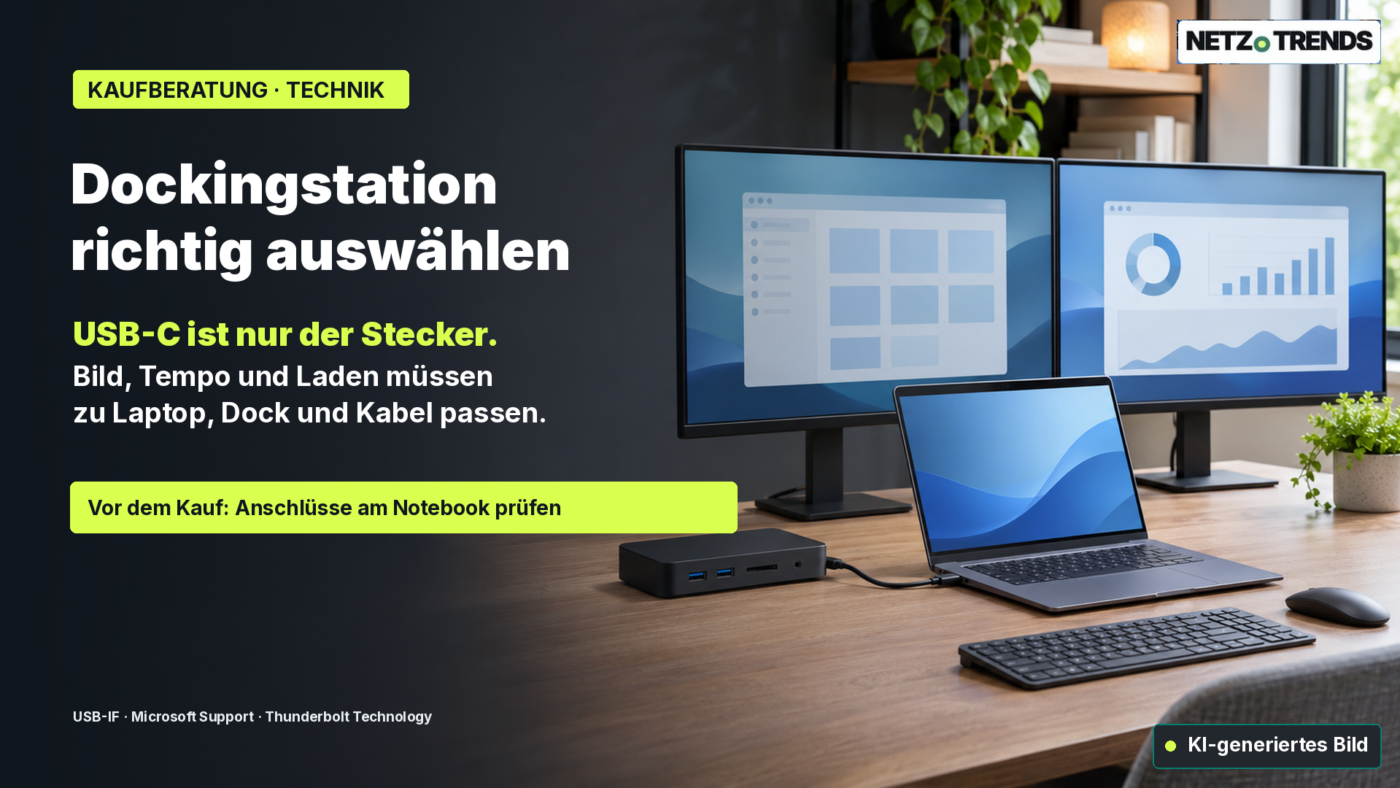
Before buying a USB-C docking station, match your laptop, monitors and cable first. The USB-C connector alone says nothing about video output, data speed or charging power.
Key points
- USB-C describes the shape of the connector. By itself it guarantees neither USB4 nor DisplayPort, Thunderbolt, or a specific charging wattage.
- For video output, the laptop, dock and cable all need to support the same mode, plus the resolution and refresh rate you actually want.
- For charging, what matters is the power the dock actually passes through to the laptop, which can be lower than what’s printed on the included power adapter.
A dock is supposed to turn a single USB-C port into a full desk setup: monitors, keyboard, mouse, network and power, all connected with one cable. What decides whether that works isn’t the number of ports on the case, but whether the whole chain – laptop, dock, cable – actually supports what you need. USB-C is only the plug shape; which video, data and charging features run over it are set by the devices, the cable and the standards they implement. Checking this before you order avoids the most common letdowns: a monitor staying black, two displays only mirroring instead of extending, an external SSD running slower than expected, or a laptop still losing battery while plugged into the dock.
This guide explains how to pick a USB-C dock, which spec-sheet details actually matter, and when a simple hub is enough. It doesn’t run its own product tests and doesn’t recommend a single model; it relies on manufacturer specifications and on the USB-IF, VESA and Thunderbolt standards, which are the same worldwide.
As a rough price anchor for US buyers (as of November 15, 2026, prices as listed, before sales tax): a basic 8-in-1 USB-C hub with charging pass-through, such as the Anker 555, typically runs in the $50–70 range at US retailers, while a full Thunderbolt 4 dock with many ports, such as the CalDigit TS4, is currently listed at $379.99 on CalDigit’s own US store. Both are examples to illustrate the price range, not a recommendation for either brand.
What USB-C does – and doesn’t – tell you
USB-C is the name of a compact, reversible connector shape. By itself it doesn’t tell you what data rate a port reaches, whether it can carry a monitor signal, or how much power it supplies. The USB Implementers Forum (USB-IF) states explicitly that USB Type-C is not the same thing as USB 3.2, USB4 or USB Power Delivery. Manufacturers can implement different combinations of features, which is exactly why they’re expected to spell out the supported protocols and power levels.
For buyers that means a laptop with a USB-C port isn’t automatically suited to every multi-monitor dock. Check the exact laptop model’s spec sheet for terms like “DisplayPort Alt Mode,” “Thunderbolt 4,” “USB4,” or an explicit note on external display support. A small lightning-bolt icon next to the port can be a hint, but it’s no substitute for the manual – on some laptops, only certain USB-C ports support the feature you need.
DisplayPort Alt Mode lets a DisplayPort video signal travel over a USB-C connection. Whether that works depends on the exact host port and the path used. Microsoft advises checking Alternate Mode support on the PC, the display and the cable; VESA likewise confirms that the USB-C port on the source device itself has to support DisplayPort. A dock can’t simply add video output that the laptop’s port doesn’t already provide, unless it uses a separate, software-based display technology instead.
A USB-C cable isn’t just a passive wire with the right plugs, either – it can support only part of the possible data, video and charging features. Use the cable that shipped with the dock where you can; for a replacement cable, verify its data rate, video support and power rating in the spec sheet. A cheap phone-charging cable may be fine for a smartphone and unsuitable for a demanding monitor or Thunderbolt connection.
Monitors, resolution and refresh rate
First decide how many external monitors you actually want to run, and at what resolution and refresh rate. “Supports two monitors” is an incomplete claim if it isn’t clear whether that means two 4K screens at 60Hz, two 1080p screens, or a lower refresh rate. The real ceiling is set by the laptop’s graphics, operating system, the dock’s own chip, port layout and the cable.
One concrete example shows the gap between a connector class and an actual device’s capability: Thunderbolt 4 specifies that suitable computers and dock configurations can drive up to two 4K displays at 60Hz over a single Thunderbolt port. That’s a capability of the specification, not a blanket promise that every laptop, dock and combination will always output two screens that way – the exact laptop and dock specs both have to explicitly support that resolution together.
Manufacturers can also list different external-display counts for different variants of the same laptop line. Apple, for instance, notes that the number of supported external displays on a MacBook varies by the exact Mac model and the chosen resolutions and refresh rates. In practice: never assume a spec from the product family name – look up the exact model identifier.
In the dock’s own spec sheet, check which port serves which screen – HDMI, DisplayPort, USB-C or Thunderbolt. Some docks split the available video bandwidth across several outputs, so not every combination of ports can run at once. Watch for footnotes like “when a second display is connected,” “MST required,” or a lower max refresh rate in that case. If you only plan to run one monitor, a simpler model is often enough – a second output you’ll never use isn’t a reason to pay more.
On Windows, docks built around DisplayLink chips can add extra screens over USB data plus a driver. DisplayLink’s own documentation lists several supported operating systems and installation steps. That works differently from native DisplayPort-over-USB-C or Thunderbolt video. Check the dock maker’s own notes on OS support, drivers, protected video playback, sleep behavior and supported monitors – and keep in mind that a locked-down work laptop may not allow driver installation at all. For gaming, color-critical work or anything latency-sensitive, don’t assume a DisplayLink connection behaves identically to native graphics output unless the manufacturer says so.
Data rate and shared bandwidth
A dock bundles several devices behind one connection. That’s convenient, but it doesn’t mean every port hits its advertised peak speed at the same time and independently of the others. Monitors, USB storage, networking and other functions can share the connection back to the laptop depending on the dock’s internal design – so what matters is what you’re actually running at once.
For a keyboard, mouse, printer and the occasional file transfer, top data rate rarely matters. If you regularly work with large video or project files on an external SSD, the connection between computer and dock, and the SSD’s own port, both need to support the required speed. Check whether a USB port is rated at 5, 10 gigabits per second or more, and whether that figure describes the downstream port or the host connection – the number of ports says nothing about whether they all run at full speed.
USB4 and Thunderbolt are protocol families with more concrete capabilities than the bare connector name. Thunderbolt 4 works with a link capacity of 40 gigabits per second and lists, among its core features, support for two 4K displays at 60Hz. Real-world throughput for connected storage still isn’t simply the same as the raw link speed: protocol overhead, other connected devices and the host computer’s own capabilities all play a part. Compare the dock’s actual specs for its SSD ports, networking and monitor support, rather than relying on one big number on the box.
For a desk with two monitors, external SSDs and gigabit Ethernet, it’s worth reading the fine print: are the monitors driven via DisplayPort Alt Mode? Is bandwidth shared when several USB devices are active at once? Are certain ports disabled once a second screen is connected? These details are often buried in the support pages or the full manual rather than the headline product description.
Charging: reading the wattage correctly
Many docks charge the laptop over the same USB-C connection that carries data and video. What matters isn’t the printed wattage of the power adapter, but the charging power the manufacturer states for the host – usually labeled “Power Delivery,” “host charging” or “PD passthrough.” The dock’s own electronics and any connected devices draw power too, so the power that actually reaches the laptop can be lower than the adapter’s rated output.
Compare that figure with your laptop’s own included charger, or the value in the manufacturer’s manual. If the dock’s output is lower, the laptop may charge more slowly under heavy use, or fail to hold its battery level. That doesn’t automatically rule out a purchase – a lightweight office laptop may be fine with a lower figure, while a demanding machine needs a stronger supply. What matters is your own use case, not the highest theoretical USB-PD number on the spec sheet.
USB Power Delivery itself can carry up to 240 watts with suitable, fully rated USB-C cables – that doesn’t mean any given dock delivers 240 watts to a laptop. Check the specific combination of power adapter, dock, cable and laptop. Some docks need their own separate power supply; compact hubs draw power from the laptop itself, or pass through an optional charger’s output. On bus-powered hubs, running several power-hungry devices at once can shrink the power available further still.
If you want to connect your whole desk with a single cable, also check for “Power Delivery passthrough” and whether a power supply is included in the box. If not, factor its price and compatibility into the total cost. An existing USB-C charger only works reliably if its power rating, voltage profiles and cable requirements match what the dock and laptop both need.
Laptop, dock and cable compatibility
A proper buying check follows the whole chain from the laptop to the device at the other end. Start by noting the exact laptop model, operating system and the ports it actually has. Then look in the manufacturer’s manual for USB-C video output, the number of supported external displays, the resolutions they support, and charging behavior. Where a manufacturer lists several configurations for the same model, make sure the figures match your specific variant.
Next, compare these capabilities with the dock. A dock can offer more ports than your laptop can drive at full functionality at the same time. Check whether the connection to the host requires USB-C, USB4 or Thunderbolt, and which features remain available over a simpler connection. Where a manufacturer only publishes a compatibility list, your exact model – or a clearly defined device class – should appear on it.
Third, check the software side. Native USB-C or Thunderbolt video typically doesn’t need a special DisplayLink driver, though security permissions or firmware can still matter. For DisplayLink-based docks, operating-system version and driver support need to be checked explicitly. Companies can restrict driver installation, and macOS, Windows and Linux aren’t automatically supported equally. Firmware updates can fix stability or compatibility issues too, but may require installation by the user or by IT.
In mixed environments with both personal and work laptops, extra caution pays off: a dock that drives two monitors on a Windows laptop won’t necessarily do the same on a Mac, since operating systems handle multiple displays and video streams differently. Look for a compatibility matrix that names the exact operating system and the monitor arrangement you want, not just the connector standard.
Dock or hub: what fits your desk?
A compact USB-C hub makes sense if you occasionally need HDMI, USB-A or a card reader on the go, and don’t run a fixed multi-monitor setup. It’s small and light, but usually offers fewer ports and no power supply of its own. The host feature still needs checking: a hub can have an HDMI output, yet without DisplayPort Alt Mode on the laptop itself, the screen may simply stay dark.
A stationary dock suits a fixed desk with several peripherals better. It can combine extra video outputs, Ethernet, audio, a card reader and charging in one unit. Larger models often need their own power supply and cost more. Their main advantage is the convenience of a single cable to plug and unplug every day; if you only connect a mouse and a single monitor, a hub may well be enough.
A monitor with a built-in USB-C hub can be an alternative if it combines the screens and ports you need and charges the laptop adequately. Here too, check the actual charging power, the number of USB ports, the video inputs and whether it can drive more than one display – a USB-C monitor doesn’t automatically offer the functionality of a full Thunderbolt dock.
For working on the go, weight, cable length, build quality and a secure connector on the hub itself all matter. For a fixed desk, a sufficiently long host cable, a stable power supply and easily reachable ports tend to matter more. If you regularly use USB drives or SD cards, check that the card reader supports the card type you actually use; for a wired network connection, check the Ethernet speed and whether your OS supports it fully.
Buying checklist: note these details before you order
Practical checklist
- Have the exact laptop model number and its USB-C/Thunderbolt spec sheet on hand.
- Decide on the number of external screens, resolution and refresh rate you need.
- Check that laptop, dock and cable all support the same required display or Thunderbolt mode.
- Compare the dock’s host charging power with what your laptop actually needs.
- Check the USB data rate of the ports you’ll really use, and any bandwidth sharing.
- Check operating system, driver requirements, company policy and the compatibility list.
- Decide which ports you actually need: HDMI/DisplayPort, USB-A, USB-C, Ethernet, audio, SD card.
- Factor the power supply, host cable, warranty and return policy into the total price.
A simple rule of thumb: for a single display and a handful of USB devices, an inexpensive hub can be enough, provided the laptop’s own video output is up to it. For two monitors, fast external storage, or a tidy single-cable desk, a dock with clearly documented host compatibility is the safer bet. If you’re weighing a cheaper USB-C dock against a Thunderbolt model, only pay for the extra features if your laptop and peripherals can actually use them.
Frequently asked questions
Does every USB-C dock work with every USB-C laptop?
No. The plug may fit while video output, data rate or charging aren’t supported. Check the specific laptop port’s features, the dock’s requirements and the cable. Microsoft states explicitly that Alternate Modes require support from the computer, the accessory and the cable.
Can a dock drive two external monitors?
That depends on the laptop, the dock, the operating system and the resolutions and refresh rates you want. Get the exact combination confirmed. “Two monitors” without a stated resolution and refresh rate isn’t enough for a reliable comparison.
Is Thunderbolt 4 the same as USB-C?
No. USB-C names the plug shape; Thunderbolt 4 is a connection specification that uses the same plug type but adds further requirements for data, displays and compatibility. The Thunderbolt logo, or the model listing in the laptop manual, says more than the shape of the port.
Is a 100-watt charger enough for any dock and laptop?
Not automatically. The dock may pass on less power to the laptop than the charger itself can provide, and the computer’s power needs vary. Compare the dock’s host charging power with what the laptop manufacturer states it needs. 100 watts is no universal guarantee of fast charging.
Do I need a driver for a USB-C docking station?
With native DisplayPort or Thunderbolt output, a DisplayLink driver usually isn’t how the video gets there at all. Docks built around DisplayLink do need matching software, though. Follow the dock maker’s instructions for your OS, and check your employer’s IT policy on a work laptop.
What matters more: more ports, or a higher data rate?
It depends on how you use it. For a mouse, keyboard and printer, extra ports can matter more. If you move large files on external SSDs, or use several monitors and a network connection at once, check the host bandwidth and the speed of the specific ports instead.
Which ports do you actually need?
What combination should your dock handle day to day – one or two monitors, at what resolution, and which devices need to be connected at the same time? Tell us your laptop model and your planned desk setup in the comments, so the buying decision can be matched to your exact interfaces.
Sources and status
- USB Implementers Forum (USB-IF): USB Type-C Product and Packaging Guidelines – how USB-C, data protocols and Power Delivery relate to each other.
- Microsoft Support: Fix USB-C problems in Windows – requirements for Alternate Modes, host, accessory and cable.
- VESA: DisplayPort on USB Type-C Help Page – notes on DisplayPort support over USB-C.
- Thunderbolt Technology Community: What Is Thunderbolt 4? – capabilities and monitor examples for Thunderbolt 4.
- USB-IF: USB Charger (USB Power Delivery) – power levels and requirements of USB PD.
- Apple Support: How many displays can be connected to MacBook Pro? – model-dependent display support on MacBook Pro.
- DisplayLink Support: How to install DisplayLink Software – driver and operating system notes.
- CalDigit US store: TS4 Thunderbolt dock – US pricing example for a full Thunderbolt 4 dock.
Research and data as of November 15, 2026. Prices shown are manufacturer list prices before sales tax, which varies by state. Compatibility details should be checked against the current manufacturer documentation for the exact device model before buying.
Transparency note: AI-assisted tools were used in researching, structuring and writing this article. The sources used are listed in the article. Publication takes place only after manual editorial approval.
Share this article



Comment Tell us what you think →