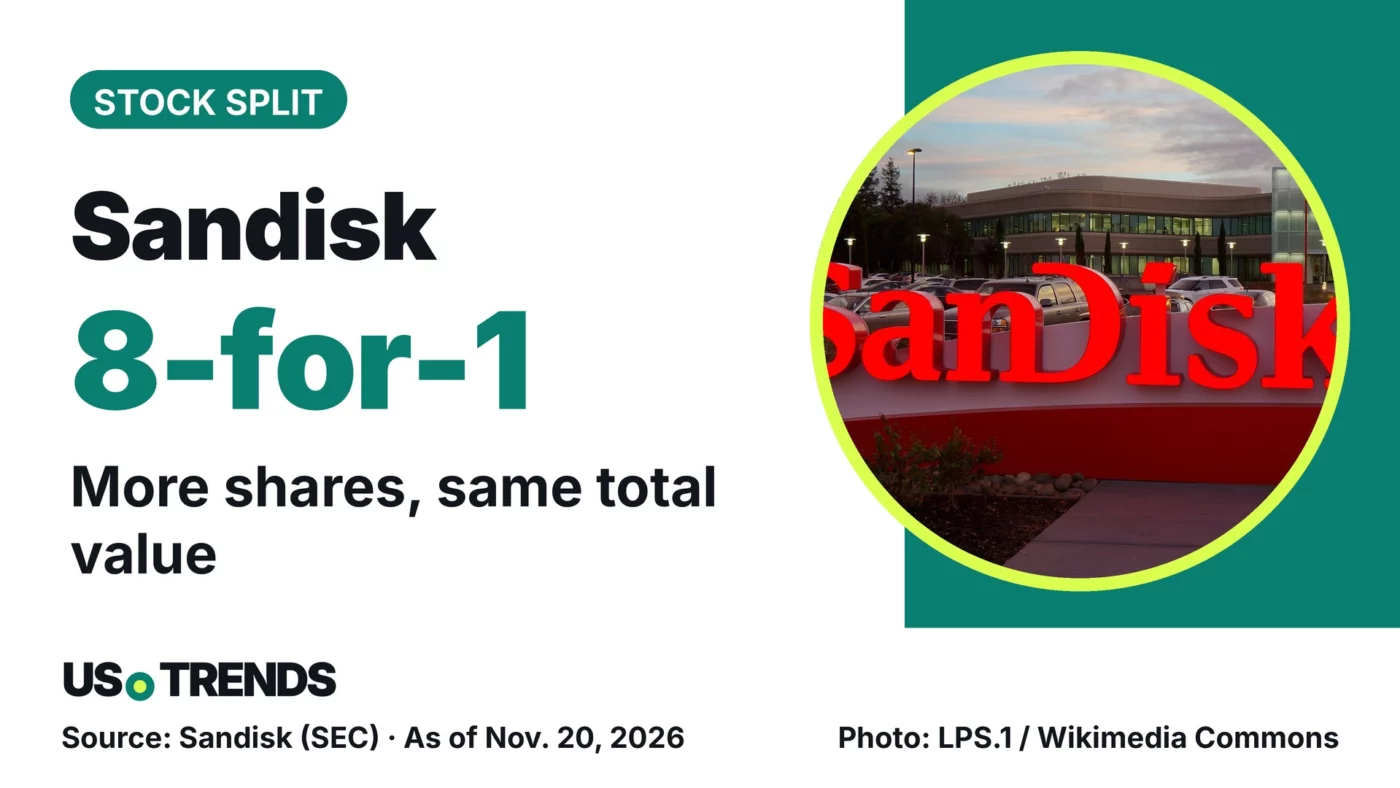
The split changes your share count and the price per share, not what your position is worth – and the IRS says it is not a taxable event.
Key points
- Sandisk approved an 8-for-1 forward stock split, according to its October 29, 2026, filing with the Securities and Exchange Commission (SEC): holders receive seven additional shares for each share held.
- The charter amendment took effect at 4:01 p.m. Eastern Time on November 19, 2026, and split-adjusted trading was expected to start at the open on November 20, 2026.
- Eight times as many shares at one-eighth of the price: the value of your position stays the same.
- The IRS says stock splits don’t create a taxable event; your total cost basis stays the same and is spread across the new shares.
Sandisk has split its stock 8-for-1: each share becomes eight, and the price drops to one-eighth. Investors see more shares in their brokerage account, but no change in value.
If you own Sandisk (SNDK), your brokerage account now shows a higher share count and a much lower price. That is arithmetic, not a sell-off. The storage company announced the move in a Form 8-K filed with the SEC on October 29, 2026.
What happened on November 19 and 20
According to the October 29 filing, the board approved an “eight-for-one forward stock split” of the common stock. Stockholders of record as of the close of business on November 9, 2026, receive seven additional shares for each share held. These were to be issued after market close on Thursday, November 19, 2026.
In a second Form 8-K dated November 19, 2026, Sandisk said the charter amendment filed with the Delaware Secretary of State became effective at 4:01 p.m. Eastern Time. Trading on a split-adjusted basis was expected to begin at market open on Friday, November 20, 2026. That is the company’s expectation, not a confirmation from the exchange. The ticker stays SNDK.
At the same time, authorized common stock rises from 450 million to 3.6 billion shares. This is not a capital raise: the extra shares come from dividing existing ones, and no new money goes into the company.
One share becomes eight: your numbers
A hypothetical example: 10 shares at $800 each are worth $8,000 before the split. Afterward, you hold 80 shares at $100 each, still worth $8,000. The calculator below uses your own figures. The default values are not a current quote.
What changes in your account?
Example using the default values
- Shares after the split
- 80.00
- Price per share after the split in USD
- 100.00
- Cost basis per share after the split in USD
- 62.50
Simplified example based on the source shown. This is not tax, legal or financial advice. Your actual amount may differ.
The calculator assumes the 8-for-1 ratio and a single purchase lot. Commissions and price moves on the day of the split are not included.
Taxes: no taxable event, new basis per share
The IRS addresses splits in its FAQ on stocks, options, splits and traders: “Stock splits don’t create a taxable event.” Tax is due only when you sell. “Your overall basis doesn’t change as a result of a stock split, but your per share basis changes.”
If you bought Sandisk in several lots at different prices, the IRS says to allocate basis lot by lot. Your broker normally adjusts the per-share basis it reports; when you sell later, compare it with your own records.
Why the price now looks lower
The lower price is an optical effect. The SEC’s investor site Investor.gov defines a stock split as an increase in the number of shares “without a change in the shareholders’ equity” and notes that it “does not dilute the ownership interests of existing shareholders.”
The company does not get cheaper; each slice is simply smaller. Sandisk’s filings give no reason for the split. On its own, a split is not a reason to buy.
What you can do now
Check over the next few days that your account shows eight times your previous share count. Review any open limit or stop orders: an $800 limit would make no sense after the split. How your broker handles open orders in a split depends on its policies. Your broker can answer questions about the new shares, orders or cost basis reporting. This article is not investment advice.
Frequently asked questions
Does the Sandisk stock split reduce the value of my shares?
No. The share count rises in the same proportion as the price per share falls. Normal price swings can still happen.
How many Sandisk shares will I have after the split?
Eight times as many. According to Sandisk, holders receive seven additional shares for each share held.
Do I owe taxes on the Sandisk stock split?
No. The IRS says stock splits don’t create a taxable event. Your total basis stays the same, but the basis per share changes.
Is Sandisk stock cheaper after the split?
No. Only the price per share is lower; your stake in the company stays the same.
Your view: Have you held a stock through a split before, and did your broker update the cost basis correctly? Tell us about your experience in the comments.
Sources and date
- Sandisk Corp.: Form 8-K, approval of stock split (SEC filing, October 29, 2026)
- Sandisk Corp.: Form 8-K, charter amendment for stock split (SEC filing, November 19, 2026)
- Internal Revenue Service: Stocks (options, splits, traders) (FAQ, accessed November 20, 2026)
- U.S. Securities and Exchange Commission: Stock Split (glossary, accessed November 20, 2026)
As of: November 20, 2026
Transparency note: AI-assisted tools were used in researching, structuring and writing this article. The sources used are listed in the article. Publication takes place only after manual editorial approval.
Share this article

Comment Tell us what you think →