undefined
Key points
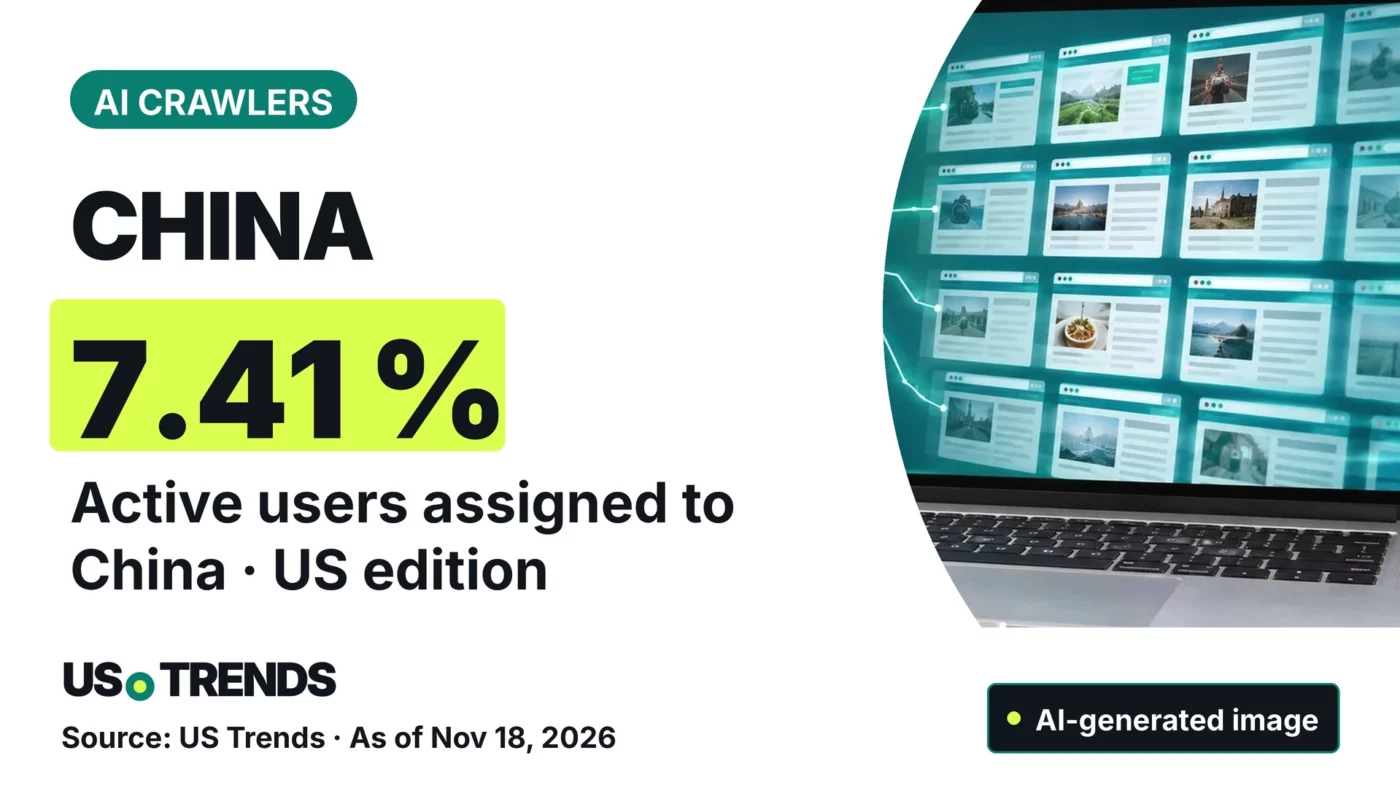
- Google Analytics assigned 7.41 percent of US Trends active users in the 30-day report to China.
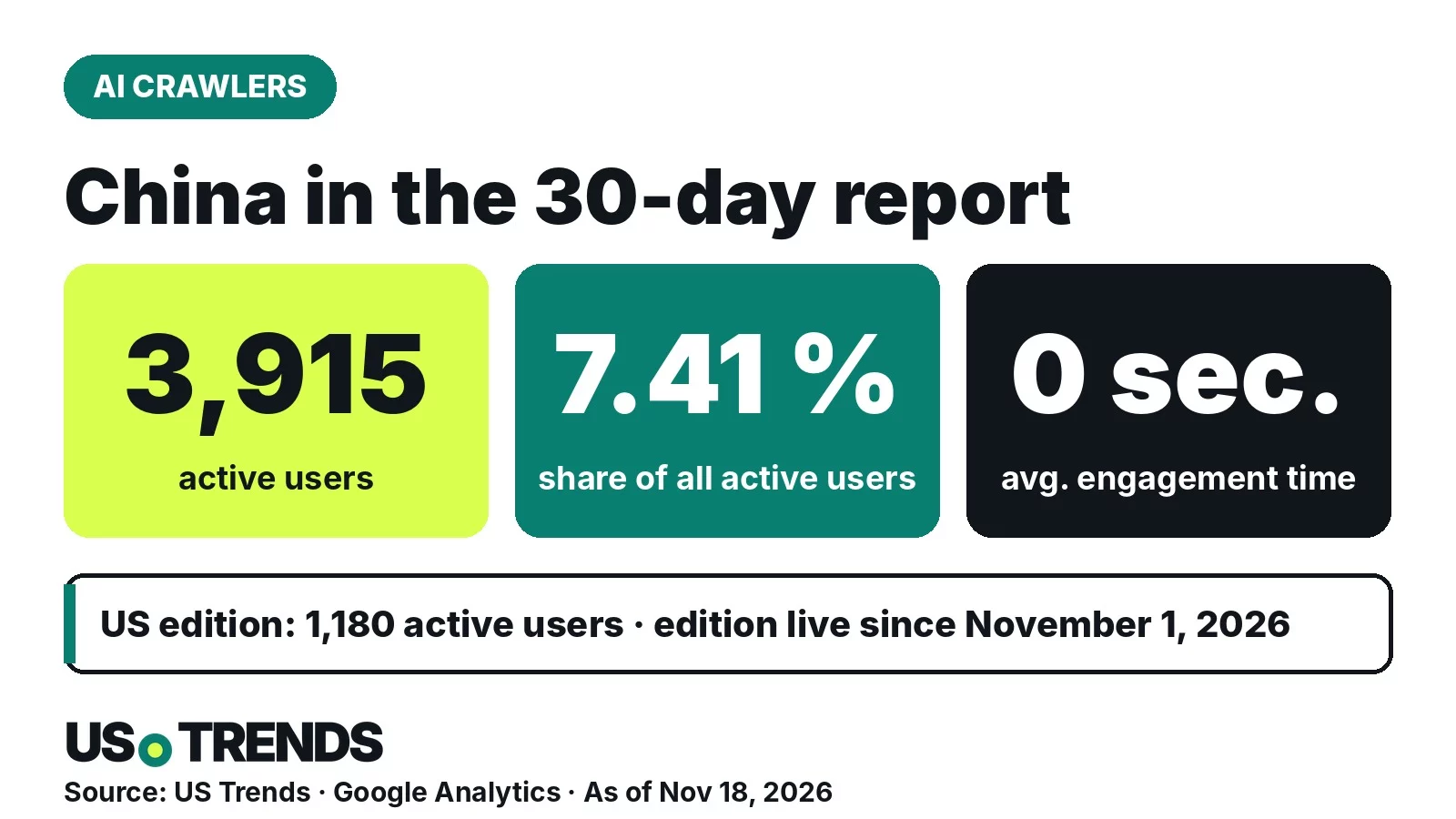
- The average engagement time of this group was measured at zero seconds.
- Automated requests for AI systems are our working hypothesis. Who loaded the pages, and why, remains open.
- The United States accounts for 1,180 active users (2.23 percent). The US edition has been online since November 1, 2026.
In the combined Google Analytics report covering all editions of US Trends, 3,915 active users were assigned to China within 30 days. We have not seen traffic of this size from China before.
We do not run a Chinese-language edition and do not target the Chinese market editorially. Anyone reading us from there is welcome. What stands out is the combination of the unusually high number and the lack of any measurable engagement time. Our only concrete working hypothesis at present is that programs retrieve our pages automatically to collect text for AI systems.
China ranks second in the monthly report
From October 18 to November 16, 2026, Google Analytics recorded 52,843 active users in total. It assigned 40,607 to Germany. China, with 3,915, ranked ahead of Austria with 2,967. The 7.41 percent refers to active users in the full 30-day report. US Trends media data with the note on the China line (in German)
Active users by assigned country, 30-day report
Data table
| Period | Share of active users |
|---|---|
| Germany | 76.84 |
| China | 7.41 |
| Austria | 5.61 |
| United States | 2.23 |
| Switzerland | 2.1 |
| France | 0.65 |
| Spain | 0.54 |
| Italy | 0.51 |
For users assigned to China, the report shows an average engagement time of zero seconds. The report does not reveal how many people are behind that number.
How does Google count users at zero seconds?
The signal for a first visit can be enough for Google Analytics to count a user as active. Engagement time separately records how long the page was in the foreground. A first visit can therefore appear in the statistics without any measured engagement time. Google on the “active users” metric
Google filters known bots automatically. According to Google, scripts and programs that read web pages and behave like ordinary browsers can still show up in reports. The assignment to China is based on the IP address visible at the time of access. It does not reveal who operates or commissions a possible crawler. Google on excluding automated traffic · Google on country assignment
Chinese AI providers use web text
It is documented that Chinese companies prepare publicly accessible web content for language models. The Qwen team at Alibaba describes how it extracts text from web pages, sorts it by language and removes duplicates. DeepSeek states 14.8 trillion tokens of pre-training data for DeepSeek-V3. Tokens are units such as words and word fragments. Besides English and Chinese, the dataset covers other languages. Alibaba technical report · DeepSeek technical report
What server logs could show
Does the search for training material reach an independent technology magazine such as US Trends? Server logs could show whether the same connections retrieved an unusual number of archive articles in a short time. That would point to automated requests. Who triggered them, and whether our texts later ended up in a training dataset, would have to be clarified separately.
What this means for the United States
The report covers all editions of US Trends, not only the US one. From October 18 to November 16, 2026, Google Analytics assigned 1,180 active users to the United States. That is 2.23 percent and fourth place behind Germany, China and Austria.
The US edition has been online since November 1, 2026, and the 30-day report starts 14 days earlier. The media data do not yet break out the period since launch. A full month with country editions will be available from early December 2026. A country assignment also does not show which language edition someone read.
Frequently asked questions
What does the 7.41 percent refer to?
The share of active users assigned to China from 18 October to 16 November 2026, across all editions of US Trends.
Are visits by AI crawlers confirmed?
AI crawling is the editorial team’s working hypothesis. In this report, Google Analytics identifies neither the operator nor the purpose of the requests.
Does the report prove that articles were used for AI training?
The statistics say nothing about that. It would take evidence of how the texts were actually used.
How many active users does the US have?
1,180 in the 30-day report from October 18 to November 16, 2026, or 2.23 percent. The US edition has been online since November 1, 2026.
Your view: What would you expect AI providers to disclose about the origin of their training data? Share your experience in the comments.
Sources and date
- US Trends, media data and Google Analytics (30-day report, as of 11/18/2026; in German)
- Google Analytics, user metrics and engagement time
- Alibaba, Qwen Technical Report (2023)
- DeepSeek-AI, DeepSeek-V3 Technical Report (2024)
As of: November 19, 2026
Transparency note: AI-assisted tools were used in researching, structuring and writing this article. The sources used are listed in the article. Publication takes place only after manual editorial approval.
Share this article



Comment Tell us what you think →