The EU’s new per-item customs handling fee mostly lands on US sellers shipping into Europe, not on American shoppers. Meanwhile, the US is dismantling its own duty-free de minimis exemption on a very different timeline.
The bottom line
- Since November 1, 2026, the EU charges a flat €2 customs handling fee per declared “item” on distance sales shipped into the EU from outside the bloc, including from the United States.
- The fee is owed mainly by the seller, marketplace or their customs representative, not the end buyer – so US merchants selling into the EU, more than US shoppers, are the ones who feel it directly.
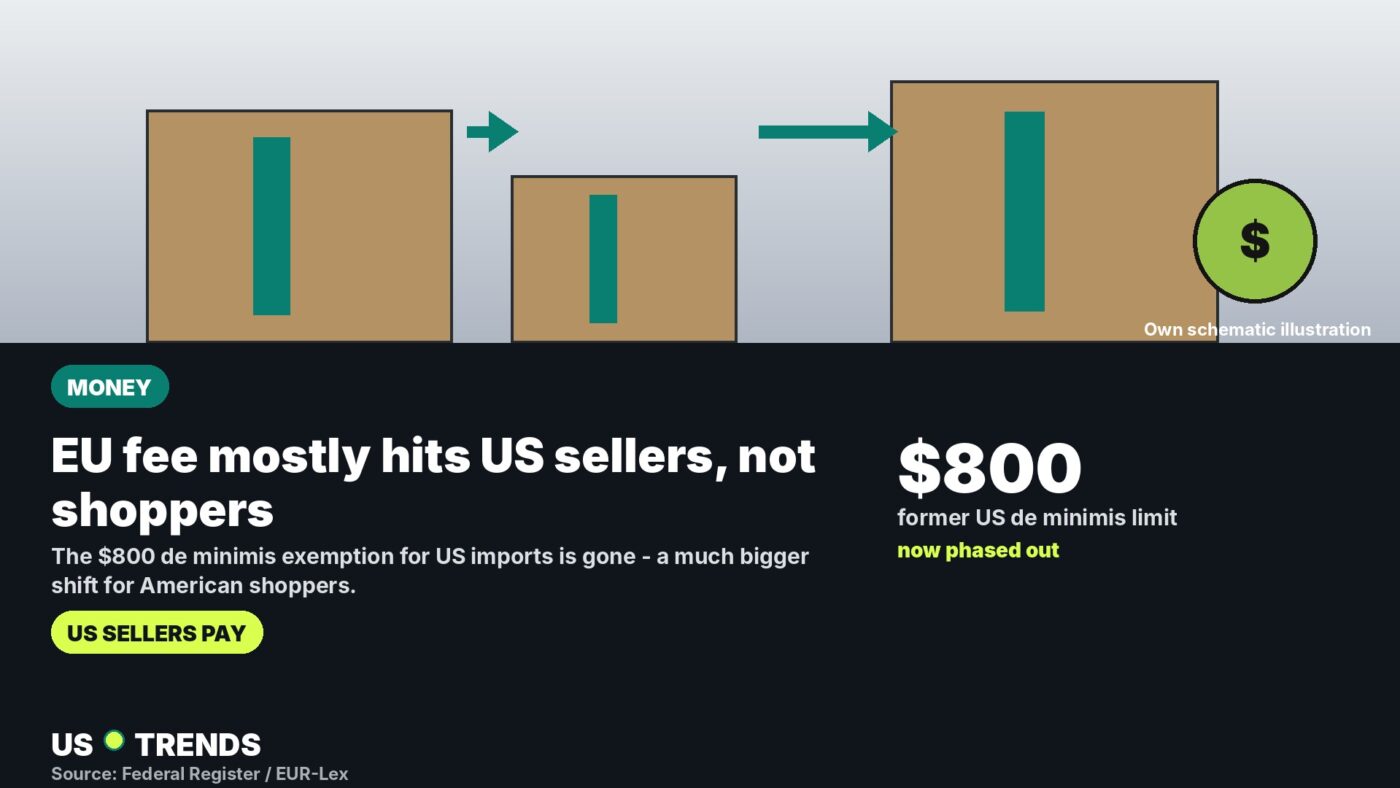
- The US has been on its own, separate path: it eliminated its $800 de minimis exemption for low-value imports in stages between 2025 and 2027, a much bigger change for American shoppers buying from abroad.
American sellers shipping products to European customers, and US-based marketplaces facilitating those sales, are the ones most directly affected by the EU’s new customs handling fee – not shoppers in the United States buying from abroad.
The fee is set out in Commission Delegated Regulation (EU) 2026/2152 together with the new Union Customs Code (EU) 2026/2108: a flat €2 (roughly $2.23 at the November 2026 ECB reference rate of 1.1127 USD/EUR) per customs “item,” a term that can cover several identical goods declared together. It applies to every distance sale into the EU regardless of order value and comes on top of a separate, temporary €3 ad valorem customs duty that has applied since July 1, 2026 to shipments valued up to €150. The debtor is normally the importer of record – typically the seller, the marketplace, or a customs representative acting for them – not the EU consumer who placed the order.
The US’s own, much larger shift: the end of the $800 de minimis exemption
While the EU adds a small per-item fee, the United States has been removing an exemption altogether. Under a series of executive orders – including Executive Order 14324 and subsequent orders culminating around mid-2026 and extending into 2027 – the longstanding $800 duty-free de minimis threshold for low-value imports, once used heavily by shoppers buying directly from overseas sellers, has been phased out. Unlike the EU’s flat €2 handling fee, this means many shipments into the US that previously entered duty-free now face ad valorem tariffs or flat per-item duties, a change the Federal Register notice frames as closing a loophole exploited by high-volume, low-value shipments.
In short: a US business selling into the EU now budgets for an extra, modest handling fee per item. A US consumer buying from abroad has already been living with a far larger shift, as duty-free treatment for low-value parcels has been rolled back at home.
Frequently asked questions
Do US shoppers pay the EU’s new €2 fee?
Only indirectly, if at all. The fee applies to goods shipped into the EU – a US shopper ordering from a US store for US delivery is not affected by it.
Who actually pays the EU fee?
Normally the importer of record – the seller, marketplace, or their customs representative – not the end customer, though costs can be passed through in pricing.
Is this related to the end of the US de minimis exemption?
No, they are separate measures by separate authorities. The EU fee is a new per-item customs charge on imports into the EU; the US change removed a duty-free exemption for low-value imports into the United States.
Sources and status
- Commission Delegated Regulation (EU) 2026/2152 – EU handling fee, amount and date of application.
- Regulation (EU) 2026/2108, notably Articles 5 and 20 – definition of “item” and debtor.
- Federal Register: Suspending Duty-Free De Minimis Treatment for All Countries – US de minimis phase-out.
Research and data as of November 13, 2026.
Transparency note: AI-assisted tools were used in researching, structuring, and writing this article. Sources used are listed in the article. Publication occurs only after manual editorial approval. US edition researched independently for the United States, based on an article by Net Trends. Illustration: original schematic representation, based on the structure of the original German article.
Share this article