The average finance rate on 24-month personal loans at commercial banks rose for the third straight quarter, Federal Reserve survey data shows.
Key points
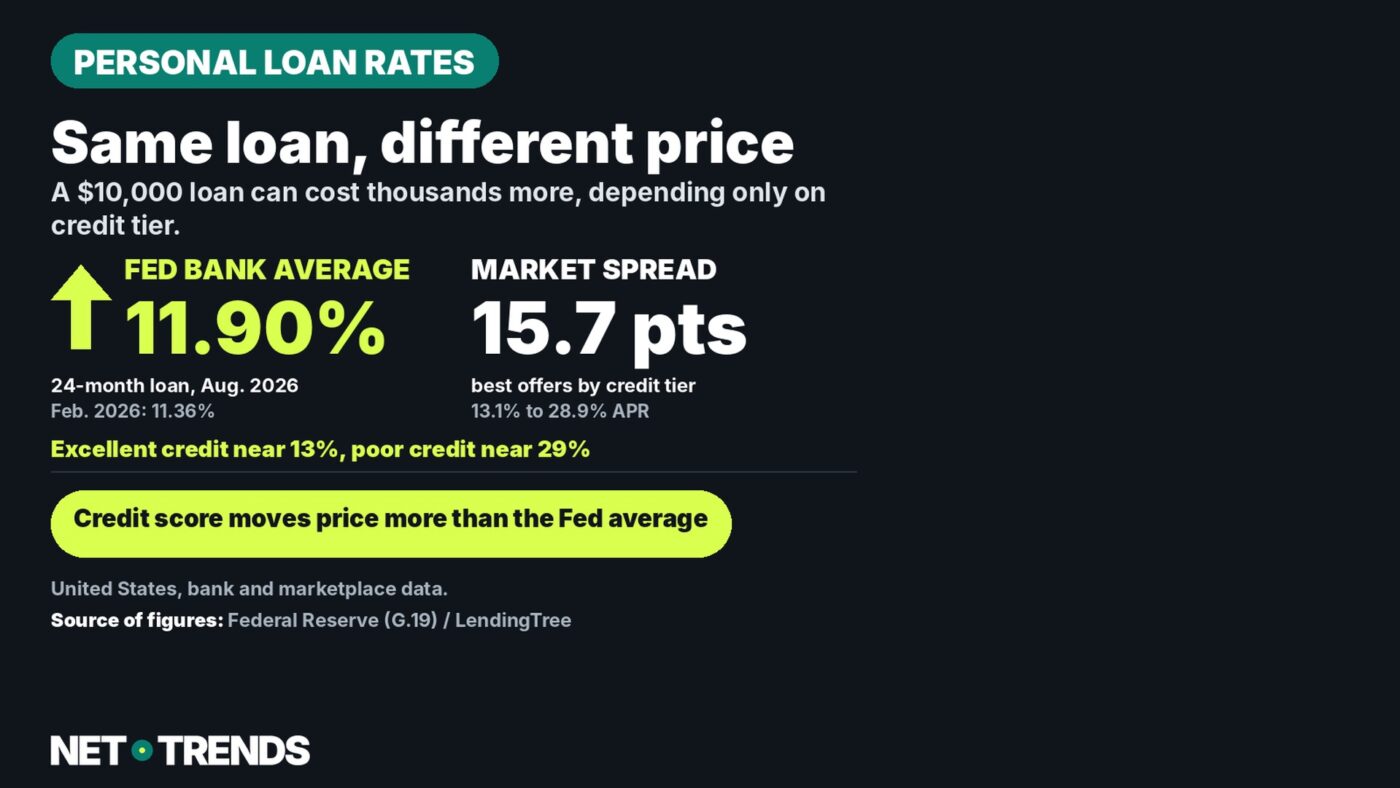
- The Federal Reserve’s quarterly G.19 survey puts the average finance rate on a 24-month personal loan at commercial banks at 11.90 percent in August 2026, up from 11.36 percent in February 2026.
- Marketplace data from LendingTree shows a much wider range once credit tiers are factored in: best-offer APRs for borrowers with excellent credit average 13.13 percent, versus 28.85 percent for borrowers with poor credit.
- For a $10,000 loan over 48 months, the difference between a strong-credit offer and a weak-credit offer runs into thousands of dollars in total interest.
Personal loan rates at U.S. commercial banks have risen for three straight quarterly readings, according to the Federal Reserve’s own survey of lenders. The average 24-month finance rate reached 11.90 percent in the Fed’s August 2026 survey, continuing a climb that began in early 2026.
The figures affect anyone taking out a new unsecured personal loan in the United States — for debt consolidation, a major purchase, or an unexpected expense. They come from the Federal Reserve’s G.19 Consumer Credit statistical release, which reports commercial bank interest rate terms quarterly, with the latest data published November 6, 2026.
How the current average compares with the past two years, how much credit tier changes the rate a borrower actually gets, and what that means in dollars on a typical loan — this article breaks it down.
The rate trend in detail
The Federal Reserve surveys commercial banks on their consumer loan terms four times a year — in February, May, August and November — rather than every month. The resulting series, “Finance Rate on Personal Loans at Commercial Banks, 24-Month Loan,” is the closest U.S. equivalent to the average effective rate that European central banks publish for consumer installment loans.
Over the past two years, the rate has moved in a fairly narrow band, but the direction has shifted. After falling to 11.14 percent in August 2025, it rose to 11.63 percent in November 2025, eased slightly to 11.36 percent in February 2026, then climbed to 11.86 percent in May 2026 and 11.90 percent in August 2026 — the third consecutive quarterly increase.
| Survey quarter | Finance rate | Change vs. prior survey |
|---|---|---|
| November 2024 | 12.32% | — |
| February 2025 | 11.66% | −0.66 |
| August 2025 | 11.14% | −0.43 (vs. May) |
| November 2025 | 11.63% | +0.49 |
| February 2026 | 11.36% | −0.27 |
| May 2026 | 11.86% | +0.50 |
| August 2026 | 11.90% | +0.04 |
Finance rate on 24-month personal loans, commercial banks, United States. Source: Federal Reserve, G.19 Consumer Credit series TERMCBPER24NS, data as of November 6, 2026.
Why rates have been climbing
The Federal Reserve’s release does not explain the move — it only reports the surveyed rate. Commercial bank personal loan pricing broadly tracks the general level of short-term interest rates and each lender’s own funding costs and risk appetite, but the G.19 release itself draws no conclusions about the cause of any single quarter’s change.
The 24-month bank rate is also only one part of the U.S. personal loan market. A large share of personal loans today are originated by online lenders and marketplaces rather than traditional commercial banks, and those lenders price loans primarily by credit tier rather than a single quoted average.
Credit tier matters more than the bank average
The Fed’s bank average is useful as a benchmark, but it masks how differently individual borrowers are priced. Marketplace data published by the online lending platform LendingTree breaks down average annual percentage rates (APR) by credit score tier for the third quarter of 2026.
| Credit tier (FICO score) | Best offers (APR) | All offers (APR) |
|---|---|---|
| Excellent (800+) | 13.13% | 15.49% |
| Very good (740–799) | 16.15% | 17.75% |
| Good (670–739) | 20.44% | 22.87% |
| Fair (580–669) | 25.33% | 26.99% |
| Poor (below 580) | 28.85% | 30.02% |
Average personal loan APR by credit tier, marketplace offers, third quarter of 2026. Source: LendingTree Personal Loan Marketplace Data.
Unlike the smava bank survey used for comparison in Germany, which compares offers for the same borrower across different banks, LendingTree’s numbers compare different borrowers across credit tiers on an online marketplace — a different market segment from the Fed’s commercial-bank average. The two data sets are not directly interchangeable, but together they show the same underlying point: the rate a single published average suggests is rarely the rate any individual borrower will actually be offered.
What drives the spread
- Credit score: the single largest factor in the APR a lender quotes for an unsecured personal loan.
- Lender type: traditional commercial banks, credit unions and online marketplace lenders price risk differently and report through different channels.
- Loan purpose and term: debt-consolidation and medical-expense loans are often priced differently than general-purpose loans of the same amount.
What a $10,000 loan actually costs
Model calculation: $10,000 loan, 48-month term
- At the Federal Reserve’s bank average (11.90 percent APR): monthly payment around $261, total cost around $12,528, total interest around $2,528.
- At LendingTree’s best-offer rate for excellent credit (13.13 percent APR): monthly payment around $268, total cost around $12,850, total interest around $2,850.
- At LendingTree’s best-offer rate for poor credit (28.85 percent APR): monthly payment around $333, total cost around $15,966, total interest around $5,966.
Calculation method: standard amortization formula with monthly compounding on the stated APR, $10,000 principal, 48 equal monthly installments. Model calculation by the Net Trends editorial team — not a forecast and not an offer from any lender. Actual terms vary by lender, origination fees and individual underwriting.
Moving from an excellent-credit offer to a poor-credit offer on the same loan amount and term adds more than $3,400 in interest over four years — a larger swing than the roughly $300 difference between the Fed’s current average and an excellent-credit marketplace offer. Credit profile, not which single average is quoted in the news, is what determines most of the final cost for an individual borrower.
What to check before signing
Personal loan offers in the U.S. vary by lender type, state and individual credit file, and rates have moved several times in the past two years alone.
Checklist for comparing personal loan offers
- Compare the APR, not just the advertised interest rate — the APR includes origination fees and other charges required to be disclosed under the federal Truth in Lending Act, as explained by the Consumer Financial Protection Bureau.
- Use prequalification tools that rely on a soft credit check where available, so comparing multiple lenders does not by itself lower a credit score.
- Check for an origination fee, which some lenders deduct from the loan proceeds upfront rather than charging separately.
- Confirm whether early payoff carries a prepayment penalty before signing — this varies by lender and by state.
Anyone planning to take out a personal loan in the coming months can offset part of the current rate environment by comparing several offers rather than accepting the first one — credit tier and lender choice still matter more than the quarterly average alone.
Frequently asked questions
What is the average personal loan interest rate right now?
According to the Federal Reserve’s G.19 survey, the average finance rate on a 24-month personal loan at commercial banks was 11.90 percent as of the August 2026 survey, published November 6, 2026. Online marketplace rates vary far more widely by credit tier, from around 13 percent for excellent-credit borrowers to near 29 percent for poor-credit borrowers, according to LendingTree.
Why have personal loan rates been rising?
The Federal Reserve’s release does not state a reason; it only reports the surveyed rate. The 24-month commercial bank rate has risen in three of the last four quarterly surveys, after falling to a two-year low in August 2025.
How much does credit score actually change the rate I’ll get?
According to LendingTree’s third-quarter 2026 marketplace data, average best-offer APRs range from 13.13 percent for borrowers with excellent credit (800+) to 28.85 percent for borrowers with poor credit (below 580) — a gap of nearly 16 percentage points.
Is it still worth comparing personal loan offers given rising rates?
Yes. The gap between credit tiers is far larger than the quarterly movement in the Fed’s bank average, so shopping multiple lenders and improving credit profile before applying still has a bigger effect on the final cost than the general rate trend.
Sources and status
Federal Reserve, G.19 Consumer Credit statistical release, data published November 6, 2026 (survey quarter: August 2026). Federal Reserve Bank of St. Louis (FRED), series TERMCBPER24NS, Finance Rate on Personal Loans at Commercial Banks, 24-Month Loan. LendingTree, Personal Loan Marketplace Data, third-quarter 2026 figures. Consumer Financial Protection Bureau, guidance on personal loans and APR disclosure. Model calculation: Net Trends, as of November 10, 2026.
Transparency note: AI-assisted tools were used in researching, structuring and writing this article. The sources used are listed in the article. Publication takes place only after manual editorial approval. Länderfassung auf Basis eines Artikels von Net Trends, für die USA recherchiert.
How much does your credit score change the loan offers you actually see? Share your experience in the comments.
Share this article