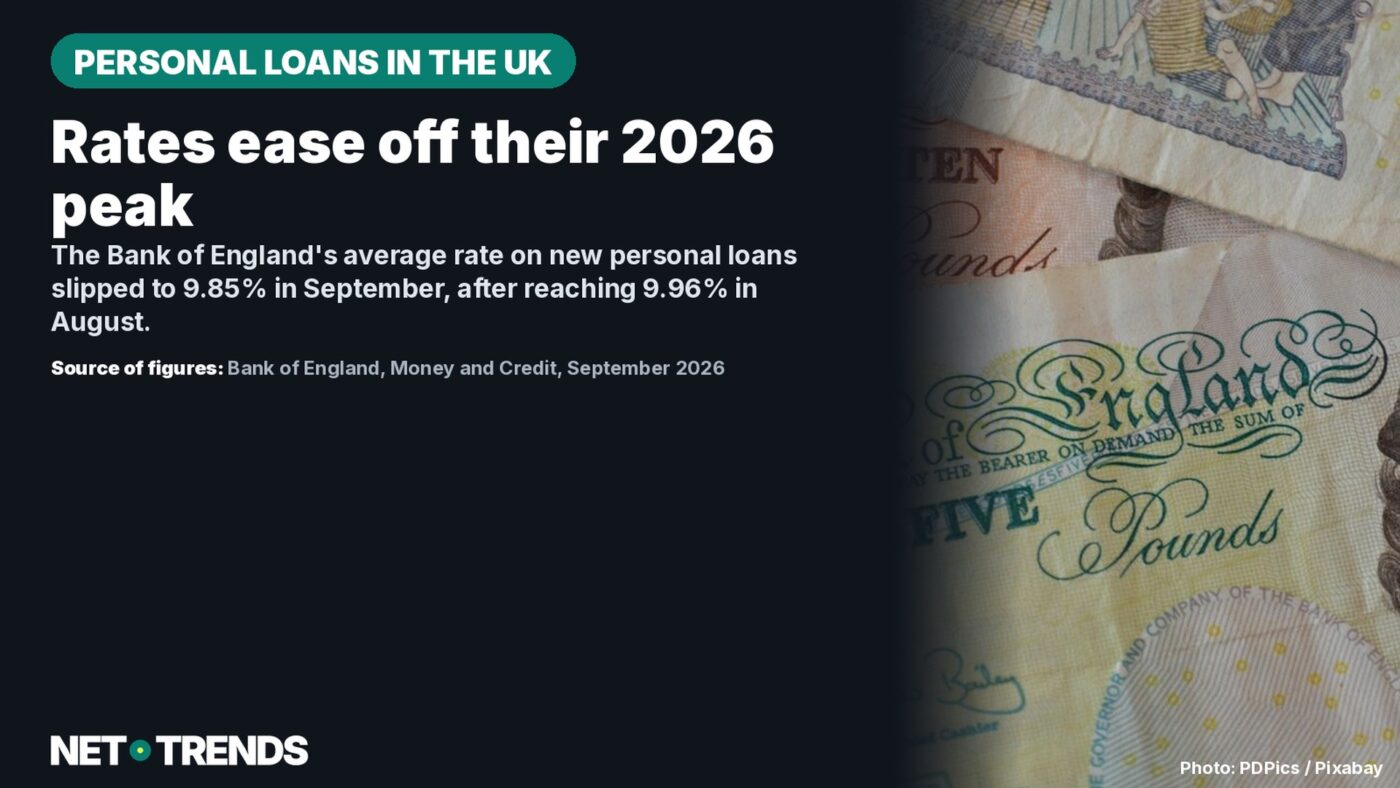
The Bank of England’s effective rate on new personal loans peaked at 9.96% in August 2026, its highest point this year, before easing slightly to 9.85% in September.
Key points
- The Bank of England’s Money and Credit statistics put the effective interest rate on new personal loans to individuals at 9.85% in September 2026, down from a 2026 high of 9.96% in August but still well above the 9.03% recorded in January.
- Net consumer credit borrowing by individuals was £1.9 billion in September 2026, with annual growth in all consumer credit at 9.8%.
- The rate the Bank publishes is a market average: under the Financial Conduct Authority’s representative APR rules, lenders only have to offer their advertised rate to 51% of successful applicants, so individual quotes can differ considerably from the headline figure.
Personal loan rates in the UK eased slightly in September after reaching their highest level of 2026 in August. The Bank of England’s effective rate on new personal loans to individuals fell to 9.85% in September, from 9.96% the month before.
The figures come from the Bank of England’s monthly Money and Credit statistical release, which tracks lending and deposits by UK households and businesses. The effective rate is a weighted average across new personal loans agreed in the month, so it does not show what any individual borrower will actually be offered.
This article sets out how the rate has moved through 2026, what the Bank’s borrowing figures show, why the rate advertised by a lender is not necessarily the rate a borrower receives, and what a 9.85% rate means in practice on a typical £10,000 loan.
How the rate has moved in 2026
The Bank of England publishes the effective rate on new personal loans to individuals as part of its monthly Money and Credit release, drawing on data reported by UK banks and building societies. The rate rose through most of 2026 before easing back slightly in September.
| Month | Effective rate | Change on previous month |
|---|---|---|
| January 2026 | 9.03% | +0.25 |
| March 2026 | 9.09% | +0.03 |
| May 2026 | 9.66% | +0.13 |
| July 2026 | 9.86% | +0.33 |
| August 2026 | 9.96% | +0.10 |
| September 2026 | 9.85% | −0.11 |
Effective interest rate on new personal loans to individuals, United Kingdom. Source: Bank of England, Money and Credit statistical releases, January to September 2026.
The Bank’s release for September also shows net consumer credit borrowing by individuals of £1.9 billion, down from £2.7 billion in August and slightly below the preceding six-month average of £2.1 billion. Within that total, credit card borrowing fell to £0.7 billion and other consumer credit, including car dealership finance and personal loans, to £1.2 billion. The annual growth rate for all consumer credit edged up to 9.8%, from 9.7% in August.
The Bank’s release does not explain why the rate rose through the summer or eased in September; it reports the figures without a stated cause. UK households continued to take out new borrowing throughout the period despite the higher cost.
Why the advertised rate is not always the rate you get
The Bank’s 9.85% figure is a market-wide average across all new personal loans agreed in September, not a quote for any particular borrower. What an individual lender actually offers depends heavily on the applicant’s credit history, income and the loan amount and term requested.
Under the Financial Conduct Authority’s consumer credit advertising rules, a lender can only quote a “representative APR” in its marketing if that rate, or a better one, is actually given to at least 51% of customers who go on to take out the loan. In practice this means up to 49% of successful applicants can be offered a higher rate than the one advertised. The FCA opened a consultation, CP26/15, in April 2026 asking, among other things, whether this 51% threshold and the way the representative APR is disclosed still serve borrowers well; the consultation closed in June 2026.
For a borrower, that means the headline rate seen in an advert or comparison table is a useful starting point, but only a formal quote, based on a full application, shows the rate that will actually apply to them.
What 9.85% means on a £10,000 loan
Model calculation: £10,000 loan, 48-month term
- At the September 2026 average rate (9.85% effective): monthly payment around £252.91, total repayment around £12,139.49, total interest around £2,139.49.
- At the August 2026 peak (9.96% effective): monthly payment around £253.43, total repayment around £12,164.82, total interest around £2,164.82.
Method: standard annuity formula with monthly compounding on the stated effective annual rate, £10,000 net loan amount, 48 equal monthly instalments. Model calculation by the Net Trends editorial team, not a forecast and not an offer from any lender.
The gap between August and September is modest in cash terms, around £25 in total interest on this example, because the month-on-month change in the Bank’s average was itself small. The far larger unknown for any individual borrower is where their own personal quote will fall within the wide range the FCA’s representative APR rules allow.
What to check before taking out a loan
With the market average still close to its 2026 high, a careful comparison before signing matters more than usual.
Checklist for comparing personal loans
- Get a personalised, soft-search quote from more than one lender before applying formally, so your credit file is not marked by multiple hard searches.
- Treat an advertised “representative APR” as an example, not a guarantee; under FCA rules, up to 49% of successful applicants can be offered a higher rate.
- Check whether early repayment charges apply if you plan to pay the loan off ahead of schedule.
- Assess any optional payment protection insurance separately rather than accepting it as part of the loan by default.
Borrowers who need a loan in the coming months cannot change the market rate, but a careful comparison of personalised quotes can still make a measurable difference to the total cost.
Frequently asked questions
What is the current average interest rate on a personal loan in the UK?
According to the Bank of England’s Money and Credit release, the effective interest rate on new personal loans to individuals was 9.85% in September 2026, down from 9.96% in August, the highest point so far in 2026.
Why did the rate rise through the summer of 2026?
The Bank of England’s statistical release does not give a reason for the increase; it reports the figures without an explanation. The rate rose from 9.03% in January to 9.96% in August before easing slightly in September.
Why might my own loan quote differ from the published average?
The Bank’s figure is a market-wide average. Under FCA rules, a lender’s advertised “representative APR” only has to be given to at least 51% of successful applicants, so up to 49% can be offered a higher rate depending on their credit history and circumstances.
Is it still worth comparing loans while rates are elevated?
Yes. The gap between the best and the advertised rate for an individual borrower is separate from the overall market level, so comparing personalised quotes can still reduce the cost even while the market average stays high.
Sources and status
Bank of England, Money and Credit – September 2026, and earlier monthly releases for January, March, May, July and August 2026. Financial Conduct Authority, CP26/15, Reviewing the financial promotions rules for consumer credit, published 29 April 2026, consultation closed 17 June 2026. Model calculation: Net Trends, as of 10 November 2026.
Transparency note: AI-assisted tools were used in researching, structuring and writing this article. The sources used are listed in the article. Publication takes place only after manual editorial approval. Länderfassung auf Basis eines Artikels von Net Trends, für Großbritannien recherchiert. Symbolbild: KI-generierte Darstellung, übersetzt und neu aufgelegt für diese Ausgabe.
Do you shop around for a personal loan, or tend to take the first offer from your own bank? Let us know in the comments.
Share this article