Ofgem raised the UK energy price cap by 4% from 1 October 2026, taking the typical direct debit bill to £1,723 a year – driven mainly by wholesale gas prices, while a government VAT cut kept electricity bills flat.
Key points
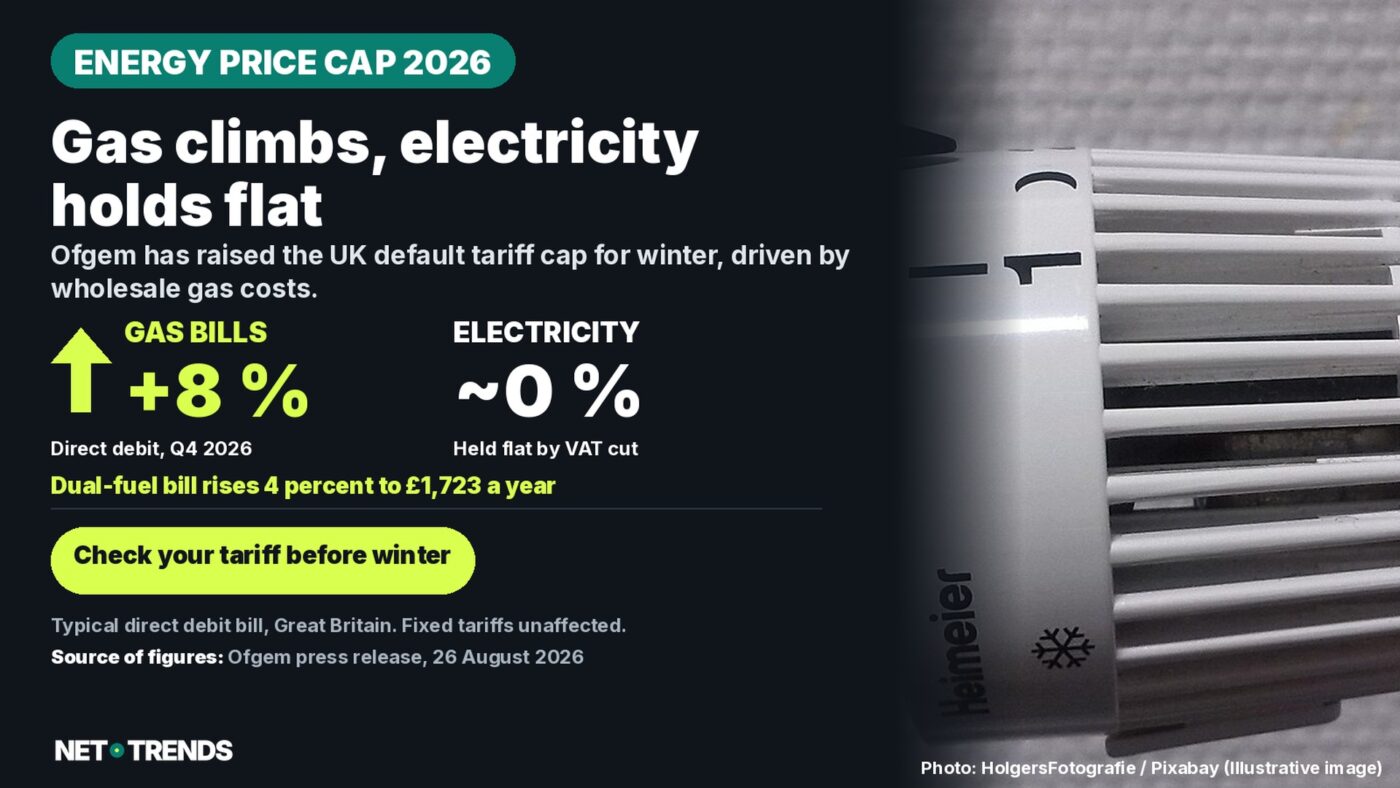
- Ofgem raised the energy price cap for 1 October to 31 December 2026 by 4%, taking the typical direct debit dual-fuel bill from £1,663 to £1,723 a year.
- Gas bills rose by around 8%, while electricity bills stayed broadly flat because the government scrapped VAT on domestic electricity.
- Around 11 million UK households already on a fixed tariff are not affected by the rise, according to Ofgem.
- Fixed deals priced £100 or more below the new cap are available, and prepayment customers typically pay about £45 a year less than direct debit customers.
Ofgem raised the energy price cap for 22 million households in Great Britain by 4% from 1 October 2026, taking the typical dual-fuel bill to £1,723 a year – up £60. The regulator blames the rise mainly on higher wholesale gas prices tied to the conflict in the Middle East.
The increase applies to the default tariff cap, which covers households paying by direct debit, standard credit or prepayment meter in England, Scotland and Wales and have not switched to a fixed deal. It does not apply to the roughly 11 million households already on a fixed-rate tariff, which Ofgem says remain unaffected by the change.
For readers outside Great Britain the pattern will look familiar: once a quarter, major regulators and energy suppliers across Europe revise what millions of households pay for gas and electricity. In Great Britain it is Ofgem, the Office of Gas and Electricity Markets, that sets the level every three months, based on wholesale costs, network charges and government policy costs – and announced the autumn figures on 26 August 2026.
The new cap in detail
The typical dual-fuel bill for a Direct Debit customer rose from £1,663 to £1,723 a year from 1 October 2026, an increase of 4%, or roughly £5 a month. Gas bills rose by about 8%, while electricity bills stayed broadly flat, since a government VAT cut on domestic electricity offset higher wholesale electricity costs. Ofgem says the increase would have been about £45 higher without that VAT change.
For a typical Direct Debit customer, the current electricity unit rate is 26.32 pence per kilowatt-hour with a daily standing charge of 54.83 pence; gas costs 7.97 pence per kilowatt-hour with a standing charge of 29.68 pence a day. These figures, which apply from 1 October 2026, are based on a typical household using 2,500 kWh of electricity and 9,500 kWh of gas a year – consumption estimates Ofgem lowered this year because households are using roughly 7% less electricity and 17% less gas than at its last review.
Why the cap is rising
According to Ofgem, the main driver is higher wholesale gas prices, which it links to the ongoing conflict in the Middle East; wholesale prices rose by around 11% over the three months before the announcement. Adjusted for inflation, the new cap is about 7% higher than the equivalent period in 2025, though it remains 52% – or £1,859 – below the peak reached during the 2022 energy crisis.
“High international gas prices are continuing to drive energy costs in the UK.”
Neil Kenward, Director General for Markets, Ofgem
Kenward also welcomed the UK government’s decision to remove VAT from domestic electricity bills, which Ofgem credits with keeping electricity prices broadly stable even as wholesale costs for electricity increased alongside gas.
Who is – and isn’t – affected
The price cap sets a maximum unit rate and standing charge for the default tariff – the one households are automatically placed on if they have never switched, or if a previous fixed deal has ended. It does not set a maximum bill: what a household actually pays still depends on how much energy it uses.
Unlike a fixed-term contract, a default tariff under the cap has no minimum contract length, so a household can switch supplier whenever it finds a better deal. Around 35% of UK households, some 11 million, are on a fixed tariff instead and are not affected by this change; many such deals are currently cheaper than the cap, Ofgem says, with some priced £100 or more below it.
Checklist: what households can check now
- Check your latest bill: are you on your supplier’s standard variable (default) tariff, or already on a fixed deal?
- If you’re on the default tariff, compare fixed deals – some are currently priced £100 or more below the new cap.
- If you have a smart meter, ask your supplier about time-of-use tariffs that offer cheaper off-peak electricity.
- Compare payment methods: prepayment customers typically pay around £45 a year less than Direct Debit customers.
- If you’re struggling to pay, contact your supplier early to arrange a repayment plan or ask about support schemes.
Households already tied into a fixed deal with a price guarantee are not affected by this change, since it applies specifically to the default tariff. Suppliers remain free to set their own fixed-term prices above or below the cap, which is why comparing deals – rather than assuming the cap itself is competitive – remains the main lever available to consumers.
What households can do
Ofgem’s own advice to consumers centres on comparing tariffs rather than assuming the cap is the cheapest option. Because the cap is a ceiling on unit rates, not a fixed price, suppliers remain free to offer fixed deals below it – and currently many do. Households with a smart meter have an additional option: some suppliers offer cheaper rates for electricity used outside peak hours.
Anyone falling behind on payments is urged to contact their supplier directly rather than wait, since suppliers are required to offer affordable repayment plans and can point customers toward hardship funds and other support.
Model calculation: what it means per month
Typical Direct Debit dual-fuel bill (Great Britain, 1 October-31 December 2026)
- Before 1 October 2026: £1,663/year, about £138.58/month.
- From 1 October 2026: £1,723/year, about £143.58/month – plus roughly £5/month, or £60/year.
- Basis: medium use of 2,500 kWh electricity and 9,500 kWh gas a year.
Calculation: Ofgem’s published annual figures divided by twelve for an approximate monthly cost. These are typical-use figures for a medium household; actual bills depend on individual consumption and vary by region and payment method.
The model figures show gas driving most of the increase: an 8% rise in gas costs against a roughly flat electricity bill. That matches Ofgem’s own explanation, which points to wholesale gas markets – not network or policy costs – as the main factor behind the autumn rise.
Frequently asked questions
When did the new price cap take effect, and how long does it last?
The new cap took effect on 1 October 2026 and applies until 31 December 2026, when Ofgem sets the next quarterly level.
How much more will a typical household pay?
A typical Direct Debit dual-fuel household now pays £1,723 a year, up £60 (4%) from £1,663 – about £5 a month more.
Does the price cap apply to everyone?
No. It applies only to default (standard variable) tariffs. Around 11 million UK households on fixed-rate deals are unaffected by the change.
Why did gas prices rise more than electricity?
Ofgem points to higher wholesale gas prices linked to the conflict in the Middle East. Electricity bills stayed broadly flat because the government removed VAT from domestic electricity, offsetting higher wholesale electricity costs.
Sources and status
- Ofgem, press release “Energy price cap will rise 4% from October 2026”, 26 August 2026: ofgem.gov.uk/press-release/energy-price-cap-will-rise-4-october-2026
- Ofgem, “Summary of changes to energy price cap, 1 October to 31 December 2026” (PDF), 26 August 2026: ofgem.gov.uk/sites/default/files/2026-08/Summary-of-changes-to-energy-price-cap-1-October-to-31-December-2026.pdf
- Ofgem, “Energy price cap unit rates and standing charges”: ofgem.gov.uk/your-energy-supply/your-energy-bill/energy-price-cap-unit-rates-and-standing-charges
Research and data as of: 9 November 2026.
Transparency note: AI-assisted tools were used in researching, structuring and writing this article. The sources used are listed in the article. Publication takes place only after manual editorial approval. Country edition based on an article from Net Trends, researched for the United Kingdom.
Share this article