A new EU processing fee on parcels imported into the European Union also affects US sellers shipping to EU customers. For shoppers in the United States, the bigger story is closer to home: Washington suspended its own $800 de minimis exemption in 2025 and tightened postal entry rules again in 2026.
Key points
- Since November 1, 2026, the EU charges a 2-euro processing fee per customs-declared item on cross-border online orders shipped into the EU, separate from a temporary 3-euro duty on shipments worth up to 150 euros; this mainly concerns US merchants selling into the EU.
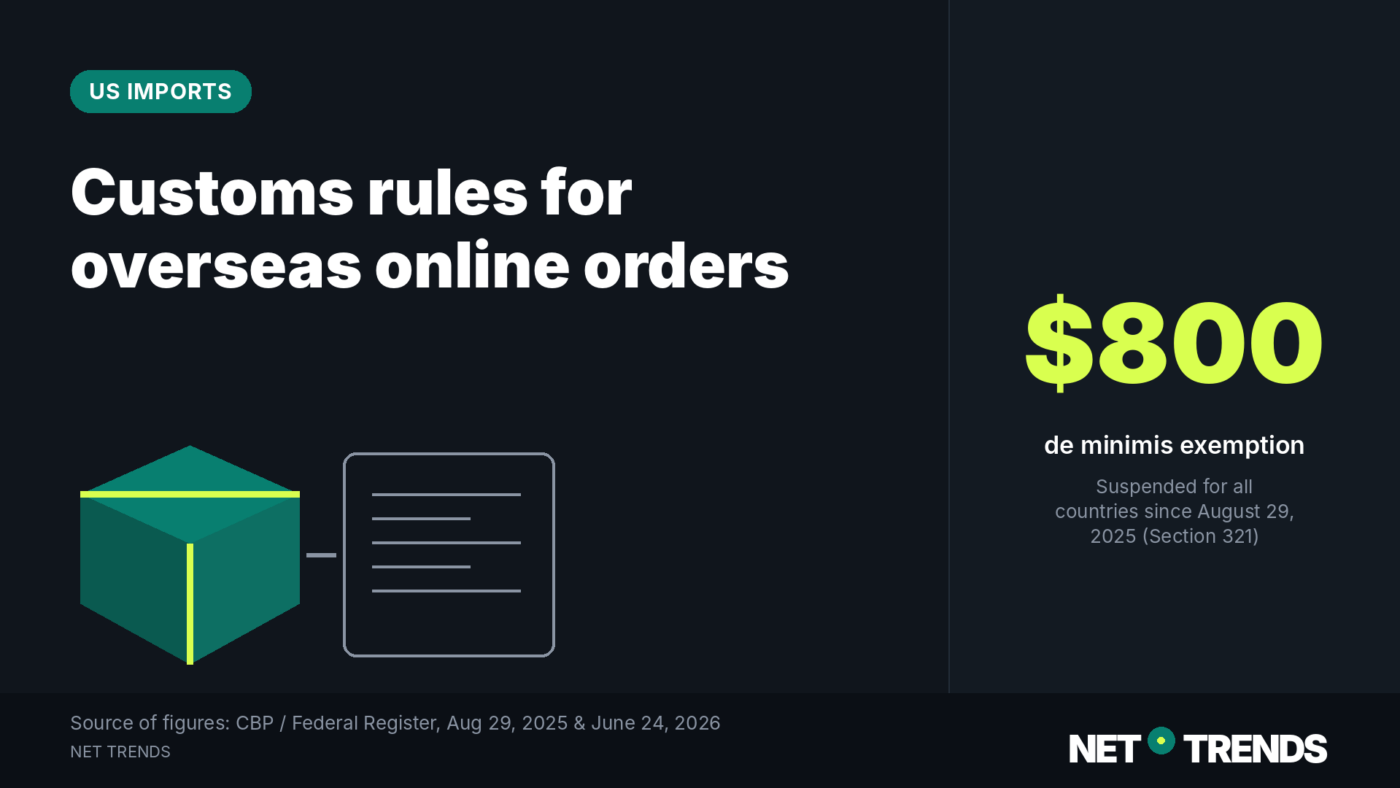
- For purchases coming into the United States, the relevant rule is American: the Section 321 “de minimis” exemption, which let shipments worth $800 or less enter duty-free, has been suspended for all countries since August 29, 2025.
- Since a June 24, 2026 rule, US Customs and Border Protection (CBP) also requires a new postal entry process for international mail parcels, with most provisions in force from July 24, 2026.
US consumers buying from overseas sellers, on sites such as Shein, Temu or AliExpress, no longer get automatic duty-free treatment on small packages. Separately, US sellers shipping to the EU now face a new 2-euro-per-item EU processing fee on top of existing EU customs rules.
The EU change took effect on November 1, 2026 under the Delegated Regulation (EU) 2026/2152, based on Regulation (EU) 2026/2108, Article 20. It applies to declared items in distance sales imported into the EU regardless of value, according to the European Commission’s customs guidance of October 5, 2026. It does not apply to shipments arriving in the United States; it matters to US businesses only when they ship goods to customers in the EU.
The EU fee: why US sellers should care
The EU’s new processing fee is 2 euros per declared item in the customs declaration for an eligible distance sale, not a percentage of value. Per the Commission’s guidance, it applies “regardless of whether the value of the goods is below or above 150 euros.” A separate, temporary 3-euro duty under Regulation (EU) 2026/382 applies only to items in shipments with a total value up to 150 euros, in force since July 1, 2026 and due to expire July 1, 2028.
Neither EU charge is paid directly by a US shopper. They apply to the import declaration when goods enter the EU, so the practical effect for American businesses is on sellers and marketplaces that ship to EU customers: compliance costs, customs-declaration handling, and potentially higher landed prices for EU buyers. US companies selling internationally should budget for this separately from their own US import obligations.
The end of the $800 de minimis exemption
Under Section 321 of the Tariff Act, shipments valued at $800 or less could historically enter the United States without duties or a formal CBP entry. That changed on August 29, 2025, when a Federal Register notice suspended the de minimis exemption for all countries, relying on Executive Order 14257 as its basis. The notice states the exemption no longer applies to covered shipments “regardless of value, country of origin, mode of transportation, or method of entry.”
For shipments outside the international mail network, importers must now file formal or informal entries through CBP’s Automated Commercial Environment (ACE) and pay all applicable duties, taxes and fees — there is no $800 free pass left. The change applies to commercial shipments from any country, not just the countries that had earlier country-specific de minimis actions (Canada, Mexico and China/Hong Kong).
“The duty-free de minimis exemption no longer applies to covered shipments regardless of value, country of origin, mode of transportation, or method of entry.”
US Customs and Border Protection, Federal Register notice, September 2, 2025
New postal entry rules since mid-2026
International mail parcels initially kept a simplified process: carriers could choose between an ad valorem duty (based on the exporting country’s effective IEEPA tariff rate) or a flat per-package fee tied to that rate — $80, $160 or $200 depending on the rate tier. The flat-fee option was only available for six months and, per the original notice, was due to stop applying to entries from February 28, 2026 onward, leaving the ad valorem method as the ongoing approach for postal shipments.
CBP went further on June 24, 2026, publishing an interim final rule that indefinitely suspends de minimis treatment for mail shipments worth $800 or less and creates a new postal informal entry process for mail parcels valued at $2,500 or less. Most provisions took effect July 24, 2026, with certain data and compliance requirements phased in by October 22, 2026. Only the owner, purchaser, or a licensed customs broker they designate may file these postal entries, and the filer must hold a customs bond.
| Rule | What changed | Effective date |
|---|---|---|
| Global de minimis suspension | $800 duty-free exemption suspended for all countries and entry methods | August 29, 2025 |
| Postal-specific rule | New postal informal entry process; de minimis suspended for mail shipments | July 24, 2026 (most provisions); October 22, 2026 (further requirements) |
What it means for US shoppers
A package ordered from an overseas marketplace can no longer rely on value alone to avoid duties. Depending on how the carrier or seller handles the shipment, a US buyer may now see duties calculated on the item’s declared value at the country-of-origin’s applicable tariff rate, built into the price at checkout or billed separately on delivery. Figures vary by seller, carrier and country of origin, so Net Trends cannot state one flat amount every US shopper pays — check the seller’s own customs and duties disclosure before ordering.
It is worth checking at checkout whether duties are already included in the displayed price (“delivered duty paid”) or will be collected separately by the carrier before delivery (“delivery duty unpaid”), since this changes who deals with customs paperwork and when a second charge might appear.
Frequently asked questions
Is the $800 de minimis exemption completely gone?
For commercial shipments, yes: CBP’s Federal Register notice of September 2, 2025 suspended it for all countries, regardless of value, origin, mode of transport or entry method. Only certain qualifying donations and informational materials remain eligible through a separate manifest process.
Does the EU’s new 2-euro fee apply to US shoppers?
No. The EU processing fee under Delegated Regulation (EU) 2026/2152 applies to goods entering the EU, not the United States. It is relevant to US businesses selling to EU customers, not to US shoppers ordering from abroad into the US.
What replaced the flat per-package postal duty option?
CBP’s original August 2025 notice allowed carriers a flat fee of $80, $160 or $200 per package for six months, through February 28, 2026, after which the ad valorem method (duty based on item value and country-of-origin tariff rate) became the standing approach. The June 24, 2026 rule then built a new postal informal entry process around this.
Who has to file a customs entry for a mailed package now?
Under the postal informal entry process created by the June 24, 2026 rule, only the owner or purchaser of the goods, or a licensed customs broker they designate, can file. The filer needs a basic importation and entry bond and must report shipment details to CBP.
Sources and status
Research as of November 9, 2026. Sources used:
- Delegated Regulation (EU) 2026/2152 (in German) — EU processing fee, applicable from November 1, 2026.
- Regulation (EU) 2026/2108 (in German), Article 20 — legal basis for the EU processing fee.
- Regulation (EU) 2026/382 (in German) — temporary 3-euro duty for shipments up to 150 euros.
- European Commission customs guidance, October 5, 2026 — scope and application of the EU processing fee.
- US Customs and Border Protection, Federal Register notice, September 2, 2025 — global suspension of the Section 321 de minimis exemption.
- US Customs and Border Protection, Federal Register interim final rule, June 24, 2026 — new postal informal entry process for mail shipments.
Transparency note: AI-assisted tools were used in researching, structuring and writing this article. The sources used are listed in the article. Publication takes place only after manual editorial approval. Country edition based on an article from Net Trends, researched for the United States. Lead image: own schematic illustration (no photo).
Share this article