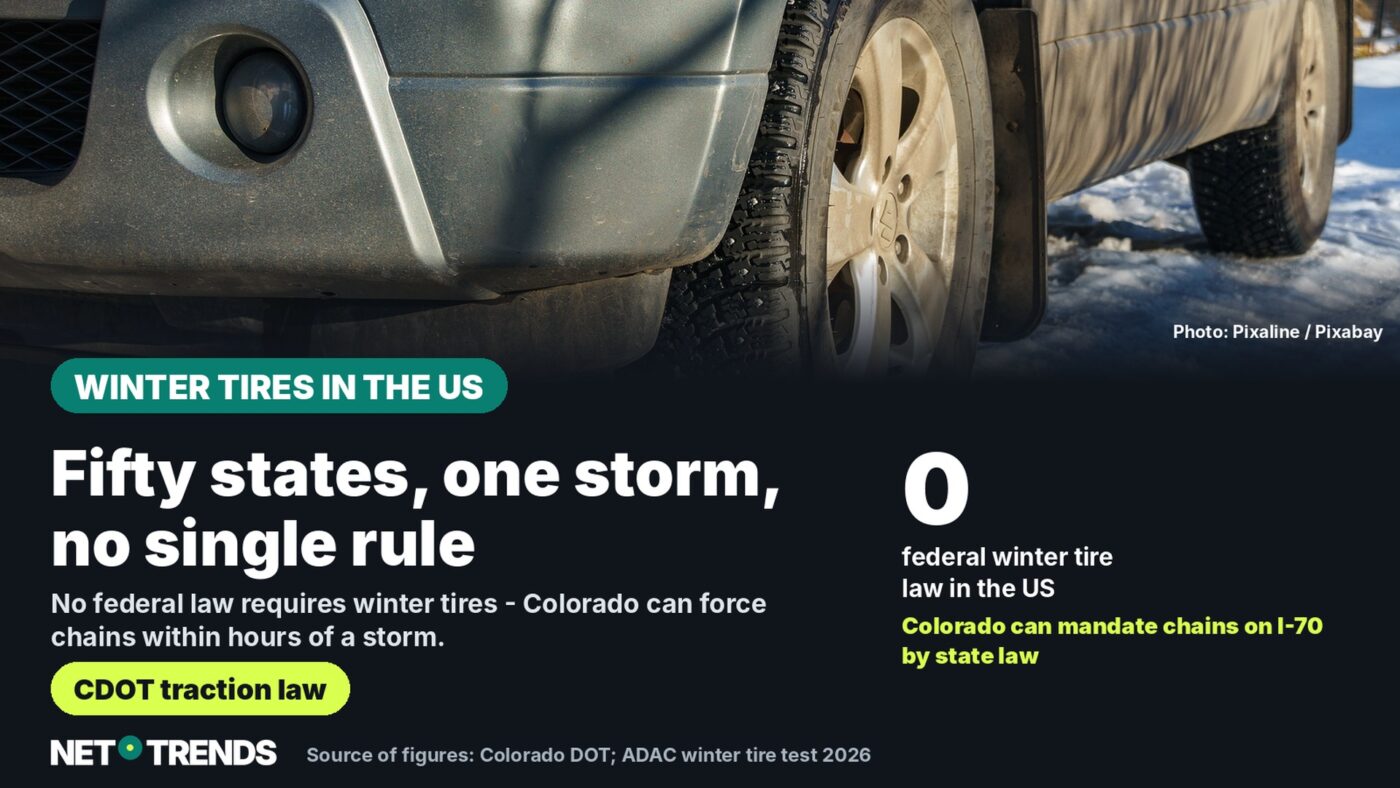
No single US law sets winter tire rules; Colorado’s traction law and similar state rules fill the gap that federal law leaves open.
Key points
- There is no federal law in the US requiring winter tires; traction and chain rules are set state by state.
- Colorado’s traction law (CDOT) can require all vehicles on I-70 and other mountain routes to carry tires with a mud-and-snow or 3-peak-mountain-snowflake marking, or chains, once conditions turn severe.
- A 2026 ADAC test in Europe, using the same EU-style wet-grip rating now mirrored on many US-sold tires, found a nearly 12-meter braking-distance gap between tires of the identical size.
A strong wet-grip rating on a tire’s label is a useful starting point, but it is not a complete buying decision for winter. What matters is the exact size approved for your vehicle, a mountain-snowflake (3PMSF) marking, and an independent test on dry, wet and snowy pavement.
What the law says
T
h
What the EU-style label shows
The EU-style tyre label, now echoed on many tyres sold in the US, rates rolling resistance and wet grip from A to E, plus a noise value in decibels. Tyres built for severe snow or ice carry extra symbols, and in the US the mountain-snowflake (3PMSF) marking plays the equivalent role to the EU snow symbol, distinguishing a genuine winter or severe-snow tire from an all-season tire that merely carries an M+S mark. The label alone does not rate dry handling, steering precision, or full winter balance.
Why tire size decides
In the 2026 ADAC winter tire test, Germany’s motoring organisation examined 32 products in two sizes, 185/65 R15 and 225/50 R17. In the larger size, the best and weakest tires differed by nearly 12 metres (about 39 feet) in wet braking from 80 km/h, roughly 50 mph (detailed results). One tire scored well on snow yet failed overall because of weak dry and wet performance – proof that a single strong score is not enough, and that results from one size cannot be assumed for another.
Buying checklist
- Confirm the exact tire size, load and speed index from the vehicle’s door-jamb sticker or owner’s manual.
- Look for the mountain-snowflake (3PMSF) symbol, not just an M+S mark, if winter grip is the priority.
- Check the EU-style label data where available for the specific tire model, especially wet grip and rolling resistance.
- Read an independent test of exactly this size, covering dry, wet and snowy surfaces together.
- Check your state’s or route’s chain/traction law before a mountain trip, and carry chains if the tire alone may not qualify.
Frequently asked questions
Is there a federal US law requiring winter tires?
No. There is no federal mandate. States set their own rules, and some, like Colorado’s traction law, only apply on specific routes once weather turns severe.
Does the mountain-snowflake symbol guarantee the best tire?
No. It confirms the tire passed a snow-traction test, but braking on wet or dry pavement can still vary widely between tires carrying the same symbol.
Can I rely on a test done in a different tire size?
Not reliably. Construction and tuning can differ by size and version, so look for test results in your exact size before buying.
Which tire size do you drive, and do you weight wet grip, mileage or snow performance most? Share your experience in the comments.
Sources and status
- Colorado Department of Transportation: Passenger Vehicle Traction & Chain Laws.
- Colorado State Patrol: chain law information.
- European Commission: tyre label and EPREL.
- ADAC winter tire test 2026 (in German).
Research and data as of: November 6, 2026.
Transparency note: AI-assisted tools were used in researching, structuring and writing this article. The sources used are listed in the article. Publication takes place only after manual editorial approval. Länderfassung auf Basis eines Artikels von Net Trends, für die USA recherchiert. Bildhinweis des Originals: KI-generiertes Symbolbild.
Share this article