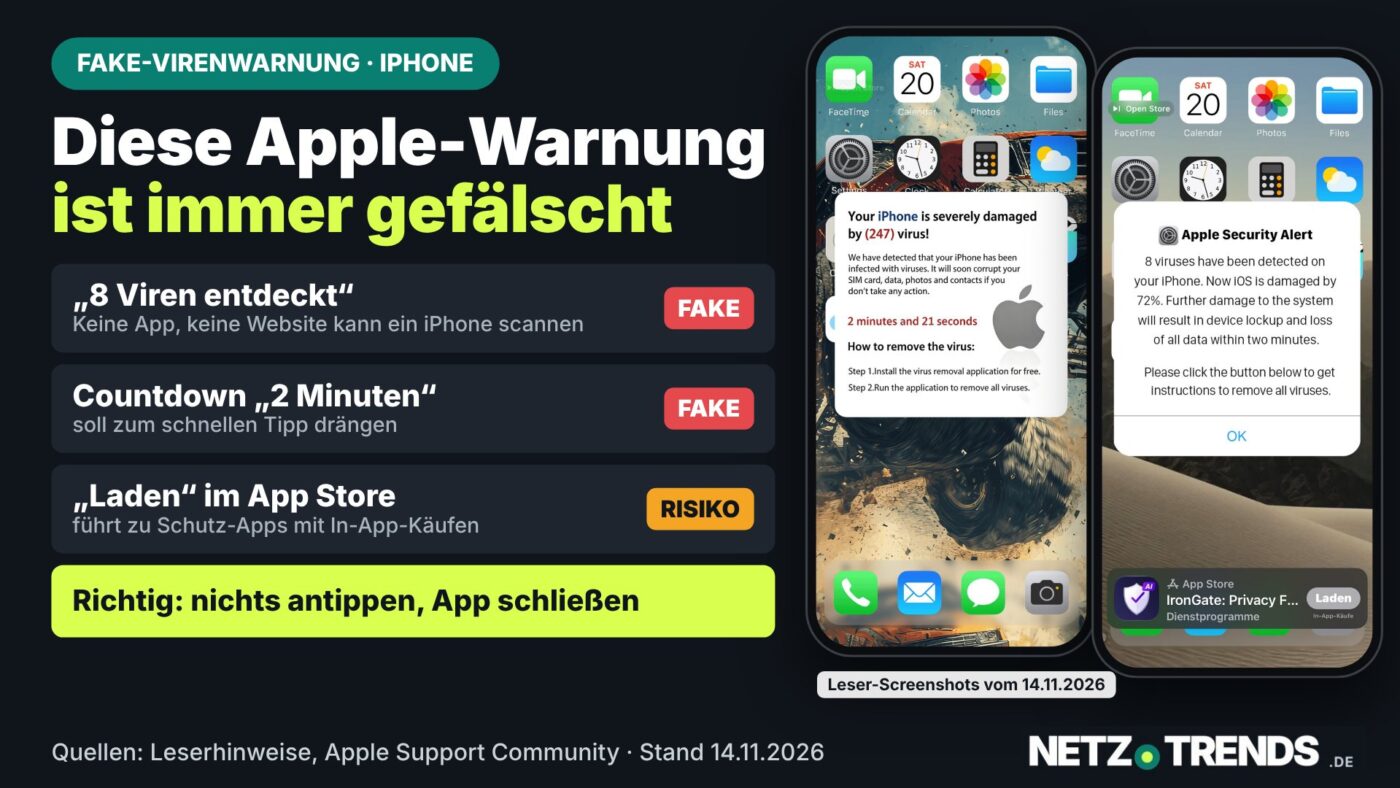
Pop-ups claiming your iPhone has viruses are always fake – the FTC has repeatedly fined companies for exactly this scam.
What Net Trends readers saw in Grindr
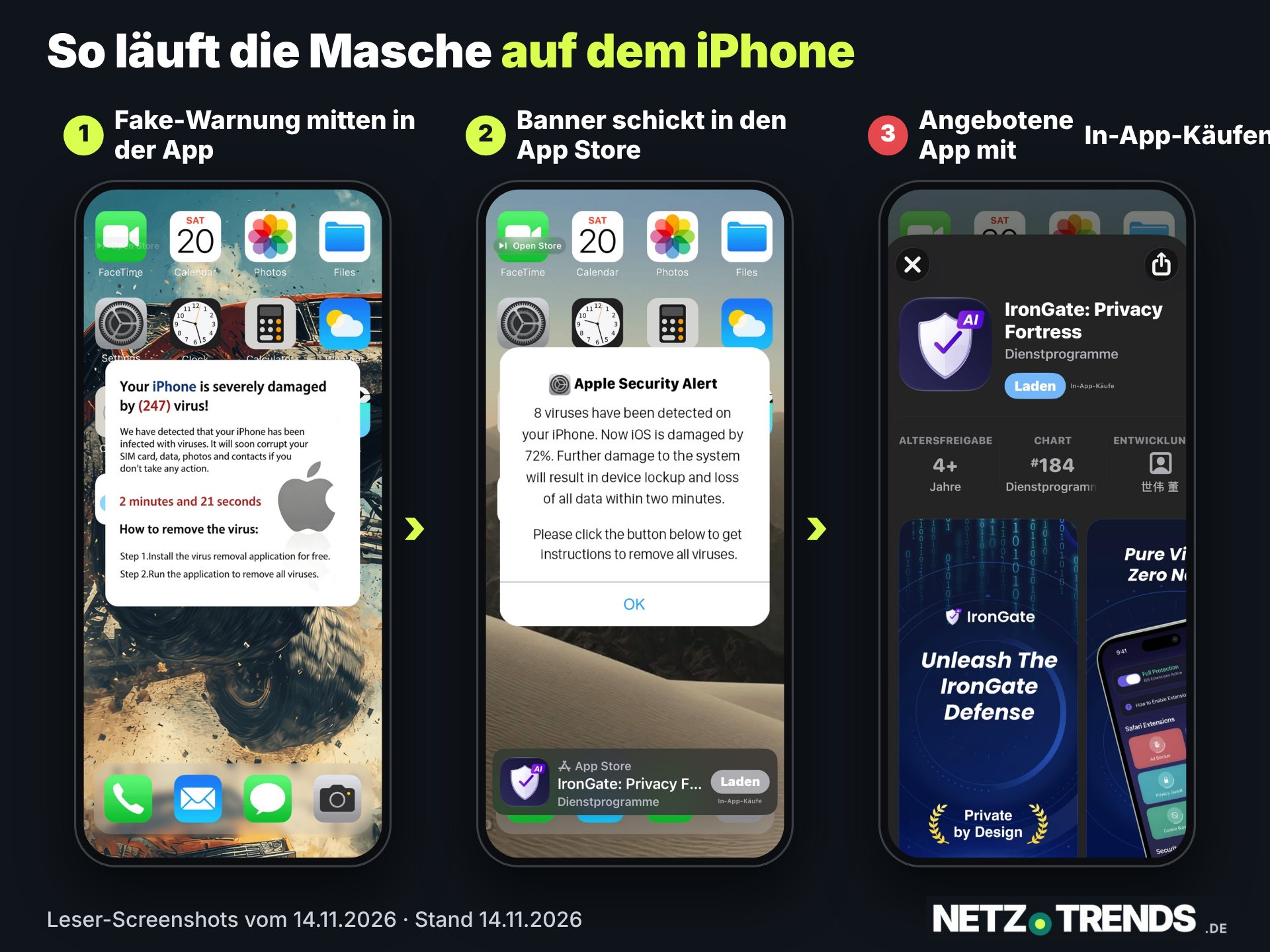
On 14 November 2026, readers of our German edition sent screenshots of fake Apple security alerts appearing inside Grindr on iPhone. One showed a countdown and claimed that eight viruses had been found. The screenshots show a prompt leading to an App Store listing for an app with in-app purchases. The alert itself provides no evidence of an infection.
Grindr’s free tier shows ads from partners. A misleading ad can make its way into an ordinary ad slot, a practice called malvertising. The screenshots do not identify which ad network served it. Close the affected app without tapping the alert. If you entered your Apple Account password, change it through Apple directly. If you paid, contact your card issuer or bank.
Key points
- A pop-up saying “your iPhone has 8 viruses” is always fake. No website can scan an iPhone for viruses.
- The Federal Trade Commission (FTC) has charged and fined multiple tech-support companies for using fake virus pop-ups to sell unnecessary repairs.
- Security firm Netskope tracked over 250 Google Ads campaigns spreading fake alerts between 31 August and 14 September 2026, affecting more than 619 organizations worldwide.
- Anyone who tapped a pop-up and lost money can file a complaint with the FTC at reportfraud.ftc.gov.
A pop-up claims your iPhone is infected with eight viruses and will be damaged within two minutes. The message is always fake – no website can technically scan an Apple device.
The pattern is always the same: a bright warning with a fake Apple logo, a countdown, and a button promising to “remove all viruses.” Anyone who sees it is in no danger from the message itself – but the trick behind it, known as malvertising, reaches millions of users worldwide across very different apps and websites.
Where the pop-up really comes from
According to security researchers, this is malvertising: a website or an in-app ad banner redirects – usually without any click – to a fraudulent page mimicking an official Apple warning. The cybersecurity firm Netskope documented more than 250 Google Ads campaigns spreading such fake alerts between August 31 and September 14, 2026, affecting over 619 organizations.
The FTC has fined companies for exactly this scam
The Federal Trade Commission has a long record of enforcement actions against tech-support scams built on fake virus pop-ups. In one case, the FTC and the State of Ohio charged several companies – including Repair All PC LLC, Pro PC Repair LLC, I Fix PC LLC, WebTech World LLC and Online Assist LLC – with using pop-ups that impersonated well-known tech brands, falsely claiming a device was infected and directing people to call a toll-free number, where telemarketers posing as Microsoft or Apple staff sold unnecessary repairs for hundreds of dollars. Settlements in that case imposed judgments of $12.4 million each, largely suspended on payment of lower amounts given the defendants’ limited ability to pay.
How to get rid of the pop-up
On an iPhone, swipe up to close the browser in the app switcher, then clear browsing data for that site in Settings and block its notifications. On Android, run a Google Play Protect scan. On a Windows PC, open Task Manager (Ctrl + Alt + Delete) and end the browser process; on a Mac, use Force Quit (Option + Command + Esc).
Reporting a scam
A fake virus pop-up or any resulting financial loss can be reported to the FTC at reportfraud.ftc.gov. Anyone who has lost money should also contact their card issuer or bank immediately.
Frequently asked questions
Can a website really detect viruses on my iPhone?
No. iOS does not allow any website to scan the device. Every such pop-up is fake, no matter what it claims to have found.
Has the FTC actually punished companies for this?
Yes. The FTC has brought multiple cases against tech-support companies that used fake virus pop-ups to sell unnecessary repairs, with settlements running into the millions of dollars.
Where can I report this in the US?
At reportfraud.ftc.gov, the FTC’s official complaint portal.
Sources and status: Netskope Threat Labs research, August-September 2026; Apple Support Community; Federal Trade Commission, enforcement action against Repair All PC LLC and related defendants (ftc.gov). As of: 14 November 2026.
Transparency note: AI-assisted tools were used in researching, structuring and writing this article. The sources used are listed in the article. Publication takes place only after manual editorial approval. Country edition based on an article from Net Trends, researched for the US.
Share this article
Kommentieren Sag uns deine Meinung →