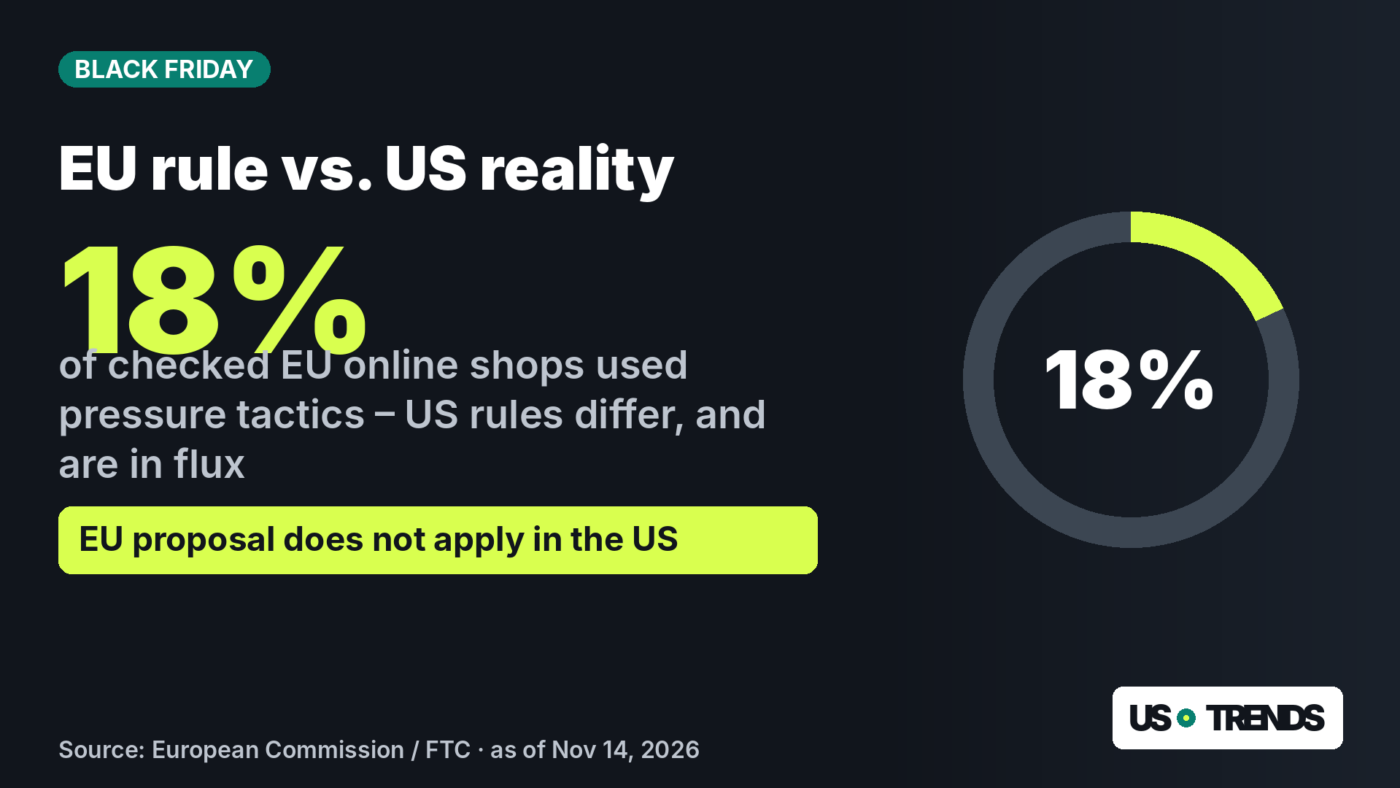
The European Commission wants to curb fake urgency and countdown-timer tricks online, but that EU proposal has no effect in the United States. American shoppers are instead covered by FTC rules on deceptive practices and subscription traps – rules that are themselves in flux.
Key points
- On 11 November 2026 the European Commission proposed a Digital Fairness Act targeting fake scarcity and manipulative design – an EU proposal, not US law.
- It is not yet EU law either; the European Parliament and Council still have to consider it, and it would not apply in the US even once adopted.
- In the US, fake urgency and subscription traps are instead policed under Section 5 of the FTC Act and the ROSCA law on negative-option billing.
- The FTC’s 2024 “Click-to-Cancel” rule was vacated in full by a federal appeals court in July 2025; the FTC reopened rulemaking in 2026, so the rule is not currently in force.
A countdown clock ticks down to a few minutes next to “only 2 left”: the European Commission wants to crack down on exactly this kind of tactic – in the EU. For US shoppers, a different and currently unsettled set of federal rules decides whether that’s legal.
The European Commission adopted its Digital Fairness Act proposal on 11 November 2026 to update EU consumer law for fake scarcity claims, manipulative interfaces, personalised targeting of vulnerable users, influencer ads and auto-renewing subscriptions. As an EU legislative proposal still awaiting review by the European Parliament and the Council, it has no legal effect anywhere outside the EU – including the United States, where a separate, older and currently contested federal framework applies instead.
Contents
What the European Commission wants to change
The EU proposal targets practices that push consumers toward a purchase through a misleading interface, such as a “only 2 left” label that doesn’t reflect real stock. The Commission adopted the text on 11 November 2026 and sent it to the European Parliament and the Council of the EU; no date for new EU obligations has been set, and the proposal would bind EU member states only, not the US.
What actually applies in the US
US shoppers are protected, if at all, by domestic law, not by anything coming out of Brussels. Section 5 of the FTC Act bans unfair or deceptive acts or practices, a standard the Federal Trade Commission (FTC) has applied to fake countdown timers and false scarcity claims in enforcement actions. For subscriptions specifically, the Restore Online Shoppers’ Confidence Act (ROSCA) requires clear disclosure and simple cancellation for negative-option billing. The FTC’s 2024 “click-to-cancel” rule, which would have made every subscription as easy to cancel as to start, was vacated in its entirety by the US Court of Appeals for the Eighth Circuit in July 2025 on procedural grounds; the FTC reopened rulemaking with a new notice in 2026, so as of this writing there is no federal click-to-cancel rule in force, and the agency is instead pursuing fake-urgency and subscription-trap cases case by case under Section 5 and ROSCA.
What shoppers should check for Black Friday
Practical checklist
- Check the product and price: model number, variant, shipping cost and total price, including sales tax at checkout.
- Put time pressure in perspective: a timer is a reason to pause, not proof of a scam. Save the product page and price with a timestamp.
- Check the seller: identity, return address and return policy.
- Read free-trial terms closely: free period length, price afterward, auto-renewal and how to cancel – US click-to-cancel protections are currently in flux.
Frequently asked questions
Does the EU’s Digital Fairness Act apply to US retailers or shoppers?
No. It is an EU legislative proposal, not yet adopted even in the EU, and as an EU consumer-law instrument it would not apply in the United States even once it takes effect.
Is the FTC’s click-to-cancel rule in effect right now?
No. The Eighth Circuit vacated the rule in its entirety in July 2025. The FTC reopened rulemaking in 2026, but as of this writing there is no federal click-to-cancel rule in force; enforcement continues case by case under Section 5 of the FTC Act and ROSCA.
Are fake countdown timers illegal in US online stores?
Not automatically. A demonstrably false scarcity or urgency claim can violate Section 5 of the FTC Act as a deceptive practice. A genuine countdown or real limited stock isn’t illegal on its own.
Sources and last checked
- European Commission: Digital Fairness Act – proposal and legislative status, accessed November 14, 2026.
- European Commission: results of the review of online sales practices (26 March 2026), accessed November 14, 2026.
- FTC: Federal Trade Commission Act, Section 5, accessed November 14, 2026.
- FTC: Restore Online Shoppers’ Confidence Act (ROSCA), accessed November 14, 2026.
Research and data as of: November 14, 2026.
Transparency: this article was researched and drafted with the support of artificial intelligence and is intended for human editorial review. Source checking and final editorial review were carried out against the linked original sources. Country edition based on a Net Trends article, researched for the US.
Share this article
Kommentieren Sag uns deine Meinung →