Fidelity, Schwab, Robinhood and E*TRADE all show $0 for stock trades — the real price differences show up in margin loans, options fees and how each broker handles payment for order flow
Key points
- Stock and ETF trades are commission-free at every major US broker checked for this article — Fidelity, Charles Schwab, Robinhood and E*TRADE all confirm $0 commission on their own 2026 pricing pages.
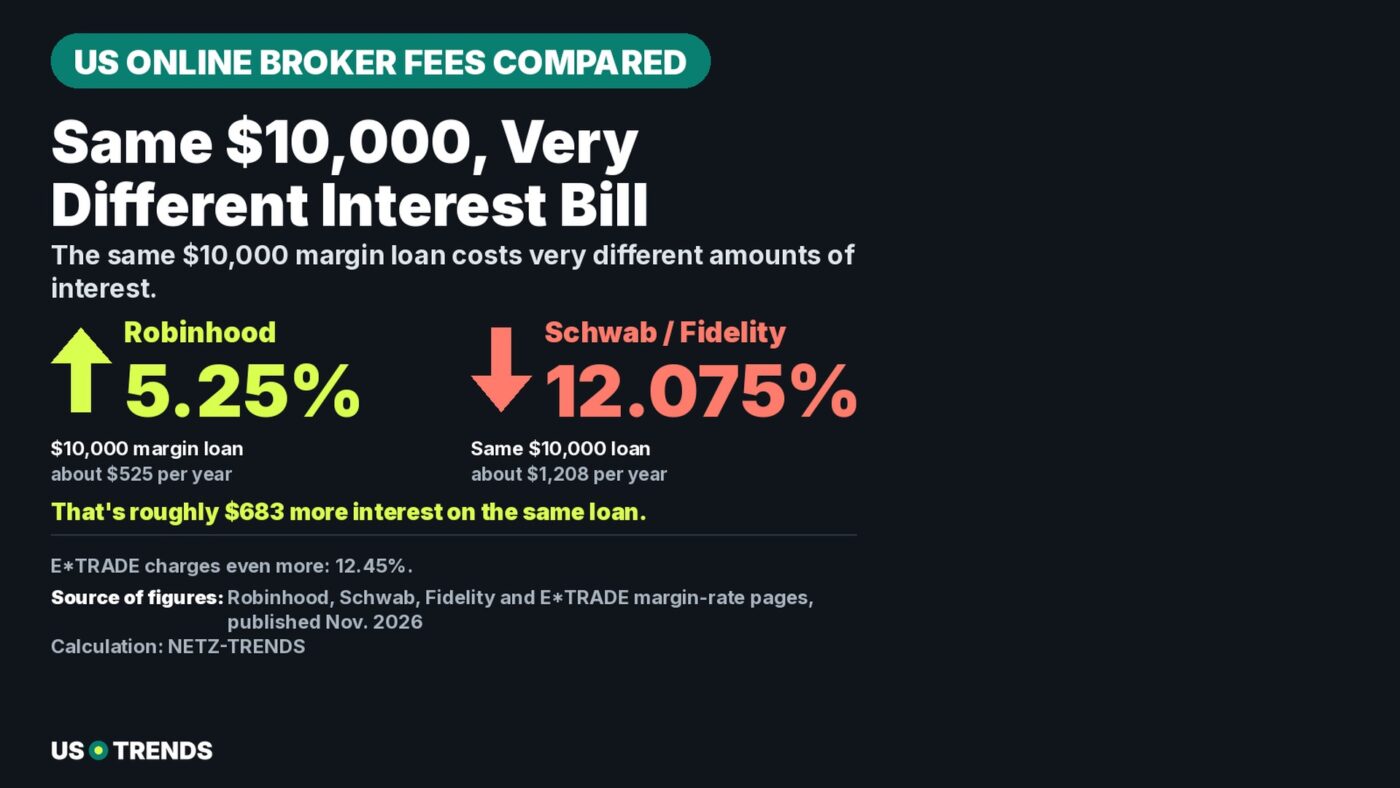
- The real cost gap has moved to margin loans: borrowing $10,000 costs about $525 a year at Robinhood (5.25%), but roughly $1,208 a year at Schwab or Fidelity (12.075%) and about $1,245 at E*TRADE (12.45%) — a gap of more than $700 a year on the same loan.
- Options traders see a similar spread: Robinhood charges $0.04 per contract, while Fidelity, Schwab and E*TRADE charge $0.65 per contract (or $0.50 for frequent traders at E*TRADE).
- Payment for order flow (PFOF) remains legal in the US and is regulated by the Securities and Exchange Commission (SEC) under Rule 606 — a sharp contrast to the European Union, where PFOF has been banned since July 1, 2026.
Online trading in the US looks free at first glance: Fidelity, Schwab, Robinhood and E*TRADE all charge $0 commission on stocks and ETFs. Dig into margin loans and options fees, and the gap between brokers tops $700 a year.
Commission-free stock and ETF trading has been standard among major US brokers since 2019, and it still is in 2026. That makes a simple price comparison of “$0 versus $0” useless for US investors — unlike Germany, where Stiftung Warentest just found more than €800 a year between the cheapest and most expensive of 42 brokerage accounts. No comparable independent cost study of US brokers’ total account fees was found for this article; where no primary source could confirm a number, it is marked “not verifiable” below rather than estimated.
What is verifiable, directly from each broker’s own pricing and margin-rate pages, is that the commission-free headline hides two real cost differences: how much a broker charges to borrow on margin, and how much it charges per options contract. Those gaps run into the hundreds of dollars a year for an ordinary investor — all amounts below exclude sales tax, which does not apply to US brokerage commissions, margin interest or regulatory fees in any state.
The $700 margin-rate gap
With stock and ETF commissions at $0 across the board, the clearest documented cost difference between major US brokers in November 2026 is the interest rate charged on margin loans — money borrowed from the broker against securities already in the account. For a debit balance of $10,000 to $24,999, Robinhood currently charges 5.25% (its standard margin rate, published on its own margin-rates page), while Charles Schwab and Fidelity both charge 12.075%, and E*TRADE charges 12.45%.
Run through a full year, that is the difference between paying about $525 in interest on a $10,000 margin loan at Robinhood and paying roughly $1,208 to $1,245 at the three larger, longer-established brokers — a gap of more than $700 a year on an identical loan.
“An inherent conflict of interest.”
Gary Gensler, then-Chair of the US Securities and Exchange Commission, describing payment for order flow, August 2021
Where the real costs hide
Robinhood’s lower margin rate is not an isolated discount. The company also charges just $0.04 per options contract — a fee that, per Robinhood’s own fee schedule, is set to cover only the regulatory and clearing costs (the Options Regulatory Fee and OCC clearing fees) and effective since January 10, 2025. Fidelity, Schwab and E*TRADE all charge $0.65 per options contract instead (E*TRADE drops to $0.50 for clients who place 30 or more trades a quarter).
Sample math: borrowing $10,000 on margin for a year
- Assumption: a $10,000 margin loan held for a full year, interest rate unchanged.
- Robinhood (5.25%): $10,000 × 5.25% ≈ $525 in interest for the year.
- Schwab or Fidelity (12.075%): $10,000 × 12.075% ≈ $1,208 in interest for the year.
Calculation: $1,208 minus $525 is about $683 — call it “more than $700” once E*TRADE’s 12.45% rate ($1,245) is used as the high end instead. None of these figures include sales tax, which US states do not apply to margin interest or brokerage commissions.
Regulatory fees add smaller amounts on top, regardless of which broker is used. The SEC charges $20.60 per $1 million of principal on stock and ETF sell orders (not purchases), and FINRA’s Trading Activity Fee adds $0.000195 per share sold, capped at $9.79 per trade; both are set by law, not by the broker, and apply industry-wide. Fidelity, Schwab and Robinhood all disclose these pass-through fees on their pricing pages.
PFOF is legal in the US — and that’s the point
Here the US picture is the opposite of the European Union’s. Payment for order flow (PFOF) — payments that market makers and wholesalers send to brokers in exchange for routing customer stock and options orders to them — is legal in the United States and has been for decades. It is not banned; it is regulated and disclosed. Under SEC Rule 606 of Regulation NMS, every US broker must publish quarterly reports showing where it routes customer orders and what payments, including PFOF, it receives for doing so. Brokers also remain bound by a “best execution” duty: they must seek the most favorable terms reasonably available for a customer’s order, regardless of any PFOF payment.
This is a direct contrast with the EU, where PFOF was banned for all member states as of July 1, 2026, closing a transition period that had let countries such as Germany allow it temporarily. In the US, no equivalent ban exists or is close to taking effect: the SEC’s own 2022 proposal to overhaul how retail orders are handled — the “order competition rule,” which would have required many retail orders to be exposed to brief open auctions before a wholesaler could fill them — was withdrawn by the SEC in 2025 under current Chair Paul Atkins, as part of a broader rollback of pending market-structure rules from the previous chair’s term. US investors should not assume the European ban applies to their own brokerage account: it does not, and nothing currently pending at the SEC would change that.
Virtually all of the brokers compared here participate in PFOF for at least some order types today. Robinhood has long relied on it as a core part of its commission-free model, particularly for options; Schwab and E*TRADE also accept PFOF and disclose it under Rule 606. Fidelity spent years marketing itself as an exception that refused PFOF on stock trades, but moved to start accepting it on equity orders as well, a shift it disclosed in a regulatory filing. None of this breaks any US rule — it is exactly the arrangement SEC disclosure rules are built around.
What US online brokers charge today
The table below shows the main costs for a US retail brokerage account at four widely used brokers, as published on each broker’s own pricing and margin pages. An options contract fee applies in addition to the $0 base commission on every options order; a stock or ETF sell order carries the industry-wide SEC and FINRA fees described above in every case, no matter which broker is used.
| Broker | Stock/ETF trade | Options, per contract | Margin rate ($10k–$25k) |
|---|---|---|---|
| Fidelity | $0 | $0.65 | 12.075% |
| Charles Schwab | $0 | $0.65 | 12.075% |
| Robinhood | $0 | $0.04 | 5.25% |
| E*TRADE (Morgan Stanley) | $0 | $0.65* | 12.45% |
* $0.50 per contract for clients placing 30 or more trades per quarter. All figures from each broker’s own pricing and margin-rate pages, published November 2026; rates and fees can change at any time without notice. Not shown: the SEC fee ($20.60 per $1 million, sell orders only) and FINRA’s Trading Activity Fee, which apply at every broker by law.
Robinhood Gold, a $5-a-month subscription, changes the math slightly by making the first $1,000 of margin interest-free, but it does not lower the 5.25% rate itself on balances above that. No broker in this table charges an account-opening or account-maintenance fee; Fidelity and Schwab list $0 for most routine account services, while E*TRADE charges $2 per quarter for paper statements unless a client enrolls in e-delivery or keeps $10,000 or more in linked accounts.
Checklist before you open an account
- Compare the margin interest rate for your actual balance tier, not just the headline “$0 commission” claim — that is where the real dollar differences are in 2026.
- Check the per-contract options fee if you trade options: $0.04 and $0.65 look small, but add up fast for active traders.
- Read the broker’s Rule 606 order-routing report (published quarterly, free on every broker’s site) to see where your stock and options orders actually get sent and what the broker is paid for sending them there.
- Remember that payment for order flow is legal and disclosed in the US — it is not evidence of a bad broker by itself, but it is worth knowing about.
- If you use margin, weigh a subscription like Robinhood Gold ($5 a month, first $1,000 of margin interest-free) against the plain margin rate before assuming it is the cheaper path for your balance.
For investors who rarely trade and mostly hold ETFs long-term, the $0 commission means trading costs are close to zero either way. Investors who borrow on margin or trade options frequently are the ones who will actually feel the several-hundred-dollar-a-year difference between brokers documented here.
Frequently asked questions
Are stock and ETF trades really free at every major US broker?
Yes, for the four brokers checked here. Fidelity, Charles Schwab, Robinhood and E*TRADE all list $0 commission for online US stock and ETF trades on their own pricing pages as of November 2026. A small, legally required SEC fee and FINRA Trading Activity Fee still apply to sell orders at every broker, regardless of which one is used.
What is payment for order flow (PFOF), and is it legal in the US?
PFOF is a payment that a market maker or wholesaler sends to a broker in exchange for routing a customer’s stock or options order to it for execution. It is legal in the United States and regulated by the SEC: brokers must disclose it quarterly under Rule 606 of Regulation NMS and must still seek best execution for customers.
Why doesn’t the EU’s PFOF ban apply to US brokers?
The European Union’s ban on PFOF, in force since July 1, 2026, only applies within the EU. It has no legal effect on US brokers or US retail accounts. The SEC considered a related overhaul of US order handling (the “order competition rule,” proposed in 2022) but withdrew that proposal in 2025, so no comparable rule is currently pending in the US.
Where is the biggest real cost gap between US online brokers right now?
Not in stock commissions, which are $0 everywhere. The clearest documented gap is the margin interest rate: Robinhood charges 5.25% on a $10,000 balance, versus 12.075% at Schwab and Fidelity and 12.45% at E*TRADE — a difference of more than $700 in interest over a year on an identical loan. Options per-contract fees show a similar, smaller gap.
Have you compared margin rates or options fees across brokers before choosing where to open an account? Tell us what you found in the comments.
Sources and status
- Fidelity: Commissions, Margin Rates, and Fees and margin interest rate schedule, accessed November 2026.
- Charles Schwab: Pricing and margin rates and requirements, accessed November 2026.
- Robinhood: Trading fees on Robinhood and Robinhood margin rates, accessed November 2026.
- E*TRADE (Morgan Stanley): Pricing and Rates, accessed November 2026.
- US Securities and Exchange Commission: Regulation NMS Rule 606 order-routing disclosure requirement, final rule text; Order Competition Rule proposal, Release No. 34-96495 (December 14, 2022), withdrawn by the SEC in 2025.
- European Union PFOF ban: Regulation (EU) 2024/791 amending MiFIR, in force EU-wide since July 1, 2026 — for comparison, see the German original of this analysis: Stiftung Warentest, press release of October 12, 2026, and BaFin’s supervisory notice of July 22, 2026 (in German).
Research and data as of November 3, 2026.
Transparency note: AI-assisted tools were used in researching, structuring and writing this article. The sources used are listed in the article. Publication takes place only after manual editorial approval. US edition based on an article from Net Trends, researched for the United States.
Share this article