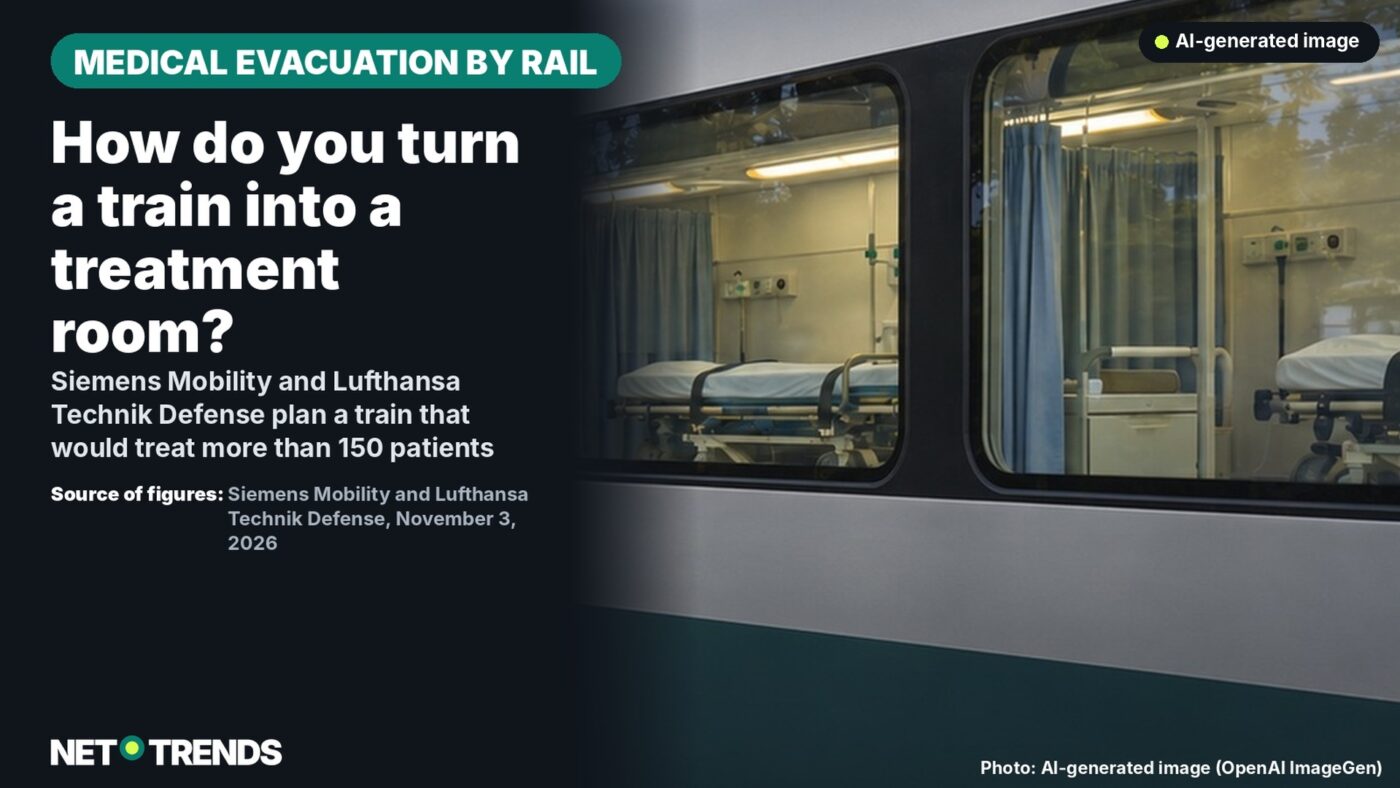
Siemens Mobility and Lufthansa Technik Defense signed a letter of intent for a medical evacuation train for Germany’s armed forces and NATO allies
Key points
- Siemens Mobility and Lufthansa Technik Defense have signed a letter of intent to jointly develop a patient-transport train.
- The companies say the train is meant to care for more than 150 injured or sick people, including some needing intensive care.
- The partners describe a concept for military evacuations and civilian disaster relief. The announcement does not confirm a finished train or a placed order.
A train able to treat more than 150 patients on the move: that is the concept Siemens Mobility and Lufthansa Technik Defense want to develop for Germany’s Bundeswehr and its NATO allies. The joint announcement, dated November 3, 2026, describes a planned solution for military evacuations and civilian disaster situations — not a train that is already in service.
The two companies say they signed a letter of intent ahead of the Berlin Security Conference. Development is planned in Germany for the Bundeswehr (Germany’s armed forces) and its NATO allies, including the United States; the firms also name civilian use as a possible option. The figures come from the companies themselves; the announcement does not state an independent project or procurement status. See Siemens’ press release (in German) and the Lufthansa Technik announcement (in German), which give the same key figures.
What is planned
According to the companies, Siemens passenger carriages would be combined with a locomotive from the Vectron-X family. Lufthansa Technik Defense would fit the carriages with medical equipment for patient transport and intensive care. The partners name military evacuations and civil disaster relief as the target use — a concept comparable to the U.S. Air Force’s own aeromedical evacuation missions, but on rails.
The figure of more than 150 patients is a planning target from the joint announcement. Space for up to 90 medical and support personnel is also envisaged. The eventual number and fit-out will likely depend on how many places are needed for intensive care, stretchers and other functions.
How care on board is meant to work
Siemens and Lufthansa Technik describe equipment levels ranging from stretcher bays to fully equipped intensive-care beds. The partners want to use medical systems Lufthansa Technik already knows from air transport, aiming to avoid moving patients between stretchers when switching between air and rail transport. Whether and how that works in the eventual vehicle will only become clear during further development.
For cross-border use, the companies describe carriages designed for European lines and high-speed routes. A dual-mode locomotive, they say, could run on both electric and diesel power, making use on non-electrified lines possible in principle. These are planned features of the concept, not confirmed performance data for an approved operational vehicle.
A conversion of the carriages for civilian passenger service is also part of the plan. The partners say flexible use could improve utilization over the vehicle’s lifetime, which they put at more than 30 years. The announcement gives no figures for cost, timeline, unit numbers, a confirmed order or an entry-into-service date — and no figures in U.S. dollars, since no contract value has been disclosed.
What is still open
A letter of intent initially records an intention to cooperate and develop something together. On its own it is neither a supply contract nor evidence of an order from the Bundeswehr or any NATO member, including the United States. Financing, technical approval, the operator, maintenance and the operational concept would all still need to be settled for an actual project to go ahead.
The idea combines the range and cross-border usability of rail with medical care during transport. Whether that becomes a deployable offer, and when it might be available, cannot be answered from the information published on November 3, 2026.
Frequently asked questions
Has the patient-transport train already been ordered or is it ready for use?
The companies report a signed letter of intent and a joint development plan. A finished train or a confirmed procurement order is not mentioned in the announcement.
How many people is the train meant to carry?
According to Siemens Mobility and Lufthansa Technik Defense, the plan envisages more than 150 patients plus up to 90 medical and support staff.
Is this a U.S. military program?
No. The companies name Germany’s Bundeswehr and its NATO allies for military evacuations, and civilian emergency services for disaster relief. No U.S. agency or contract is named in the announcement.
Sources and status
- Siemens Mobility: „Siemens und Lufthansa Technik Defense entwickeln Patiententransportzug“, November 3, 2026 (in German)
- Lufthansa Technik: joint announcement on the patient-transport train, November 3, 2026 (in German)
Research and data as of: November 3, 2026.
Transparency note: AI-assisted tools were used in researching, structuring and writing this article. The sources used are listed in the article. Publication takes place only after manual editorial approval. Translation of the German original on Net Trends. Picture note: AI-generated symbolic image, as in the original.
What requirements would a medical train need to meet to be practically useful in disaster relief? Share your view in the comments.
Share this article