FERC sets the allowed return for interstate gas pipelines one case at a time, not in a single nationwide round – and a 2026 industry report says some pipelines are earning far above it
Key points
- The Federal Energy Regulatory Commission (FERC) sets the allowed return on equity (ROE) for an interstate natural gas pipeline only when a case is filed, under Sections 4 or 5 of the Natural Gas Act – there is no single, periodic nationwide rate-of-return decision like Germany’s.
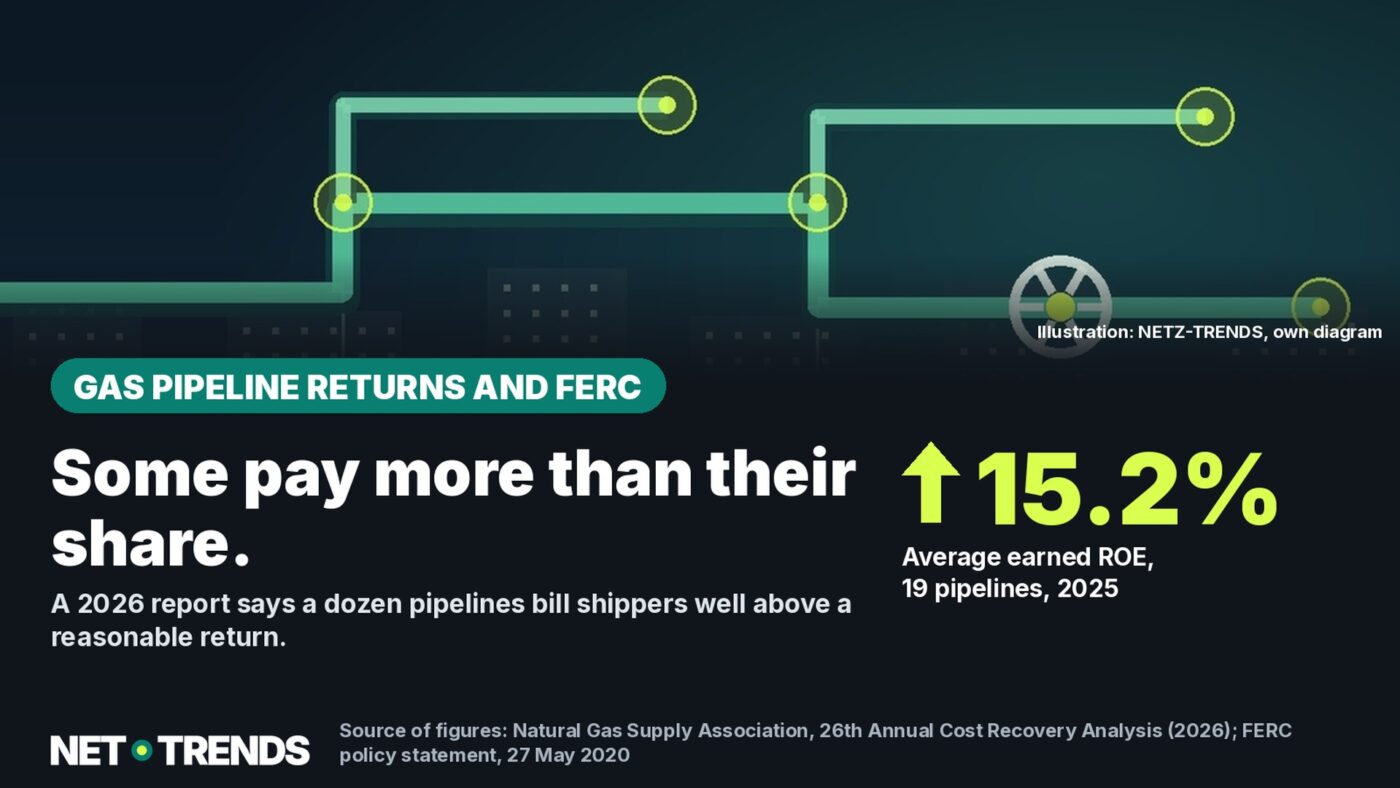
- A 2026 report by the Natural Gas Supply Association (NGSA) found 12 of 19 major interstate pipelines it reviewed consistently earned above a 12% ROE benchmark, with an average earned ROE of 15.2% in 2025 and some pipelines far higher.
- NGSA says the 19 pipelines it analyzed over-recovered about $1.3 billion relative to their regulated cost of service in 2025, and is pushing FERC to open rate reviews for pipelines whose rates it calls “stale.”
No US agency sets a single cost-of-capital figure for every gas pipeline the way some regulators abroad do for gas networks. FERC reviews each interstate pipeline’s rates, including its allowed return on equity, largely one case at a time – and a new industry report argues that gap lets some pipelines keep collecting far more than a reasonable return.
Germany’s Bundesnetzagentur recently postponed its own decision on the weighted average cost of capital (WACC) for gas network operators to 2027, saying it wants a full year of 2026 capital-market data first – but it is still heading toward one number that will apply to every German gas network for a five-year period. FERC’s system works differently: each of the roughly 160 FERC-regulated interstate pipelines keeps whatever rate, and implied return, it last had approved until something – a pipeline’s own filing, a shipper complaint, or FERC itself – triggers a new review.
How FERC sets a pipeline’s allowed return
Under the Natural Gas Act, an interstate pipeline can change its own rates by filing a Section 4 rate case; FERC, a shipper or another affected party can instead force a review of rates it considers no longer “just and reasonable” under a Section 5 complaint. In either case, FERC determines an allowed return on equity using a methodology it last overhauled in 2020, combining several financial models – discounted cash flow, capital asset pricing, risk premium and expected-earnings analysis – rather than one fixed formula, according to the Commission’s 2020 policy statement on determining return on equity.
Because that process only runs when a case is filed, a pipeline whose costs have fallen, or whose traffic has grown, since its last rate case can keep billing shippers under rates built around an older, sometimes more generous, allowed return – unless someone files a new case. Energy law commentators have also noted that FERC’s separate policy for brand-new (“greenfield”) pipeline capacity has, since the late 1990s, generally allowed about a 14% ROE regardless of where market interest rates stood at the time, a practice that has itself drawn FERC inquiries into whether it still fits current financial conditions.
What the 2026 NGSA report found
The Natural Gas Supply Association’s 26th Annual Interstate Natural Gas Pipeline Cost Recovery Analysis, released in 2026, estimated the regulated cost of service for 19 major interstate pipelines for the years 2021 through 2025, using the same method FERC applies in a traditional rate case, and compared it with what each pipeline actually collected. It found that 12 of the 19 pipelines consistently earned above a 12% ROE benchmark, with the group’s average earned ROE rising from 14.1% in the year ended 2024 to 15.2% in 2025. Some individual pipelines ran far higher: Natural Gas Pipeline Company of America at 41.1% in 2025, Northern Border Pipeline at 28.6%, and El Paso Natural Gas at 20.9%. Others were close to or below the benchmark, such as Gulf South Pipeline at 11.0% and Texas Eastern Transmission at 13.3% in 2025. Across all 19 pipelines, NGSA calculated a combined over-recovery of about $1.3 billion relative to regulated cost of service in 2025.
Reading the ROE numbers against FERC’s own benchmark
- NGSA’s benchmark: 12% ROE, which the report treats as a reasonable industry reference point, not a FERC-set figure.
- Average earned ROE, 19 pipelines, 2025: 15.2% – about 3 percentage points above the benchmark.
- Highest single pipeline, 2025: Natural Gas Pipeline Company of America, 41.1%.
- Estimated 2025 over-recovery, all 19 pipelines combined: about $1.3 billion, per NGSA’s modeling.
These are NGSA’s own cost-of-service estimates, not FERC-audited figures; FERC has not published a matching finding for these specific pipelines in the source reviewed for this article.
Who is NGSA, and why does this matter to it
The Natural Gas Supply Association represents natural gas producers and marketers – companies that pay pipelines to move their gas, not the pipelines themselves. A lower allowed return, or more frequent rate reviews, would tend to lower the tolls NGSA’s own members pay, which is the direct financial interest behind the group’s push for FERC to act. That does not make the underlying cost-of-service numbers wrong, but it is why this article names the source rather than presenting the benchmark as FERC’s own.
What this means for a gas bill
Pipeline transportation charges are one link in the chain between a gas well and a household burner tip – alongside production costs, local distribution company charges, and state-regulated retail rates (see Net Trends’ companion article on Pennsylvania’s rate-case process). A FERC rate review that lowered an interstate pipeline’s allowed return would reduce costs for the shippers that use that specific pipeline; it would not by itself change a retail customer’s bill, which depends on their state-regulated utility’s own rates.
Frequently asked questions
Does FERC set one nationwide ROE for all gas pipelines, like a single interest rate?
No. FERC determines an allowed return on equity case by case, when a pipeline files a Section 4 rate case or faces a Section 5 complaint, using a methodology that combines several financial models rather than one fixed, nationwide number.
Is the 12% figure in the NGSA report a FERC rule?
No. It is NGSA’s own benchmark, used to flag pipelines it says are earning well above a reasonable return. FERC’s actual allowed ROE varies by pipeline and by case.
Will FERC automatically open a case against a pipeline earning a high ROE?
Not automatically. Historically, FERC has opened Section 5 reviews in some cases where evidence suggested a pipeline’s rates were no longer just and reasonable, but a high estimated ROE in an industry report does not by itself force a review.
How is this different from Germany’s WACC process for gas networks?
Germany’s Bundesnetzagentur is working toward one weighted average cost of capital figure that will apply to every German gas network operator for a fixed five-year period starting 2028. FERC instead reviews individual US interstate pipelines’ allowed returns only when a case is triggered, which is why some pipelines’ allowed returns can go years without being revisited.
Do you think FERC should review pipeline rates more often, or does the current case-by-case system work well enough? Share your view in the comments.
Sources and status
- Natural Gas Supply Association: 26th Annual Interstate Natural Gas Pipeline Cost Recovery Analysis (summary), 2026.
- Federal Energy Regulatory Commission: Policy statement on determining return on equity, Federal Register, 27 May 2020.
- Bundesnetzagentur: consultation draft on the capital-return rate for gas network operators (in German), 14 August 2026.
Research and data as of: 8 November 2026.
Transparency note: AI-assisted tools were used in researching, structuring and writing this article. The sources used are listed in the article. Publication takes place only after manual editorial approval. Country edition researched for the United States, based on an article by Net Trends on the German Bundesnetzagentur’s delayed WACC decision for gas networks; the German case does not carry over directly, so US sources, figures and the regulatory process were researched separately. Featured image: own schematic illustration (pipes, buildings, a valve; no embedded text), unchanged across language editions.
Share this article