Ofgem has already set the allowed return for Great Britain’s gas networks at 4.34% through 2031 – but several network companies are now fighting parts of that settlement at the Competition and Markets Authority
Key points
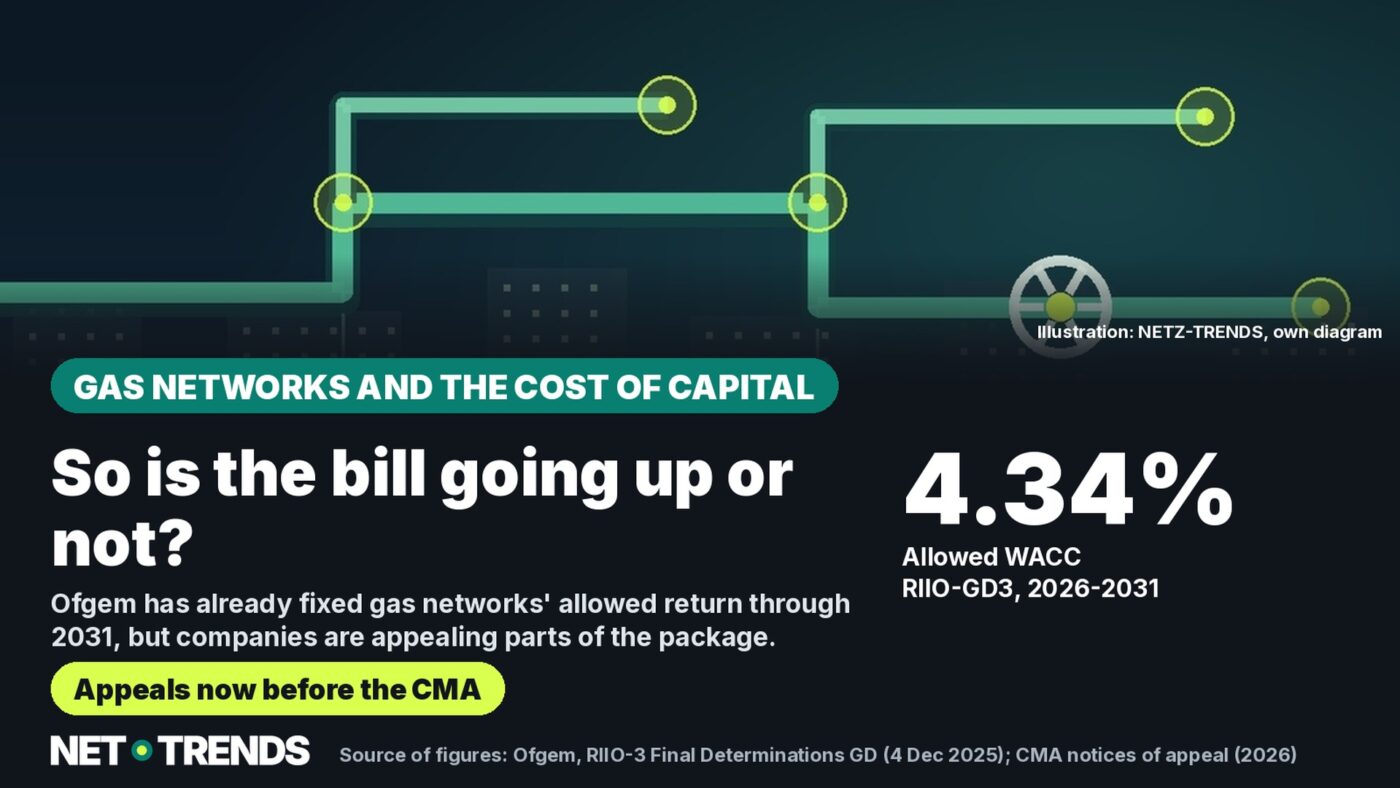
- Ofgem’s RIIO-GD3 Final Determinations, published 4 December 2025, set the allowed cost of capital for Great Britain’s gas distribution networks at 4.34% (CPIH-real) for 2026 to 2031, with an allowed cost of equity of 6.12%.
- Unlike Germany, where the Bundesnetzagentur has pushed its own gas network return decision back to 2027, Ofgem’s figure for GB gas networks is already final and in force from 1 April 2026.
- “Final” has not meant “unchallenged”: Wales & West Utilities and Scotland/Southern Gas Networks (SGN) have appealed the wider package to the Competition and Markets Authority, mainly over the efficiency target and whether it leaves them able to finance their networks – not over the 4.34% figure itself.
Great Britain’s gas network operators already know, in writing, what return they are allowed to earn until 2031. Germany’s equivalent regulator is still deciding. The British number is settled on paper – but not everyone agrees it should stay that way.
The German article this edition is based on describes the Bundesnetzagentur delaying its decision on the weighted average cost of capital (WACC) for gas networks to 2027, so it can use a full year of 2026 capital-market data. Ofgem works on a fixed five-year cycle instead: it locks in a cost of capital for the whole RIIO-GD3 period in one go, well before the period starts – which is exactly what makes the current wave of appeals notable.
What RIIO-GD3 actually fixed
RIIO-GD3 is Ofgem’s price control for Great Britain’s four gas distribution networks – Cadent, SGN, Northern Gas Networks and Wales & West Utilities – covering 1 April 2026 to 31 March 2031. In its Final Determinations, published 4 December 2025, Ofgem set the allowed cost of equity at 6.12% and the overall allowed cost of capital (the WACC) at 4.34%, both measured in CPIH-real terms (adjusted for the CPIH measure of inflation). That single figure feeds directly into how much revenue each network is allowed to recover from customers over the five-year period.
Ofgem’s statutory notices modifying each company’s gas transporter licence to give effect to RIIO-GD3 followed on 3 February 2026, with the changes taking effect on 1 April 2026 regardless of any appeal – a company has to apply to the CMA to have a provision suspended, it does not happen automatically.
Why networks are appealing anyway
Within weeks of the licence modification notices, more than one network challenged the package at the Competition and Markets Authority under section 23B of the Gas Act 1986. Wales & West Utilities’ notice of appeal does not target the 4.34% WACC figure directly. Instead it challenges Ofgem’s 1.0%-a-year “Ongoing Efficiency” assumption – a built-in expectation that the network will keep cutting costs – arguing the figure should be no higher than 0.5% and that the 1.0% assumption cuts roughly £91 million from its allowed spending over the period. WWU also argues Ofgem failed to properly assess whether the package leaves it able to finance its licensed activities, a separate statutory duty under section 4AA(2)(b) of the Gas Act.
SGN announced its own appeal on 4 March 2026 on three grounds, also centred on the Ongoing Efficiency target and on alleged calculation errors in its allowances, saying the combination leaves “the long-term investability needed to support future resilience” in question. Neither company’s published appeal papers frame their case as a direct challenge to the 4.34% cost-of-capital number – but financeability and the overall allowed return are closely linked: if a regulator sets efficiency targets too tight, the practical effect on a network’s finances can resemble a lower allowed return, even if the headline WACC does not change.
What this means for a gas bill
Network charges, including the return networks earn on their capital, are one part of a GB household gas bill alongside wholesale costs, supplier operating costs and policy costs – not the whole of it. A change at the CMA stage, if any company succeeds, would adjust an individual network’s allowed revenue for the rest of the RIIO-GD3 period; it would not by itself set a new headline price the way Ofgem’s quarterly default tariff cap does. The CMA’s decisions on these specific appeals are expected during 2026, after the licence changes already took effect on 1 April 2026.
Compared with Germany’s still-open decision
Two regulators, two different points in the process
- Germany (Bundesnetzagentur): the WACC for the fifth gas-network regulatory period (2028-2032) is not yet set; a final figure is expected only in late summer 2027, after an August 2026 draft put it provisionally at 3.76%.
- Great Britain (Ofgem): the WACC for the current gas-network period (2026-2031) was finalised on 4 December 2025 at 4.34% and took legal effect on 1 April 2026 – but parts of the same package are now before the CMA.
Neither number is directly comparable in size – they use different accounting bases, inflation measures and regulatory periods – so this article does not suggest GB networks earn “more” or “less” than German ones from the figures alone.
Frequently asked questions
Is Ofgem’s 4.34% WACC itself being challenged at the CMA?
Not directly, based on the published appeal documents from Wales & West Utilities and SGN. Their appeals target Ofgem’s “Ongoing Efficiency” assumption and financeability duty, not the headline cost-of-capital figure.
Does an appeal to the CMA delay the new charges?
No, not automatically. Ofgem’s licence modifications took effect on 1 April 2026 regardless of the appeals; a company would need the CMA to separately suspend a specific provision while the appeal is heard.
Will my gas bill change because of these appeals?
Not directly or immediately. Network costs are only part of a gas bill, and any change from a successful appeal would adjust a network’s allowed revenue over the rest of RIIO-GD3, not reset the bill on its own.
Is the German WACC process the same as Ofgem’s RIIO-GD3?
Not exactly. The Bundesnetzagentur sets a single nationwide capital-return rate for German gas networks, currently being postponed to 2027. Ofgem sets a GB-wide figure too, but as part of a fixed five-year price control that it finalised well before the period began – which is why the dispute now sits with efficiency targets rather than the return itself.
Do you think the appeals process gives gas networks too much room to challenge a “final” determination, or is it a necessary check on the regulator? Share your view in the comments.
Sources and status
- Ofgem: RIIO-3 Final Determinations – Gas Distribution, published 4 December 2025.
- Wales & West Utilities: Notice of Appeal to the Competition and Markets Authority, filed 2026.
- SGN: “SGN to appeal RIIO-GD3 Final Determination to the Competition & Markets Authority”, 4 March 2026.
- Ofgem: Gas distribution price control 2026 to 2031 (RIIO-GD3), programme overview.
- Bundesnetzagentur: consultation draft on the capital-return rate for gas network operators (in German), 14 August 2026.
Research and data as of: 8 November 2026.
Transparency note: AI-assisted tools were used in researching, structuring and writing this article. The sources used are listed in the article. Publication takes place only after manual editorial approval. Country edition researched for Great Britain, based on an article by Net Trends on the German Bundesnetzagentur’s delayed WACC decision for gas networks; the German case does not carry over directly, so UK sources, figures and the regulatory process were researched separately. Featured image: own schematic illustration (pipes, buildings, a valve; no embedded text), unchanged across language editions.
Share this article