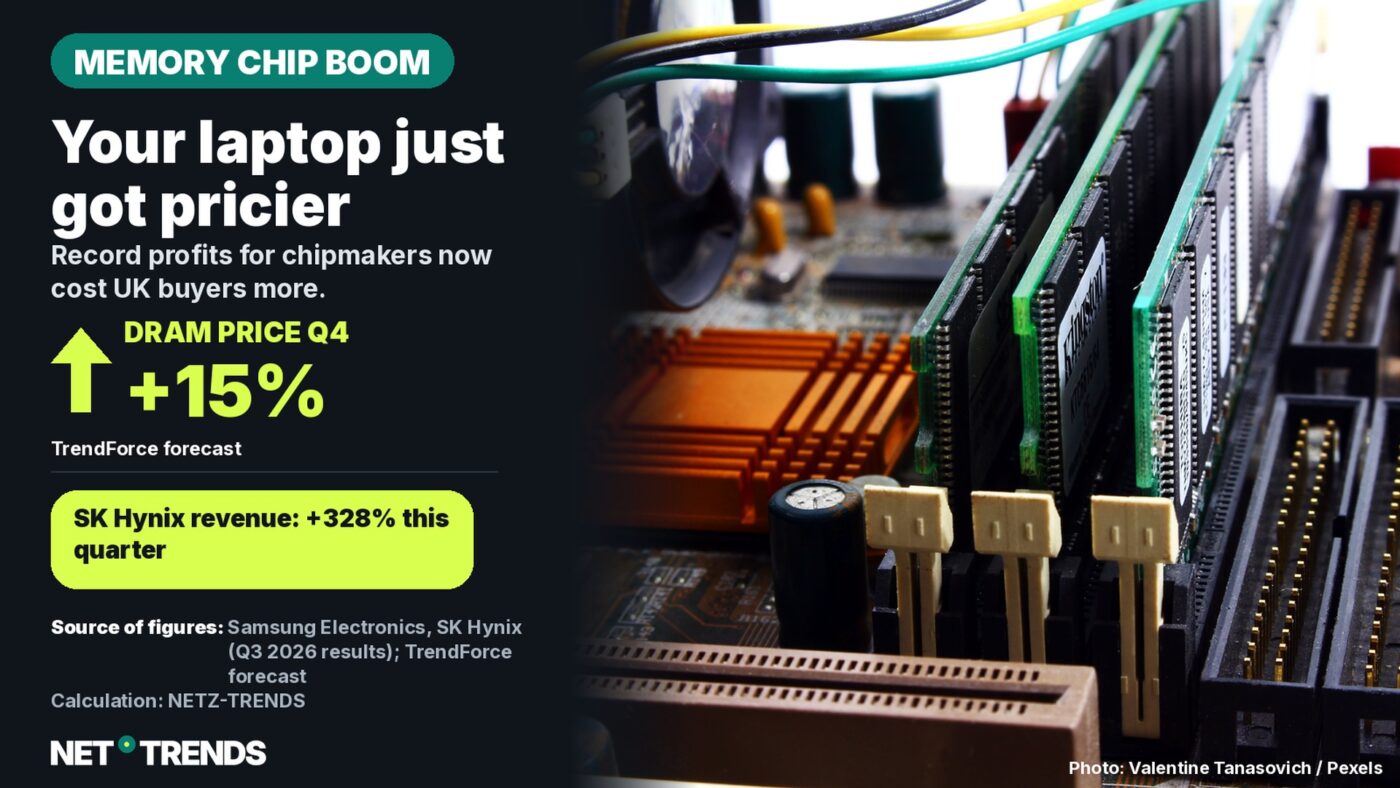
SK Hynix’s revenue nearly quadruples year-on-year and Samsung’s chip division grows 15% quarter-on-quarter, as TrendForce forecasts further DRAM and NAND price rises for the fourth quarter of 2026.
Key points
- SK Hynix reported record third-quarter 2026 revenue of 104.6 trillion won, up 328% on the same quarter last year, with an operating margin of 80%.
- Samsung Electronics also posted record revenue of 195.3 trillion won for the same period; its Device Solutions chip division grew 15% quarter-on-quarter to a record level.
- Market researcher TrendForce expects further price rises in the fourth quarter of 2026 of 10 to 15% for DRAM contract prices and 15 to 20% for NAND flash.
- SK Hynix expects the global memory chip shortage to last until at least 2030 – with knock-on effects for PC, laptop and SSD prices in the UK too.
Samsung and SK Hynix have reported record results for the third quarter of 2026 in the memory chip business. Analysts expect further price rises for RAM and SSDs in the UK this winter.
Both South Korean giants are riding a global surge in demand for memory chips used in artificial intelligence. Data centres now need so much working and flash memory for AI training and AI applications that manufacturers are struggling to keep supplying the ordinary market for PCs, laptops and smartphones as well.
How sharply that is hitting prices is visible on the UK high street: a popular 32GB DDR5-6000 memory kit from Corsair (Vengeance Grey, CAS 30) cost £529.99 at Scan.co.uk on 8 November 2026 – many times what comparable kits cost before the current shortage began.
Record quarters for Samsung and SK Hynix
SK Hynix, the world’s second-largest memory chip maker after Samsung, reported on 28 October 2026 revenue of around 104.6 trillion won for the third quarter of 2026. That is up 32% on the previous quarter and 328% on the same quarter a year earlier – the first time the South Korean company has passed 100 trillion won in revenue in a single quarter.
Operating profit rose to a record 83.3 trillion won, up 38% quarter-on-quarter and 632% year-on-year, according to the company’s own figures. That puts the operating margin at 80%. Net profit, by contrast, fell 58% to 39.8 trillion won, because the prior quarter had been boosted by a one-off gain from the sale of a stake in Kioxia.
Samsung Electronics, the world’s largest memory chip maker, reported group revenue of 195.3 trillion won for the same period on 29 October 2026 – according to the company, a new quarterly record. Its Device Solutions chip division grew 15% quarter-on-quarter and reached a record level for both revenue and operating profit. The Device eXperience consumer electronics division, by contrast, posted an operating loss of 0.8 trillion won.
“The customer trust we’ve built through our technology competitiveness is leading to long-term contracts.”
Kwak Noh-Jung, CEO, SK Hynix (South Korea), presenting the quarterly results on 28 October 2026
SK Hynix said in its results that long-term supply agreements with 14 major customers now cover more than half of its global production capacity for 2027 and 2028. For 2026, the company plans to pay out around 100 trillion won to shareholders.
Why memory chips are so scarce right now
Both companies cite demand for High Bandwidth Memory (HBM) for AI data centres as the main driver. SK Hynix said its M15X fab is set to run at maximum capacity by the end of the year, with the new HBM4 generation expected to overtake its predecessor, HBM3E, in both volume and revenue in the fourth quarter.
Because factories for the most advanced manufacturing processes take years to build, supply cannot be expanded quickly. SK Hynix therefore expects demand for memory chips to outstrip available supply until at least 2030. In the short term, the company said, demand for AI services from businesses and consumers is driving the market; in the medium term, applications such as autonomous driving and robotics will add to it.
The same shortage was recently a factor in Apple’s latest quarterly results, when rising memory costs were cited as a reason for higher iPhone and Mac prices. According to market watchers, the shortage is increasingly affecting cheaper devices too: in budget smartphones, the share of refurbished memory chips is forecast by TrendForce to climb to as much as 9% by 2027.
What it means for RAM and SSD prices
According to a TrendForce forecast, contract prices for standard DRAM memory are set to rise by 10 to 15% quarter-on-quarter in the fourth quarter of 2026, with NAND flash prices – the basis of SSDs – rising by 15 to 20%. Contract prices are what chipmakers charge large customers such as laptop and smartphone manufacturers; they feed through into retail prices with a delay.
As early as October 2026, TrendForce data showed the average fixed price for a standard DDR4 8-gigabit PC memory chip reaching a new record of $27.50, up 5.77% on September. For NAND flash, the same month brought a temporary end to a 21-month run of price rises – prices for the 128-gigabit chip tracked by TrendForce held steady in October.
What a further price jump could mean
- Current price: £529.99 for a 32GB DDR5-6000 Corsair Vengeance Grey memory kit, cheapest listed price at Scan.co.uk, as of 8 November 2026.
- Working: a further 15% rise would add: £529.99 × 1.15 ≈ £609.49, around £79.50 more for the same product.
Calculation by the editorial team based on TrendForce’s forecast for contract prices. Contract prices and retail prices don’t necessarily move in lockstep, so this figure is an illustration, not a prediction for this specific product.
What UK buyers should know now
For anyone buying a new computer, or upgrading RAM or an SSD, prices are shifting noticeably right now. A blanket buying recommendation can’t be drawn from the chipmakers’ figures alone, since retail prices depend on stock, retailer and model. The reported market trends do, however, offer some guidance.
Practical checklist before buying a PC or laptop
- Compare current prices across several UK retailers using a price-comparison site before buying.
- When upgrading RAM or an SSD, lean towards choosing more capacity now, since upgrading later could become more expensive on current forecasts.
- Check delivery times and warranty terms with the retailer, especially for memory capacities in high demand.
- Anyone delaying an otherwise planned purchase purely in hope of falling prices should weigh up current analyst forecasts, which point to further rises rather than falls.
These points don’t replace individual advice from a specialist retailer, but given fast-rising memory prices, they offer an initial steer.
Frequently asked questions
Why are RAM and SSDs getting more expensive right now?
Samsung and SK Hynix are diverting a growing share of their production to high-bandwidth memory for AI data centres. Because new factories take years to build, supply of standard RAM and SSD memory can’t be expanded quickly, while demand keeps rising.
How long do manufacturers expect the memory shortage to last?
SK Hynix says it expects demand for memory chips to outstrip available supply until at least 2030. According to the company, long-term supply contracts with major customers already cover more than half of planned production for 2027 and 2028.
Does the price rise affect smartphones too?
Yes. Rising memory costs were recently cited as one reason for higher iPhone and Mac prices in Apple’s latest quarterly results. According to market watchers, cheaper smartphones are increasingly relying on refurbished memory chips.
How much are prices expected to rise in the fourth quarter of 2026?
According to a TrendForce forecast, DRAM contract prices are set to rise by 10 to 15% quarter-on-quarter in the fourth quarter of 2026, and NAND flash prices by 15 to 20%. How quickly that feeds through into retail prices varies case by case.
Sources and status
- Samsung Electronics: “Samsung Electronics Announces Third Quarter 2026 Results”, Samsung Global Newsroom, 29 October 2026.
- SK hynix: “SK hynix Announces 3Q26 Financial Results”, news.skhynix.com, 28 October 2026.
- Market researcher TrendForce: forecast for DRAM and NAND contract prices for the fourth quarter of 2026, published 30 September 2026 (in German).
- Market researcher TrendForce: October data on DRAM and NAND prices, as of 31 October 2026.
- Scan.co.uk: Corsair Vengeance Grey 32GB DDR5-6000 CAS 30 kit, price checked 8 November 2026.
Research and data as of: 8 November 2026.
Transparency note: AI-assisted tools were used in researching, structuring and writing this article. The sources used are listed in the article. Publication takes place only after manual editorial approval. Country edition based on an article from Net Trends, researched for the UK.
Share this article