Article 50 of the EU AI Act: invisible marks vanish the moment a text is rewritten – the US relies on state law instead of a federal rule
Key points
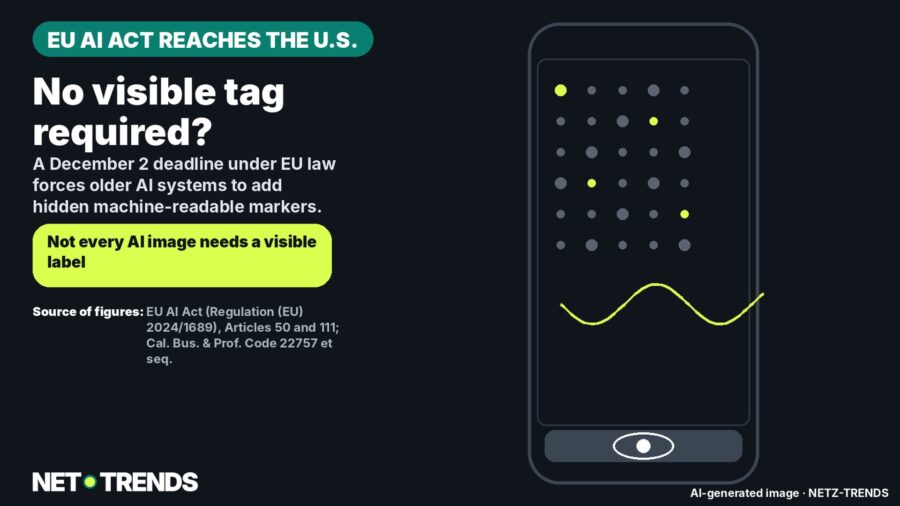
- From December 2, 2026, providers of older AI systems placed on the EU market before August 2, 2026 must machine-mark everything their systems generate: images, video, audio and text.
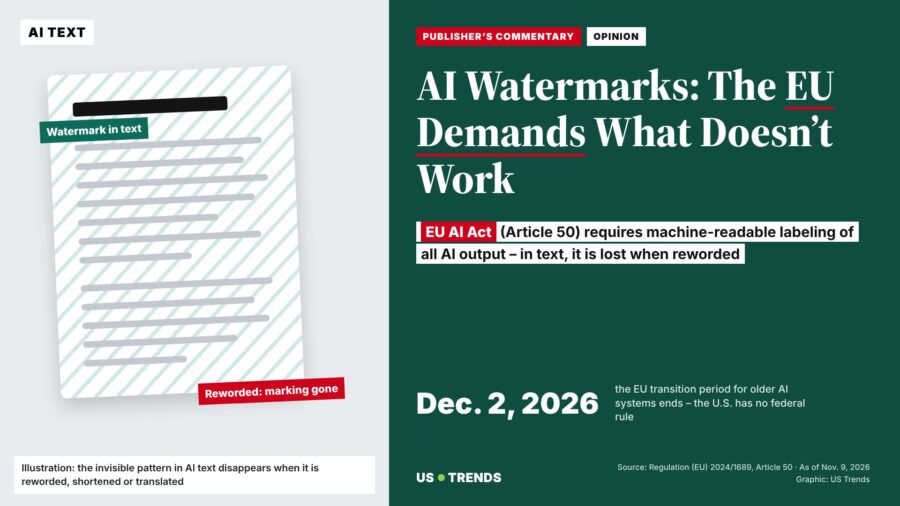
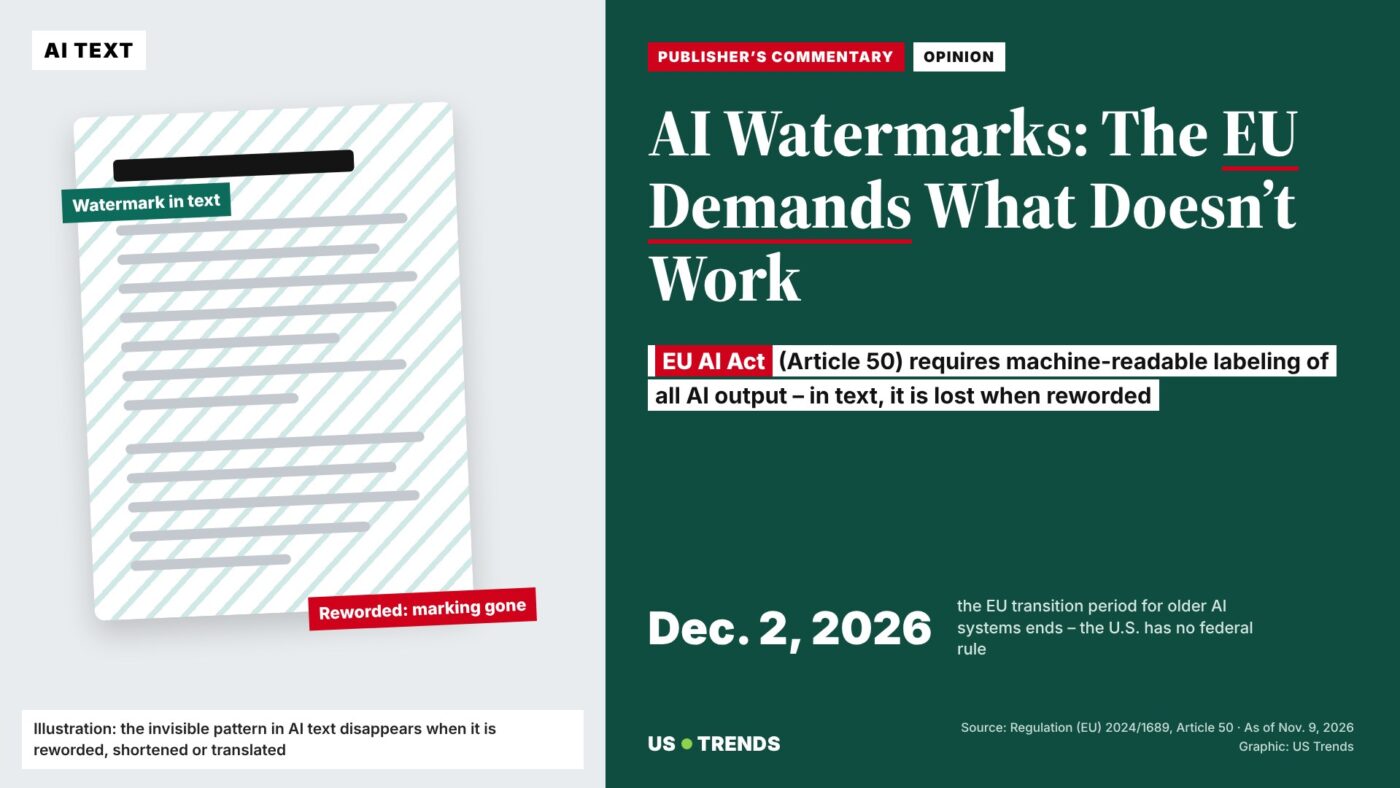
- For text, this barely works: a watermark built into word choice disappears the moment someone rewrites, shortens or translates the text.
- There is no US federal AI-labeling law. California’s AI Transparency Act (SB 942, as amended by AB 853) is the closest American equivalent, with developer duties starting August 2, 2026.
From December 2, 2026, even older AI systems placed on the EU market must machine-mark their output. It sounds like consumer protection, but it is mostly bureaucracy with a built-in expiration date – and in the US, only California has come close to doing anything similar.
On that date, a transition period under the EU AI Act (Regulation (EU) 2024/1689) ends. It covers providers – the makers of image, video and text generators – whose systems were already on the EU market before August 2, 2026. The legal basis is Article 50(2), which requires that AI-generated content be technically detectable, for example through metadata or digital watermarks. The regulation does not apply in the United States, but American AI companies selling into the EU, or whose output reaches EU users, are bound by it all the same. What the deadline requires in detail is explained in our news report on AI labeling.
Text watermarks: little more than a pattern
The problem is clearest with text. A watermark in language is just a statistical pattern: the AI picks its words according to a hidden rule, and detection software later recognizes that rule. Google already uses such a method under the name SynthID.
Anyone who reorders, translates or shortens a sentence destroys that pattern. Unlike image files, plain text carries no metadata. The regulation itself concedes the point: it only requires marking “insofar as technically feasible.” A rule that ships with its own built-in exemption ends up governing very little.
Images are barely better off
Metadata disappears the moment a platform resizes an image or someone takes a screenshot. Watermarks baked into the pixels are more robust, but not safe against deliberate tampering either. Anyone determined to spread disinformation simply uses a model outside the EU’s rules, or strips the mark.
The European Commission published a voluntary code of practice on labeling AI-generated content in June 2026. It relies on several layers of metadata and watermarking. It does not offer a reliable solution for text either.
Why there is still no federal rule
The United States has no federal law requiring AI content to be labeled or watermarked. If anything, the political momentum is moving the other way: in December 2025, the White House pursued an executive order directing a federal takeover of AI regulation aimed at preempting state AI laws, after a proposed federal moratorium on state AI statutes was left out of the FY2026 defense bill. That fight over federal preemption was still unresolved heading into late 2026, which leaves even existing state rules on uncertain legal footing.
The Federal Trade Commission has pursued some AI-related enforcement under its general authority against deceptive practices, but nothing resembling a binding watermarking mandate. Colorado’s AI Act, often mentioned in the same breath, is not a content-labeling law at all – it governs algorithmic discrimination in hiring, lending and similar “consequential decisions,” and its effective date has itself been pushed back to June 30, 2026.
California’s answer: SB 942
California comes closest to an EU-style rule. The California AI Transparency Act (SB 942), as amended by AB 853 in October 2025, requires generative-AI developers with more than one million monthly users to provide a free AI-content-detection tool, a visible “manifest disclosure” that content is AI-generated, and a tamper-resistant “latent disclosure” embedded as machine-readable metadata – functionally close to what Article 50 demands in the EU. Developer obligations now take effect August 2, 2026; large online platforms hosting generative AI content must comply starting January 1, 2027, and makers of capture devices such as cameras and phones must offer latent disclosure from January 1, 2028.
An earlier, broader California proposal, AB 3211, which had support from OpenAI, Adobe and Microsoft, did not become law; SB 942 is the version that was actually enacted. Outside California, state activity is scattered and inconsistent, which is exactly the patchwork the federal preemption fight is trying to resolve – in one direction or the other.
A sensible rule for newsrooms
For news publishers with EU operations or EU readers, a different EU provision matters more, and it has applied since August 2, 2026. Under Article 50(4), AI-assisted text on matters of public interest needs no disclosure if a human has reviewed the content and a named person or company takes editorial responsibility for it. A mere spellcheck does not count, according to the European Commission’s guidelines. US outlets have no equivalent statutory rule, but the same underlying principle – someone puts their name to the content and is accountable for it – is standard newsroom practice here too.
Deepfakes – convincingly realistic AI images of real people, places or events – must, under EU law, always be visibly labeled. There is nothing wrong with that requirement: that is exactly what accountability looks like. Breaches of the EU’s transparency duties can bring fines of up to €15 million or 3% of worldwide annual turnover under Article 99(4) of the AI Act. US companies without EU exposure face no such fine, though California’s SB 942 carries its own civil penalties for noncompliant developers.
Verdict: accountability, not a technical mandate
An invisible watermark that disappears the first time someone edits a text does nothing against deception. What actually helps is newsrooms and platforms that check facts, disclose sources and stand behind what they publish. The EU should strengthen that kind of accountability rather than burden AI providers with technical duties that miss their own target. California’s SB 942 is a more workable model precisely because it pairs a visible, user-facing label with the technical metadata requirement, rather than relying on the metadata alone.
Supporters of mandatory labeling argue the opposite: even an imperfect watermark makes mass-produced synthetic content detectable at scale, because platforms can read it automatically – particularly ahead of elections. That argument deserves to be taken seriously. It does not, however, justify a duty that is barely enforceable for text.
Frequently asked questions
Does the EU’s AI watermarking rule apply in the US?
No, not directly. But any US AI company placing systems or AI-generated content on the EU market still has to comply with Article 50 of the EU AI Act.
Is there a US federal AI-labeling law?
No. There is no federal requirement to label or watermark AI-generated content, and a fight over federal preemption of state AI laws was still unresolved in late 2026.
What is the closest US equivalent to the EU rule?
California’s AI Transparency Act (SB 942, as amended by AB 853), which requires large generative-AI developers to offer a detection tool plus visible and machine-readable disclosures, with developer duties starting August 2, 2026.
Sources and status
- Regulation (EU) 2024/1689 (AI Act), in particular Article 50 and Article 99
- European Commission: Guidelines on transparency obligations for providers and deployers of certain AI systems
- Regulation (EU) 2026/1744 amending the AI Act (AI Omnibus)
- Google DeepMind: SynthID
- California Legislative Information: SB 942, California AI Transparency Act
- Akin Gump: President Trump unveils AI executive order advancing federal preemption of state laws
- Greenberg Traurig: Colorado delays comprehensive AI law, with further changes anticipated
Research and data as of: November 9, 2026.
Transparency note: AI-assisted tools were used in researching, structuring and writing this article. The sources used are listed in the article. Publication takes place only after manual editorial approval. Country edition based on an article from Net Trends, researched for the United States.
Share this article