The European Union’s AI labeling deadline hits U.S. companies too: as of December 2, 2026, older generative AI systems whose output lands in the EU must carry a machine-readable AI marker – and California’s own AI Transparency Act starts enforcing a similar rule from August 2026.
Key points
- The EU’s AI Act (Regulation (EU) 2024/1689) reaches U.S. companies whose AI systems’ outputs are used in the European Union – OpenAI, Google, Meta and Microsoft included – even though there is no comparable federal U.S. law.
- A transition period for older generative AI systems under Article 50 of that regulation ends December 2, 2026; after that, machine-readable labeling of AI-generated images, audio, video and text is required for systems placed on the EU market before August 2, 2026.
- California’s own AI Transparency Act (Cal. Bus. & Prof. Code §§ 22757 et seq.) becomes operative on August 2, 2026, and requires large generative AI providers to offer a free detection tool and embed provenance data in AI-generated images, video and audio.
The United States has no federal law requiring AI providers to label their output, but two separate deadlines now reach American companies anyway: an EU transition period ending December 2, 2026, and California’s own AI Transparency Act starting August 2, 2026. Both target the same problem – AI-generated images, audio, video and text that nothing marks as artificial.
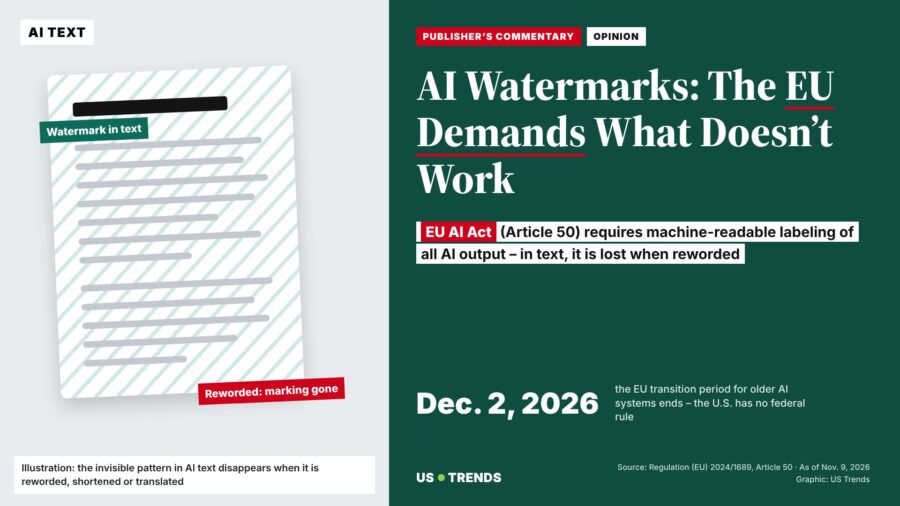
For a U.S.-based AI company, the EU rule is not optional just because it is headquartered in San Francisco or Seattle. The European Commission has said the AI Act’s transparency duties can reach providers outside the EU if their system’s output is used inside the EU – meaning any large American AI provider with European users or customers needs to comply, regardless of where the company itself is based. Why such marks rarely survive in text is argued in our publisher’s commentary on AI watermarks.
Separately, California has moved ahead with its own, narrower state law. Unlike the EU rule, California’s AI Transparency Act applies only to generative AI systems with large audiences, and only to image, video and audio output – not text.
The EU deadline and why it reaches U.S. companies
Article 50 of the EU’s AI Act, Regulation (EU) 2024/1689 as amended by the AI omnibus Regulation (EU) 2026/1744, has applied since August 2, 2026. For generative AI systems that were already on the EU market before that date, the amended regulation grants a limited transition: providers must complete the steps needed to comply with Article 50(2) by December 2, 2026. Systems placed on the market from August 2, 2026 onward must already comply.
The obligation falls on “providers” – the company that develops a system and places it on the EU market under its own name, whether or not that company is based in the EU. The European Commission’s own guidance on Article 50 states explicitly that the rule can capture providers established outside the EU if the output of their system is used in the Union. That is the core of what this means for American AI companies: a U.S. provider with no EU office can still fall under the rule the moment European users see or receive its AI-generated images, audio, video or text.
Major U.S. AI providers with large EU user bases – OpenAI, Google, Meta and Microsoft among them – therefore face the same December 2, 2026 transition deadline as any EU-based company, for any part of their generative AI output that reaches EU users.
What “machine-readable” actually requires
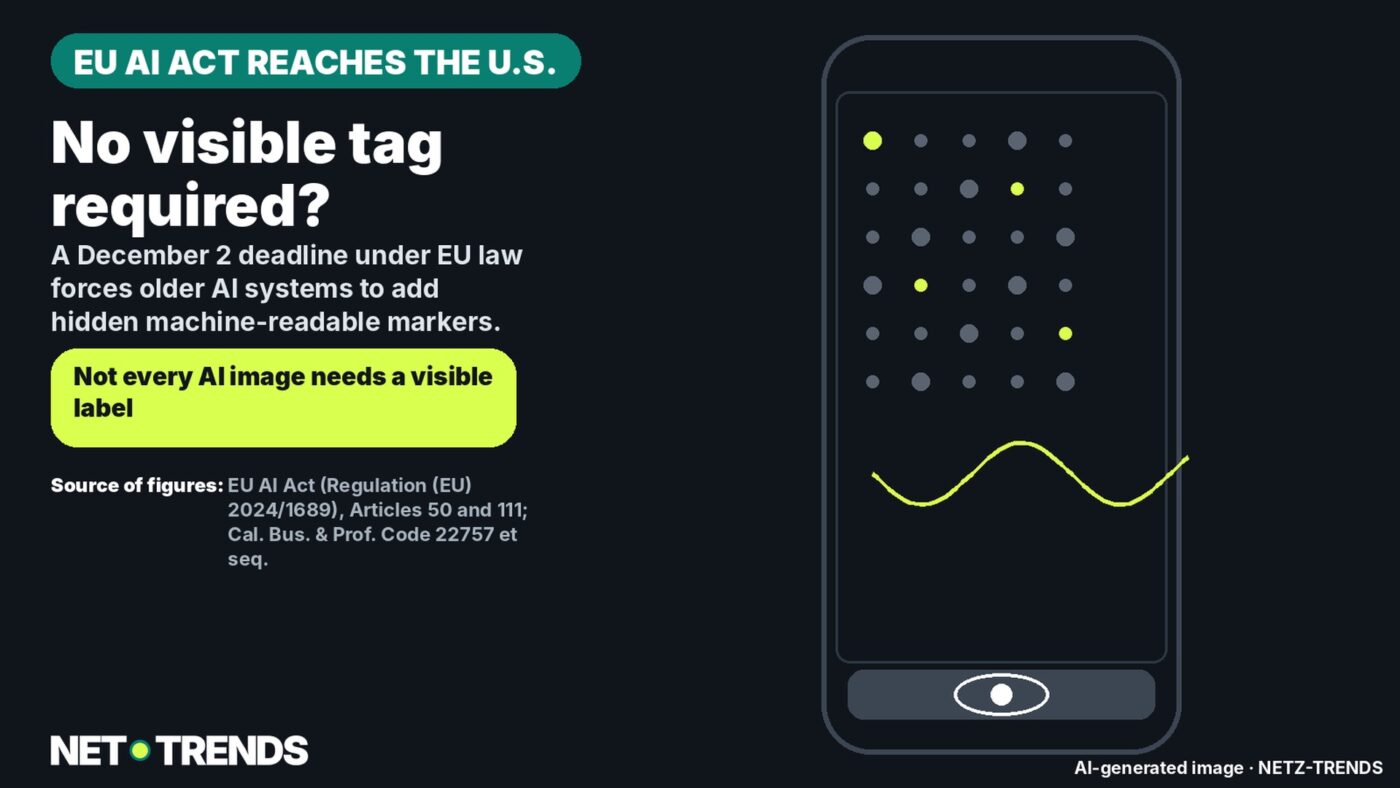
The EU rule does not require a visible warning label on every AI-generated image or piece of text. It requires providers to mark synthetic audio, image, video and text output in a machine-readable format and make it technically detectable – for example through metadata or a digital watermark – “to the extent technically feasible,” taking into account the limitations of each content type, cost and the state of the art.
Separate, visible disclosure duties apply only in narrower cases, mainly deepfakes of real people, places or events, and certain AI-generated text published to inform the public on matters of public interest – and even then, text that has gone through genuine human editorial review is exempted. Content created and already published before August 2, 2026 does not need to be labeled retroactively, according to the European Commission’s guidance.
California’s own law: the AI Transparency Act
Separately from the EU rule, California has its own state-level labeling law. The California AI Transparency Act, codified at California Business and Professions Code Sections 22757 and following (added by Senate Bill 942, as amended by Assembly Bill 853), becomes operative on August 2, 2026 for covered providers.
It applies to a generative AI system that creates image, video or audio content and that has more than one million monthly users or visitors in California. Covered providers must offer the public a free tool to check whether a given piece of content came from their system, and must embed a provenance marker in qualifying image, video and audio output – “to the extent technically feasible” – identifying the provider, the system and version, and the creation date, without making the user’s own identity traceable. A visible “AI-generated” label on content remains a choice for the end user to turn on, not a blanket requirement. Large online platforms and AI-hosting platforms that distribute such content face related duties from January 1, 2027, and device manufacturers from January 1, 2028. Violations can be enforced by the California Attorney General or local prosecutors, with penalties of $5,000 per violation and no cure period.
Text-only AI output is not covered by the California law – it applies only to image, audio and video, a narrower scope than the EU’s Article 50, which also reaches certain AI-generated text.
Why there is no federal labeling law – yet
Congress has not passed a federal law requiring AI providers to label synthetic content the way the EU’s Article 50 does. Proposals have circulated in Washington, but as of this article’s research date none has been enacted. That leaves U.S. companies navigating a patchwork: California’s AI Transparency Act for image, video and audio aimed at large providers with a California footprint, other individual state proposals on AI content provenance still moving through state legislatures, and the EU’s AI Act reaching any U.S. provider whose output lands with European users – regardless of whether that provider operates in the United States at all.
For American companies that both sell into the EU and have a large California user base, the practical result is that they may need to meet two different labeling regimes with two different scopes and two different 2026 deadlines, rather than a single U.S. standard.
Checklist: what U.S. companies and users can check now
- Does your AI product have users in the EU? If so, the Article 50 transition deadline of December 2, 2026 likely applies to any system placed on the EU market before August 2, 2026.
- Does your generative AI system have more than one million monthly users or visitors in California and produce image, video or audio? Then the state AI Transparency Act’s August 2, 2026 operative date applies.
- Check whether your AI content is text-only – California’s law does not cover text, but the EU rule can, in narrower public-interest cases.
- For deepfakes of real people or events, a visible disclosure duty can apply separately from the machine-readable marking rules, under both the EU and California frameworks.
- There is still no single federal U.S. labeling law, so compliance has to be checked state by state and, for EU users, against the EU’s own rule.
None of this changes a company’s other U.S. legal exposure – defamation, right-of-publicity or existing Federal Trade Commission rules on deceptive practices still apply to AI-generated content independently of these labeling regimes.
Frequently asked questions
Does the EU’s AI labeling rule really apply to U.S. companies?
Yes, according to the European Commission’s own guidance, if a U.S. provider’s generative AI system’s output is used in the EU, that provider can fall under Article 50 of the EU AI Act even without any EU office or EU incorporation.
Is there a federal U.S. law requiring AI content labeling?
No. As of this article’s research date, Congress has not enacted a federal law requiring AI providers to label synthetic content; the closest comparable rule in the U.S. is California’s state-level AI Transparency Act.
What exactly does California’s AI Transparency Act require?
From August 2, 2026, generative AI providers with more than one million monthly California users or visitors must offer a free public detection tool and embed provenance data in qualifying AI-generated image, video and audio output; the law does not cover text-only content.
Do older AI-generated images and videos need to be labeled retroactively?
Under the EU rule, content created and published before August 2, 2026 does not need retroactive labeling, according to European Commission guidance. California’s law applies to covered providers from its own operative date forward.
Sources and status
- Consolidated Regulation (EU) 2024/1689 (EU AI Act), Article 50 and Article 111 (transition rule): eur-lex.europa.eu.
- Regulation (EU) 2026/1744 amending the AI Act (AI omnibus): eur-lex.europa.eu.
- European Commission, questions and answers on transparency obligations under Article 50 of the AI Act: digital-strategy.ec.europa.eu.
- California Business and Professions Code, Sections 22757 et seq. (California AI Transparency Act, added by SB 942, amended by AB 853): leginfo.legislature.ca.gov.
Research and data status: November 9, 2026.
Transparency note: AI-assisted tools were used in researching, structuring and writing this article. The sources used are listed in the article. Publication takes place only after manual editorial approval. Country edition based on an article from Net Trends, researched for the United States.
Share this article