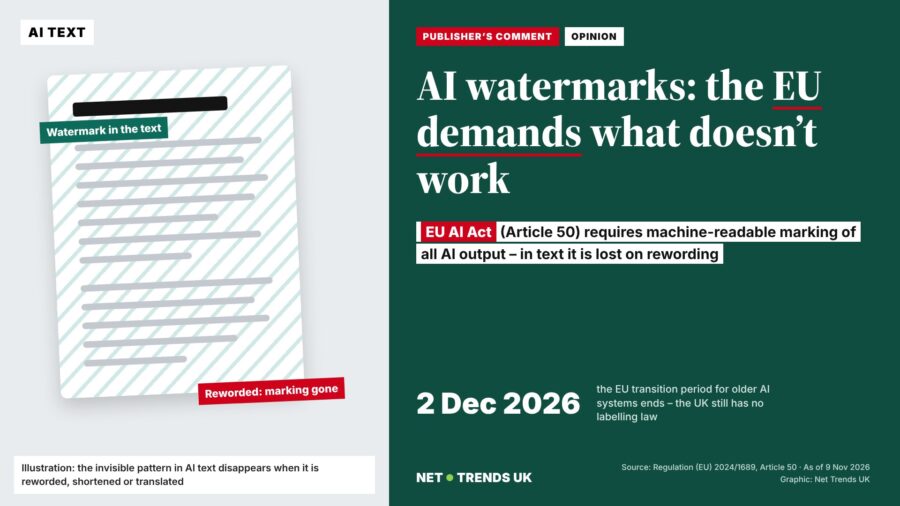
EU AI Act labelling: from 2 December 2026, providers of older generative AI systems must mark their images, video, audio and text so machines can detect them as AI-made. The rule can catch UK companies too – and Britain itself still has no labelling law of its own.
Key points
- From 2 December 2026, a transitional period ends for AI systems placed on the EU market before 2 August 2026; their providers must then meet the machine-readable marking duty in Article 50(2) of the EU AI Act.
- The European Commission says the duty can bind providers outside the EU, including UK companies, if their system’s output is used in the EU.
- The UK has no domestic law requiring AI content to be labelled; a December 2025 government statement says it is “continuing to consider all options”.
- Visible labels for deepfakes, and for unreviewed AI text on matters of public interest, are a separate EU duty on “deployers” – not part of the 2 December deadline.
From 2 December 2026, an important transitional deadline under the EU’s AI Act expires. It affects providers of generative AI systems that were already on the market before 2 August 2026, who must mark AI-generated images, video, audio and text in a machine-readable format – via metadata or a digital watermark, for example. For users, that means not every AI image or AI text will carry a visible label from that date. Separately, the Act does set visible disclosure duties for people and organisations that deploy AI, but only in specific cases.
The rule sits in Article 50 of Regulation (EU) 2024/1689, as amended by the AI Omnibus Regulation (EU) 2026/1744. The European Commission has explained the duties in its FAQ on Article 50 transparency obligations. What matters for a UK reader is who provides an AI system, who deploys it, and whether a marking needs to be machine-readable only or visible to people – because, unlike the EU’s 27 member states, the UK is not automatically bound by the Regulation at all. Why such marks rarely survive in text is argued in our publisher’s commentary on AI watermarks.
What changes on 2 December
Article 50 of the AI Act has applied in the EU since 2 August 2026. For providers of AI systems that generate synthetic audio, image, video or text and that were already on the market before that date, the amended Regulation gives a limited transitional window: they must complete the steps needed to comply with Article 50(2) by 2 December 2026. Systems placed on the market from 2 August 2026 onwards had to comply from the outset.
The duty falls on providers – the natural or legal persons who develop a system, or have one developed, and place it on the EU market or put it into service under their own name or brand. According to the Commission, this can include providers based outside the EU, where their system’s output is used in the EU.
Providers must mark generated or manipulated outputs in a machine-readable format and make them technically detectable as artificial. The Commission says the methods must be effective, interoperable, robust and reliable so far as technically feasible, taking into account the type of content, the costs involved and the state of the art. Some uses are excluded – for instance, where an AI system only performs an assistive editing function or does not substantially alter data a user provided.
Why UK providers can be caught too
The United Kingdom left the EU and is not bound by the AI Act as a matter of domestic law. But the Act’s transparency duties are not confined to companies established in the EU: the European Commission’s own FAQ states that “providers of AI systems established or located outside the EU are also subject to the provisions of the AI Act” where the output of their system is used in the EU.
In practice, that reach can catch a UK-based company with no EU office at all – a British AI tool used by customers or marketing teams inside the EU, for example, or a UK software firm whose generated content ends up published to an EU audience. For such providers, the 2 December 2026 transitional deadline applies in the same way as it does to an EU-based provider: older systems need machine-readable marking in place by that date, regardless of where the company itself is based.
The UK’s own approach so far
Britain currently has no cross-sector law requiring AI-generated content to be labelled. The Department for Science, Innovation and Technology, working with the Intellectual Property Office and the Department for Culture, Media and Sport, published a progress statement on the government’s copyright-and-AI consultation in December 2025, which addressed labelling of generative AI outputs among several options under consideration. It describes a working group examining possible transparency duties, but says only that the government is “continuing to consider all options” – no legal labelling requirement has been introduced.
That does not mean AI-generated content in the UK sits outside regulation altogether. The Advertising Standards Authority, which enforces the UK Advertising Codes, has told advertisers that its rules are “media-neutral” and apply to AI-generated and deepfake content exactly as they do to any other advertisement; in June 2026 guidance, it warned that an AI “endorsement” realistic enough to mislead, or AI-generated imagery that breaches the Code on other grounds, can still result in a ruling against the advertiser – whether or not the content is labelled as AI-made.
“Providers of AI systems established or located outside the EU are also subject to the provisions of the AI Act.”
European Commission, FAQ on transparency obligations under Article 50 of the AI Act
The Commission adds that this applies specifically where the output of such a system is used in the EU – the condition that brings UK-based providers with EU users into scope.
Checklist: what UK businesses should check
- Does your organisation provide a generative AI tool or system (image, video, audio or text) rather than just use one?
- Was that system placed on the market, or put into service, before 2 August 2026? If so, the 2 December 2026 deadline for machine-readable marking applies.
- Does the system’s output reach users or customers in the EU, even without an EU office or EU incorporation?
- If you deploy AI to create deepfakes or AI-written text on public-interest topics, check whether the separate, visible disclosure duty on deployers applies to you.
- If you advertise in the UK, remember the CAP Code applies to AI-made and deepfake content regardless of whether it carries any AI label.
None of these checks replace legal advice, but they identify which of the two different duties – provider marking or deployer disclosure – is likely to matter for a given UK organisation.
What UK businesses should check
For a UK company that only uses AI tools made by someone else – without providing an AI system itself – the Article 50(2) marking duty generally falls on the tool’s provider, not the user. The practical question for most UK businesses is therefore whether they count as a “deployer” under the Act’s separate, visible-disclosure rules: these apply to deepfakes of real people, places or events, and to AI-generated text published to inform the public on matters of public interest, unless that text has undergone genuine editorial review with a named person or organisation taking responsibility for publication.
Purely private, non-professional use of AI is treated differently again: an individual generating personal content is not considered a deployer under these rules. Businesses using AI as part of a commercial or professional activity should assume the deployer rules can apply to them, and check their specific use case against the Commission’s guidance rather than relying on general impressions of the Act.
Frequently asked questions
Does every piece of UK-made AI content need a visible label from 2 December 2026?
No. The 2 December 2026 deadline concerns machine-readable marking by providers of certain AI systems placed on the market before 2 August 2026. A visible label is a separate duty that applies to deployers only in specific cases, such as deepfakes.
Does the EU AI Act apply to UK companies at all?
The UK is not an EU member and the Act is not automatically UK law. But according to the European Commission, providers located outside the EU – including in the UK – are covered where their AI system’s output is used in the EU.
Is there a UK law requiring AI content labelling?
Not currently. A December 2025 UK government statement on copyright and AI says ministers are still considering options for transparency and labelling; no statutory labelling duty has been introduced.
Does UK advertising law already cover AI-generated content?
Yes, indirectly. The Advertising Standards Authority says its Code is media-neutral and applies to AI-generated and deepfake advertising the same way it applies to any other advertisement, regardless of any AI label.
Sources and status
- Consolidated Regulation (EU) 2024/1689, in particular Article 50 and the transitional rule in Article 111.
- Regulation (EU) 2026/1744 amending the AI Act.
- European Commission: Transparency obligations under Article 50 – FAQ.
- UK Department for Science, Innovation and Technology, Intellectual Property Office and Department for Culture, Media and Sport: Copyright and Artificial Intelligence, progress statement, December 2025 (PDF).
- Advertising Standards Authority / CAP: “AI and deepfakes: four things advertisers need to know before they hit ‘run'”, 11 June 2026.
Research and data as of: 9 November 2026.
Transparency note: AI-assisted tools were used in researching, structuring and writing this article. The sources used are listed in the article. Publication takes place only after manual editorial approval. Country edition based on an article from Net Trends, researched for the United Kingdom.
Share this article