Article 50 of the EU AI Act: invisible markings vanish at the first edit – responsibility lies with newsrooms, not watermarks
Key points
- From 2 December 2026, providers of older AI systems in the European Union (EU) must mark everything their systems generate in a machine-readable way: images, videos, audio and text.
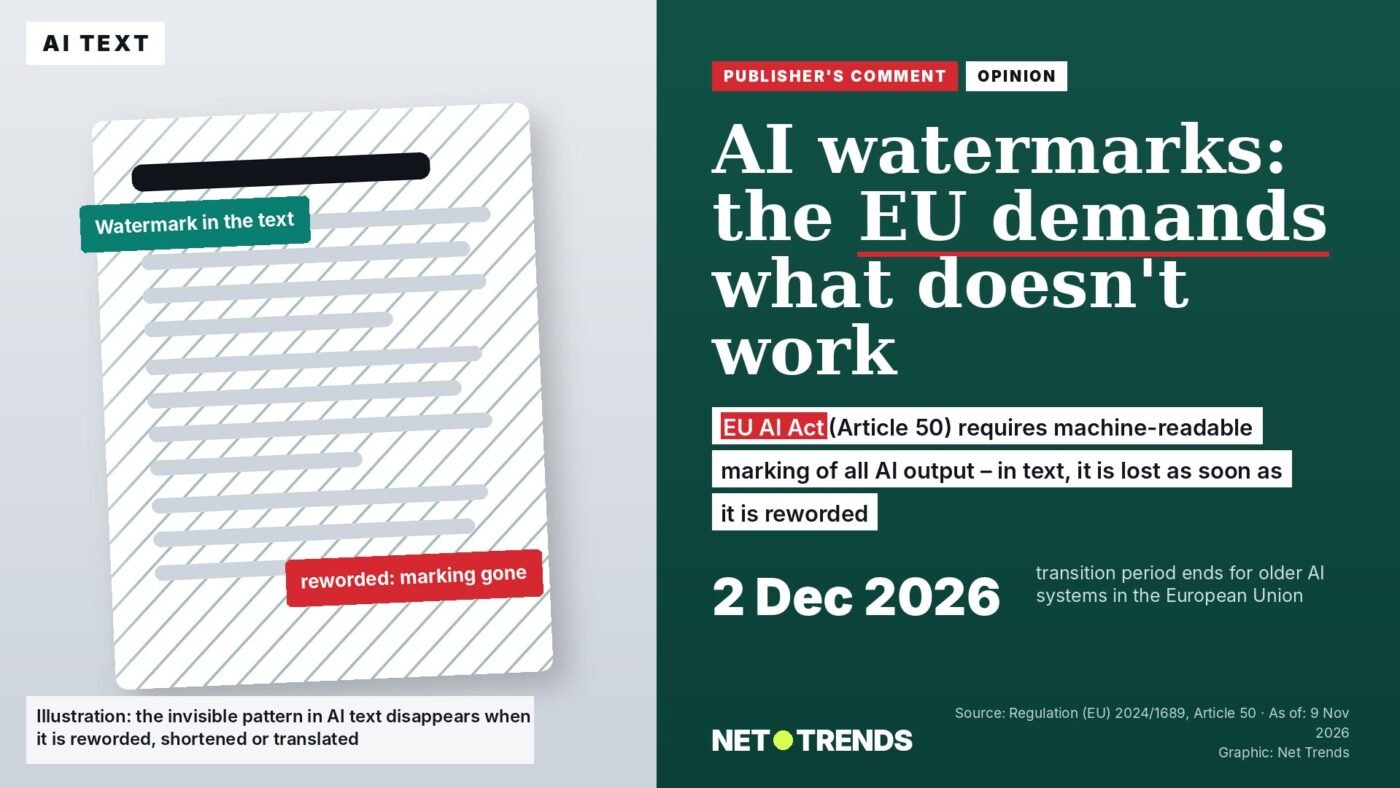
- For text, this barely works: a watermark in the choice of words disappears as soon as someone rewords, shortens or translates the text.
- Newsrooms have their own rule: AI-assisted texts need no label if a human reviews the content and takes responsibility for it.
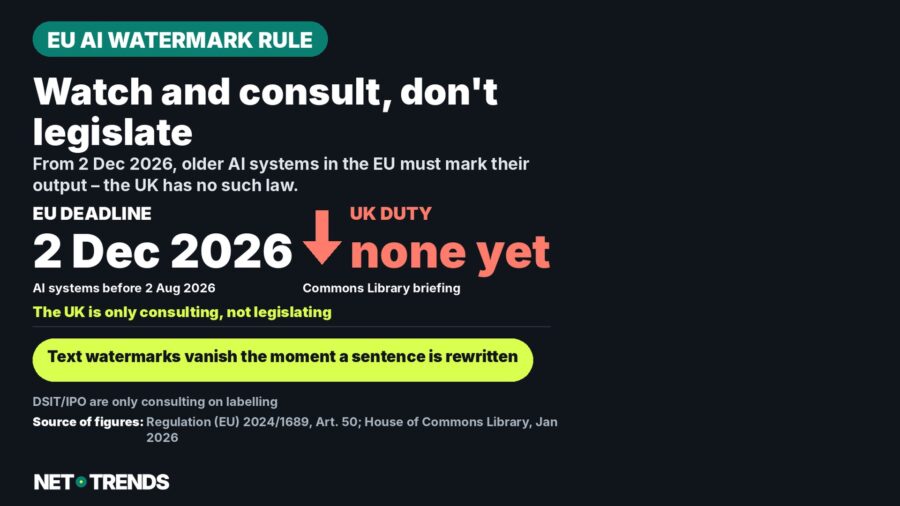
From 2 December 2026, older AI systems in the EU must also mark their output in a machine-readable way. That sounds like consumer protection, but it is mainly red tape with a built-in expiry date.
On that day, a transition period under the EU AI Act (Regulation (EU) 2024/1689) ends. It affects providers, that is the makers of image, video and text generators whose systems were already on the market before 2 August 2026. The legal basis is Article 50(2). It requires artificially generated content to be technically detectable, for example through metadata or digital watermarks. For British providers, the rule applies as soon as they place their systems on the EU market (Article 2); within the United Kingdom itself, the EU rules do not apply.
Watermarks in text: little more than a pattern
The problem is clearest with text. A watermark in language is merely a statistical pattern: the AI chooses its words according to a hidden rule, and a detection program later recognises that rule. Google already uses such a method under the name SynthID.
Anyone who rearranges, translates or shortens a sentence destroys this pattern. Plain text has no metadata the way image files do. The regulation itself knows this: it only requires marking “as far as this is technically feasible”. A law that ships with its own exemption ends up regulating very little.
Images are hardly better
Metadata disappears as soon as a platform resizes an image or someone takes a screenshot. Watermarks embedded in the pixels are more robust, but not safe against targeted manipulation either. Anyone who wants to spread disinformation uses models outside the EU rules or removes the marking.
In June 2026, the European Commission presented a voluntary code of practice on labelling AI-generated content. It relies on several layers of metadata and watermarks. It does not offer a reliable solution for text either.
Who the obligation really hits
Large US corporations build the technology in on the side. Small European providers have to find money, lawyers and development time that they then lack in competition. A rule meant to make Europe more sovereign thus ends up strengthening the market leaders from across the Atlantic.
The EU has long admitted that the deadlines could not be met. With the AI omnibus regulation (EU) 2026/1744, it postponed key dates of the AI Act. That is an admission that regulation moved faster than the technology allows.
A sensible rule for newsrooms
For journalistic outlets, another provision matters more, and it has applied since 2 August 2026. Under Article 50(4), AI-assisted texts on matters of public interest need no label if a human has reviewed the content and a person or company bears editorial responsibility. According to the European Commission’s guidelines, a mere spell check is not enough.
Deceptively realistic AI images of real people, places or events, so-called deepfakes, must by contrast always be visibly labelled. There is nothing wrong with that. This is exactly what responsibility looks like: a human vouches for the content with their name. Under Article 99(4) of the AI Act, breaches of the transparency obligations can lead to fines of up to €15 million or 3 per cent of worldwide annual turnover.
Conclusion: responsibility instead of technical mandates
An invisible marking that vanishes at the first edit does not protect against deception. What helps are newsrooms that check, disclose their sources and are liable. The EU should strengthen this responsibility instead of burdening Europe’s AI providers with technical obligations that miss their target.
Supporters counter that even imperfect marking makes the mass of automatically generated fakes detectable, because platforms can read it automatically – especially ahead of elections. The argument deserves to be taken seriously. But it does not justify an obligation that is barely feasible for text.
Frequently asked questions
Will AI texts carry a watermark from 2 December 2026?
Providers of AI systems must mark their texts in a machine-readable way as far as this is technically feasible. Such a marking is not visible, and it is usually lost when the text is reworded.
Do news sites have to label AI-assisted texts?
Not if a human has reviewed the content and a person or company bears editorial responsibility. Without such a review, a visible notice is mandatory.
What applies to AI images?
Deceptively realistic images of real people, places or events must be visibly labelled as artificially generated. For evidently artistic or satirical works, an appropriate notice is sufficient.
What do you think: do watermarks help against AI fakes, or is the obligation mainly red tape? Tell us in the comments.
Sources and status
- Regulation (EU) 2024/1689 (AI Act), in particular Articles 50 and 99
- European Commission: Guidelines on the transparency obligations for providers and deployers of certain AI systems
- Regulation (EU) 2026/1744 amending the AI Act (AI omnibus)
- Google DeepMind: SynthID
Research and data as of: 9 November 2026.
Transparency note: AI-assisted tools were used in researching, structuring and writing this article. The sources used are listed in the article. Publication takes place only after manual editorial approval. Translation of the German original on Net Trends.
Share this article