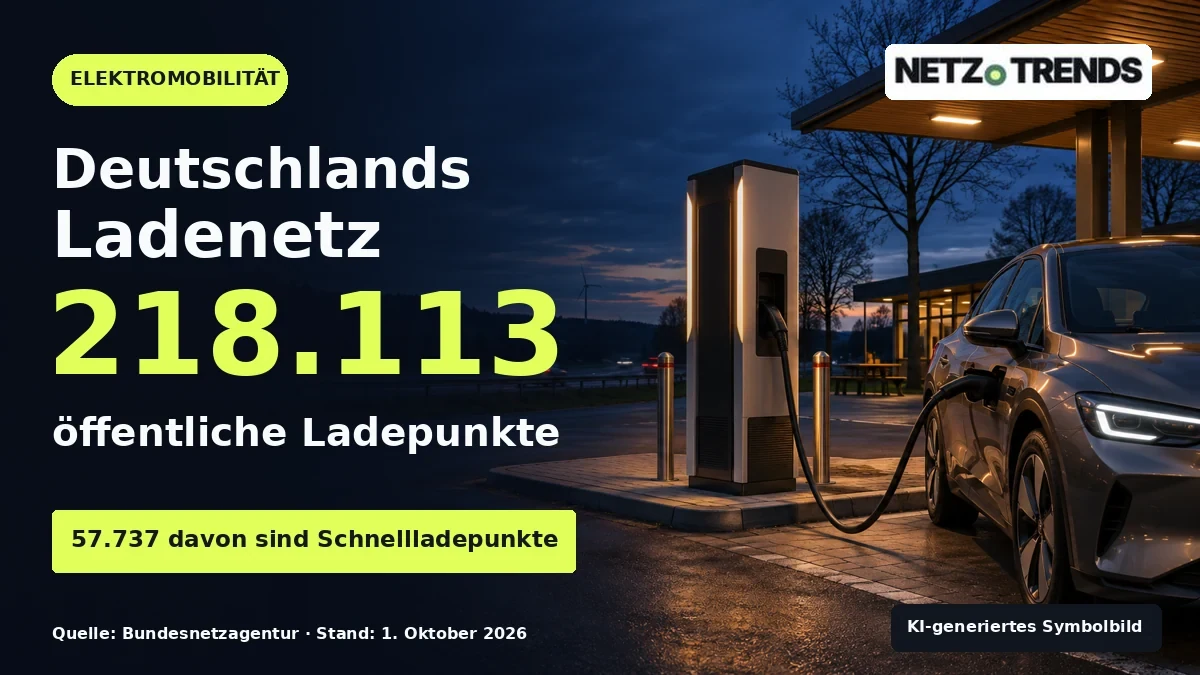
Federal data tracked by the Department of Energy shows the US passing 80,000 public charging stations and nearly 260,000 charging ports by October 2026, with DC fast chargers leading the build-out.
Key points
- Over 80,000 public EV charging stations and almost 260,000 charging ports nationwide as of October 2026 (US Department of Energy, Alternative Fuels Data Center).
- More than 75,000 of those ports are DC fast chargers, the category used for highway road trips.
- ChargePoint remains the largest network operator, with 47,811 stations and 84,053 ports as of October 2026.
- California alone counted roughly 49,000 public chargers as of its most recent state count, by far the largest state network.
The US public charging network has passed 80,000 stations and almost 260,000 ports as of October 2026. DC fast chargers, the category that matters most for road trips, are growing fastest of all.
The figures come from the federal Alternative Fuels Data Center (AFDC), run by the Department of Energy, which is the closest thing the US has to an official national count. Unlike Europe, there is no single national regulator comparable to Germany’s Bundesnetzagentur — AFDC aggregates data reported by networks and states.
Where the network stands nationally
AFDC’s October 2026 figures put the US at more than 80,000 public charging stations and almost 260,000 individual charging ports — a single station can have several ports. ChargePoint is the largest single network by far, reporting 47,811 stations and 84,053 ports as of October 2026.
No single federal law requires charging networks to report in the same standardized way German operators must report to the Bundesnetzagentur, so AFDC’s figures are a best-available aggregate rather than a legally mandated census.
DC fast charging
More than 75,000 of the nation’s public ports are DC fast chargers — the category Tesla’s Supercharger network, Electrify America, EVgo and others operate along highway corridors. This is the segment that determines whether long-distance EV road trips are realistic in a given region.
Federal funding through the National Electric Vehicle Infrastructure (NEVI) program, administered by the Federal Highway Administration, continues to co-fund fast-charging corridors on designated Alternative Fuel Corridors, though the pace of individual state rollouts varies widely.
Why state matters more than in Germany
Because charging rules, utility incentives and even connector standards have historically varied by state, the US picture is less uniform than Germany’s nationwide Bundesnetzagentur count. California, with roughly 49,000 public chargers in its most recent state-level count, has by far the largest network of any state and continues to set the pace for charger density.
States such as Texas, New York and Florida follow at a considerable distance, and rural states in the Mountain West and parts of the South still have comparatively sparse rapid-charging coverage, according to AFDC’s state-by-state station locator.
What this means if you’re buying an EV
Before you buy
- Check the AFDC station locator or PlugShare for charger density specifically in your state and along routes you drive regularly.
- Confirm which connector standard (CCS, NACS/Tesla) your prospective vehicle uses — most new US models are shifting to NACS, but compatibility still varies by charging network.
- Public charging prices are not regulated nationally and are quoted per kWh or per minute depending on the operator — compare both before committing to a membership plan.
- Published prices generally exclude state and local sales tax, which varies by state.
None of this changes week to week, but the gap between well-served states like California and sparser ones is still the single biggest factor in how practical an EV is for long trips.
Growth in numbers
| Measure | Value |
|---|---|
| Public charging stations (nationwide) | 80,000+ |
| Public charging ports (nationwide) | ~260,000 |
| DC fast charging ports | 75,000+ |
| ChargePoint network (stations / ports) | 47,811 / 84,053 |
| California public chargers (largest state) | ~49,000 |
Nationwide figures: US Department of Energy, Alternative Fuels Data Center, as of October 2026. ChargePoint figures as of October 2026. California figure from the California Energy Commission’s most recent public count. Stand: 15 November 2026.
AFDC’s station locator updates continuously, so for a specific trip, checking it or a crowdsourced app like PlugShare directly is more reliable than any single nationwide snapshot.
Frequently asked questions
How many public EV charging stations are there in the US?
Over 80,000 stations and almost 260,000 individual charging ports nationwide as of October 2026, according to the Department of Energy’s Alternative Fuels Data Center.
How many of those are DC fast chargers?
More than 75,000 ports are DC fast chargers, the category used for highway and long-distance driving.
Which state has the most public chargers?
California, with roughly 49,000 public chargers in its most recent state-level count — by far the largest network of any US state.
Do public charging prices include sales tax?
Generally no. Published per-kWh or per-minute prices from charging networks typically exclude state and local sales tax, which varies by state.
Sources and status
- US Department of Energy, Alternative Fuels Data Center (AFDC), national charging station and port counts, October 2026 — afdc.energy.gov
- ChargePoint network station and port figures, October 2026 — chargepoint.com
- Net Trends, “Deutschlands Ladenetz wächst auf 218.113 Ladepunkte, 26,5 Prozent laden schnell” (in German) — netz-trends.de
Research and data as of: 15 November 2026.
Transparency note: AI-assisted tools were used in researching, structuring and writing this article. The sources used are listed in the article. Publication takes place only after manual editorial approval. Country edition based on an article from Net Trends, researched for the US. Image note of the original: AI-generated symbolic image.
Share this article
Kommentieren Sag uns deine Meinung →