A user reports around 20 prompts with no account access after an accepted text message. What US regulators say about biometric checks.
Key points
- A Wise customer reports roughly 20 photo and positioning prompts after an SMS confirmation had already been accepted.
- The footage supplied also shows a manual review option and a notice that the face scan may be stored for up to a year.
- The research sets out general US and international data protection standards and other public complaints; it is not a regulatory finding against Wise in this case.
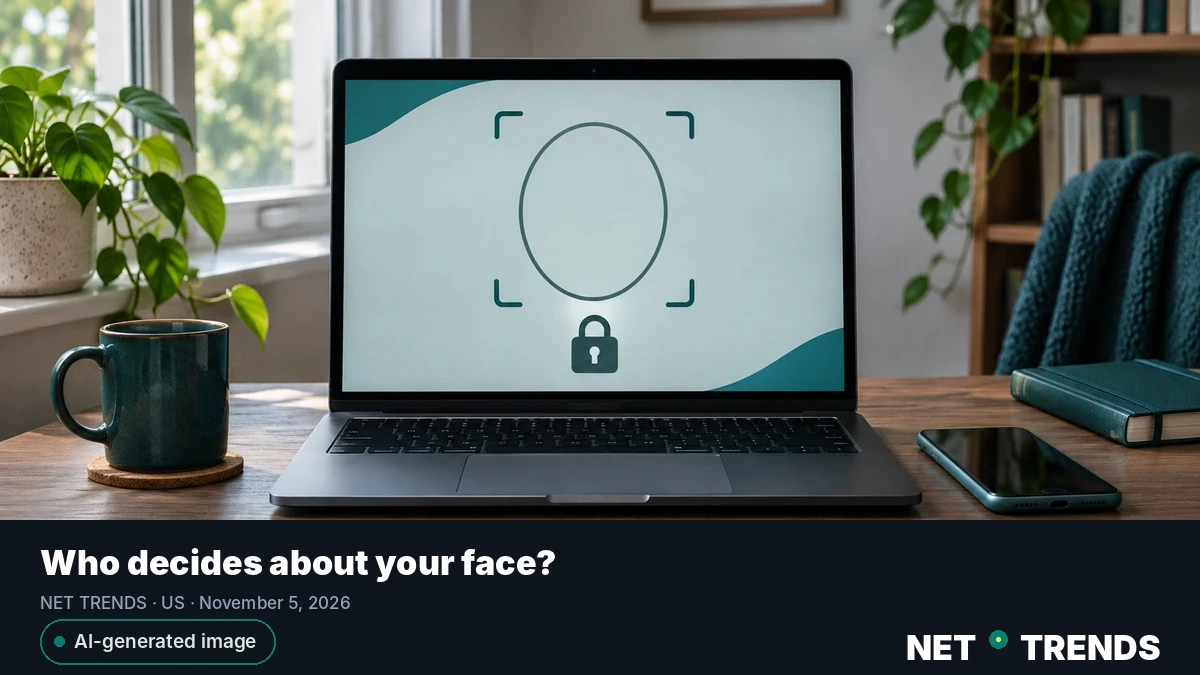
A Wise user says his SMS confirmation was accepted, yet he was repeatedly asked to reposition his face in front of the camera and was not granted access to his account. He objects to a biometric check carried out against his will. The Federal Trade Commission has publicly warned about the risks of biometric technologies.
SMS accepted, still no access
Closer to the camera, then further away, then another attempt: that is how the user, speaking to Net Trends on November 5, 2026, describes his login process. He says he received around 20 prompts. Although his SMS confirmation had been accepted, he had still not been able to access his account after several minutes. He objects to the digital measurement of his face and describes the process as harassment.
The complaint is about more than a malfunctioning camera. Someone who needs access to an existing financial account is under practical pressure. The editorial question is: what genuinely usable route is left for someone who does not want to consent to automated facial analysis? A repeating sequence of failed capture attempts does not answer that question.
What the user’s own footage shows
The screenshots document a prompt to retake a selfie. The roughly 39-second video also shows a “No, verify manually” option. Alongside the automatic option, the screen states that the face scan may be stored for up to a year. The manual route shown can reportedly take up to one business day. These details come from the on-screen text visible in the video, not from any confirmation of how this specific case was resolved.
A blanket claim that Wise offers no manual route at all would therefore be inaccurate. What remains open is whether that route actually worked in this case, what data processing actually took place, and when access was eventually restored.
Wise’s own notice on face scans and consent
Wise sets out face scans, consent and fraud prevention in its own biometric data notice. Wise: Biometric Data Processing Notice. In the United States, cross-border transfers are handled by Wise US Inc., a licensed money transmitter that is not a bank and whose funds are not FDIC-insured, as the company discloses in its US terms. Wise describes two-step verification as an additional account safeguard. Wise: two-step verification.
An accepted SMS confirmation on its own proves neither that any further check is unlawful, nor that biometric processing against a declared refusal would be lawful. These are two separate questions.
What US regulators say about biometric checks
There is no single federal biometric privacy law in the United States; rules vary by state, with laws such as Illinois’ Biometric Information Privacy Act (BIPA) imposing consent requirements on companies operating there. At the federal level, the Federal Trade Commission (FTC) has warned that the use of biometric information, including facial recognition, can create risks of privacy harm, bias and inaccuracy for consumers, and has said it will scrutinize whether companies’ claims and practices around biometric tools are deceptive or unfair. FTC: Biometric information policy statement, May 18, 2023.
The European Data Protection Board sets a comparable standard for users in the EU, requiring a non-biometric alternative where consent under Article 9 GDPR is the legal basis for using facial recognition. EDPB: Guidelines 3/2019, paragraph 86. These are general standards from different legal systems, not a finding against Wise. What matters in any individual case is the applicable law, the purpose of the processing, and how the process was actually carried out.
Public complaints and counterpoints
On Reddit, reports of rejected selfies sit alongside comments describing trouble-free checks. Reddit: rejected selfies and mixed experiences. Another Reddit post complains about a missing manual option despite having withdrawn biometric consent. Reddit: Manual Verification Gone. Hacker News has documented complaints about failed selfie checks since October 28, 2023. Hacker News: user account, October 28, 2023.
Such posts are personal, independently unverified accounts. They show that these difficulties are discussed publicly; they do not establish how common the problem is, nor do they prove a current global outage or the technical process in this particular case.
Wise has not yet been approached by Net Trends about this individual case. The company pages reviewed are general publications, not a case-specific statement. The user’s criticism is reported as such; no legally established violation is alleged.
Frequently asked questions
Does an accepted SMS confirmation prove no further check is allowed?
No. Whether further identity checks are permitted, and whether a specific biometric method may be used for that purpose, are separate questions.
Is there a federal US law specifically covering biometric data like face scans?
No single federal biometric privacy statute exists; protections vary by state, while the FTC addresses biometric practices under its general consumer protection authority.
Is the manual verification option documented?
Yes, it is visible in the video supplied. Whether it worked successfully in this case remains open.
Sources and status
- Wise: Biometric Data Processing Notice
- Wise: two-step verification
- FTC: Biometric information policy statement, May 18, 2023
- EDPB: Guidelines 3/2019, paragraph 86
- Reddit: rejected selfies and mixed experiences
- Reddit: Manual Verification Gone
- Hacker News: user account, October 28, 2023
Research and data as of November 5, 2026.
Transparency note: AI-assisted tools were used in researching, structuring and writing this article. The sources used are listed in the article. Publication takes place only after manual editorial approval. The report is based on image evidence supplied by the affected user, his account, and linked primary sources. Forum posts are unverified personal accounts. The user’s face, account links and unedited private footage are not published. This is a country adaptation based on an article from Net Trends, researched for the United States.
Share this article