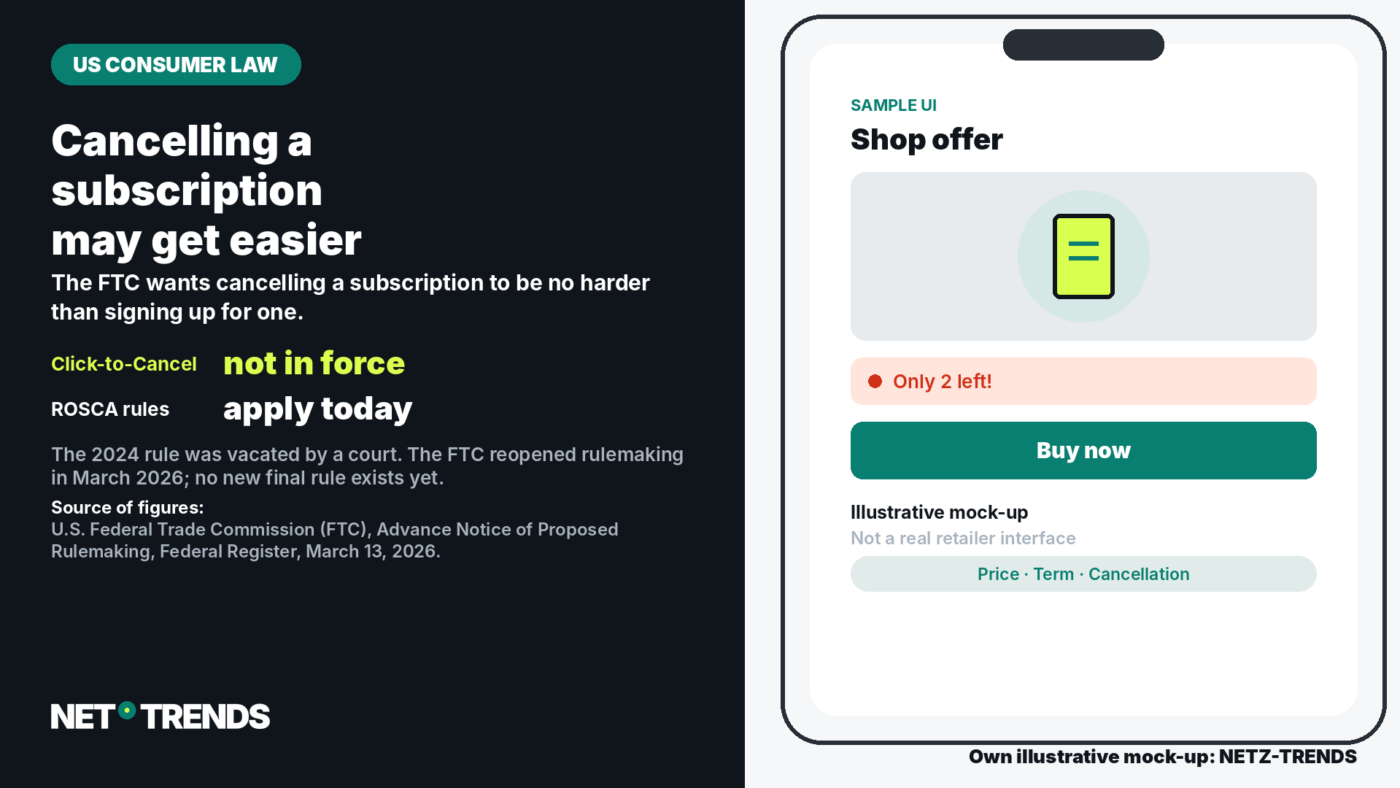
A federal court struck down the FTC’s 2024 click-to-cancel rule in 2025. The agency reopened rulemaking in March 2026, but no new final rule exists yet.
Key points
- The Federal Trade Commission’s 2024 “click-to-cancel” rule was vacated in full by the Eighth Circuit Court of Appeals in 2025.
- In March 2026 the FTC opened a new rulemaking process on negative-option subscriptions; public comments closed April 13, 2026.
- There is no new final click-to-cancel rule in effect today, and none is guaranteed.
- Cancelling online subscriptions is still regulated today under the 2010 Restore Online Shoppers’ Confidence Act (ROSCA) and about 30 state laws.
Cancelling an online subscription is not getting any easier under federal rules right now, even though the Federal Trade Commission (FTC) wants it to be. A federal appeals court struck down the agency’s 2024 “click-to-cancel” rule in 2025, and while the FTC restarted the rulemaking process in March 2026, there is still no new rule in force. Existing law already requires some cancellation protections, and the agency keeps enforcing those.
The vacated 2024 rule would have required sellers to let consumers cancel a recurring subscription through the same method they used to sign up, and no more difficult. The Eighth Circuit Court of Appeals threw it out because the FTC had skipped a preliminary regulatory analysis the law requires before such a rule can take effect – a procedural flaw, not a ruling on the substance of click-to-cancel itself.
Why the 2024 rule was struck down
The FTC finalized its Negative Option Rule, widely known as the click-to-cancel rule, in October 2024. It would have required clear disclosure of subscription terms before billing, informed consent before charging a consumer, and a cancellation mechanism no more complicated than the sign-up process. Business groups challenged it in court, and the U.S. Court of Appeals for the Eighth Circuit vacated the rule entirely in 2025, ruling that the FTC had failed to complete a required preliminary regulatory analysis before finalizing it.
Because the court’s decision rested on that procedural step rather than on the substance of the rule, the FTC was free to start over. It did not appeal further.
What the FTC is doing now
On March 13, 2026, the FTC published an Advance Notice of Proposed Rulemaking (ANPRM) in the Federal Register, reopening the question of how to regulate negative-option subscriptions. An ANPRM is an early step: it asks the public questions and gathers comment before the FTC drafts an actual proposed rule. The comment period closed on April 13, 2026, and the agency received roughly 100 submissions.
No proposed rule, let alone a final one, has been published since. Consumers and businesses should not assume a replacement click-to-cancel rule is imminent or will look exactly like the vacated 2024 version.
What rules apply to subscriptions today
Without the vacated rule, the FTC relies on Section 5 of the FTC Act, which prohibits unfair or deceptive practices generally, and on the Restore Online Shoppers’ Confidence Act (ROSCA), a 2010 law that applies specifically to internet transactions. ROSCA already requires sellers using a negative-option feature online to clearly disclose all material terms before taking billing information, to get a consumer’s express informed consent before charging them, and to provide a “simple mechanism” for the consumer to stop recurring charges. ROSCA does not define exactly what counts as a “simple mechanism,” which leaves room for FTC enforcement action case by case.
On top of federal law, about 30 U.S. states have their own automatic-renewal or negative-option laws, and some go further than the vacated federal rule. California’s law, for example, requires sellers to send an acknowledgment and, for certain terms, an annual renewal reminder.
Recent enforcement cases
The FTC has kept bringing cancellation-related cases under ROSCA and Section 5 rather than waiting for a new rule. In 2024, childcare platform Care.com agreed to pay $8.5 million to settle FTC allegations over its billing and cancellation practices. Separately, Amazon agreed to a $2.5 billion settlement over how it enrolled and retained Prime members, one of the largest consumer-protection settlements the agency has obtained. In another case, against telehealth marketer NextMed, the FTC alleged violations that mirrored the substance of the vacated 2024 rule, framed instead as ordinary Section 5 violations.
That pattern – enforcing the same underlying consumer protections through existing law rather than the vacated rule – is likely to continue for as long as no new final rule is in place.
Frequently asked questions
Is the FTC’s click-to-cancel rule back in force?
No. The 2024 rule was vacated by the Eighth Circuit Court of Appeals in 2025. The FTC opened a new rulemaking process in March 2026, but no new rule has been finalized.
Can companies still make it hard to cancel a subscription?
They are not supposed to under existing law. The Restore Online Shoppers’ Confidence Act (ROSCA) already requires a “simple mechanism” to stop recurring charges on internet transactions, and the FTC can bring enforcement action under ROSCA and Section 5 of the FTC Act without a dedicated click-to-cancel rule.
Do state laws offer more protection than federal law?
In some cases, yes. About 30 states have automatic-renewal laws, and some, like California’s, add requirements such as annual renewal reminders that go beyond the vacated federal rule.
When will a new federal click-to-cancel rule take effect?
There is no confirmed date. The FTC is still at the advance-notice stage of rulemaking as of this article’s publication, and a formal proposed rule has not yet been published.
Tell us what you think: have you had trouble cancelling an online subscription, and did a published cancellation link actually work?
Sources and status
- U.S. Federal Trade Commission: Advance Notice of Proposed Rulemaking on the Negative Option Rule, Federal Register, March 13, 2026
- U.S. Federal Trade Commission: Negative Option Rule (click-to-cancel), Federal Register, November 15, 2024, later vacated
Research and data as of 12 November 2026. The status of FTC rulemaking can change; figures and case outcomes are drawn from the agency’s own filings and public settlements.
Transparency note: AI-assisted tools were used in researching, structuring and writing this article. The sources used are listed in the article. Publication takes place only after manual editorial approval. Country edition based on an article originally published on Net Trends, researched independently for the United States.
Share this article