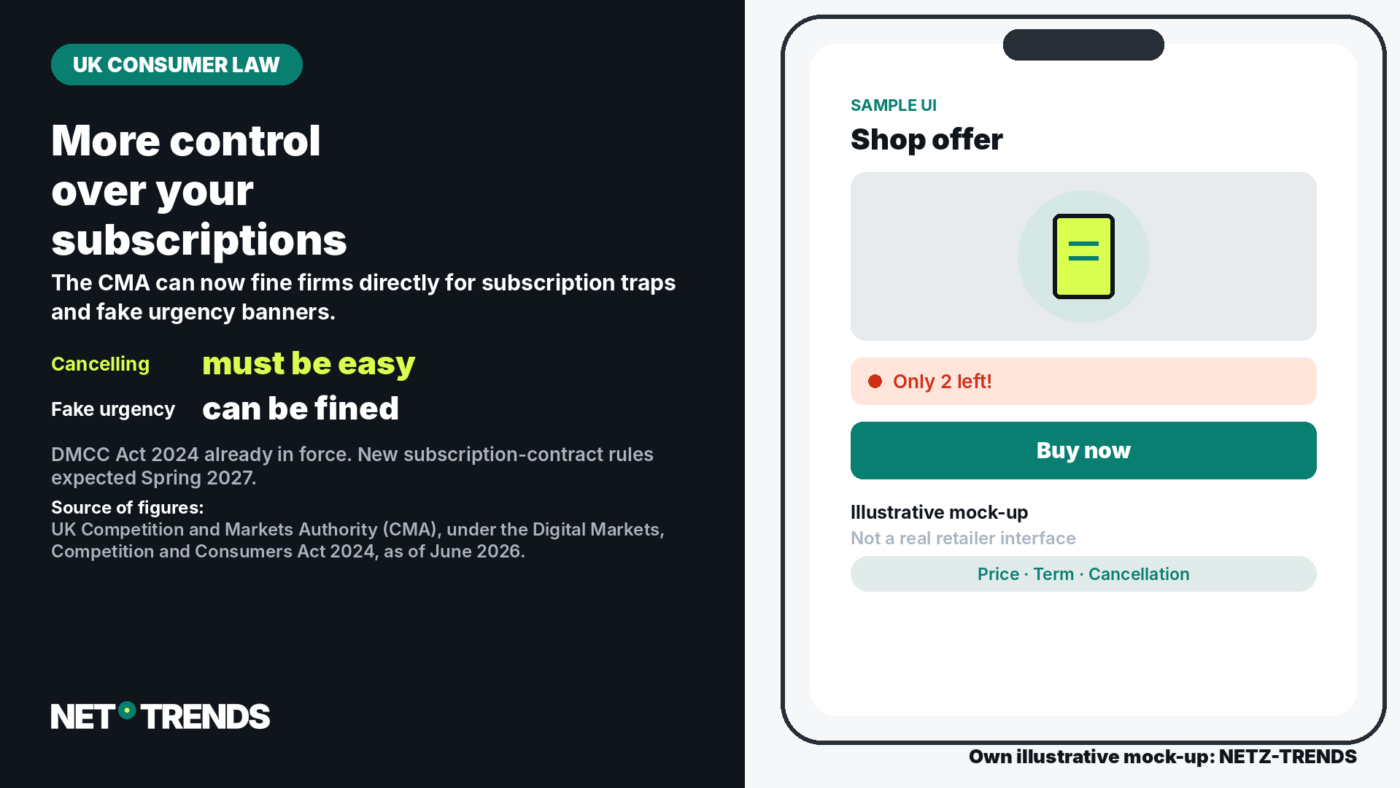
The Competition and Markets Authority can fine firms directly for subscription traps and misleading urgency banners. New subscription-contract rules are expected in 2027.
Key points
- Since April 2025, the UK Competition and Markets Authority (CMA) can fine firms itself for unfair consumer practices, without going to court first.
- In 2026 it has already fined companies over automatic opt-ins, drip pricing and misleading checkout design.
- New rules specifically on subscription cancellation are expected under the Digital Markets, Competition and Consumers Act 2024 in Spring 2027.
- Today’s contracts and cancellation rights do not change because of this: existing consumer law already applies.
Shoppers in the UK already have a regulator that can act fast against subscription traps and fake urgency banners. Since April 2025, the Competition and Markets Authority (CMA) has had the power to fine firms directly under the Digital Markets, Competition and Consumers Act 2024 (DMCC Act), without first going through the courts. In 2026 it used that power several times, and separate rules aimed specifically at subscription cancellation are due in Spring 2027.
The DMCC Act gives the CMA new tools for exactly the kind of practices this is about: artificial countdowns, “only 2 left” style scarcity claims that are not true, pre-ticked extra charges, and checkout journeys that make buying far easier than cancelling. The Act also lists 32 practices that count as unfair in all circumstances.
What the CMA can now do
Before April 2025, the CMA had to ask a court to rule that a business had broken consumer law. Under the DMCC Act, it can now investigate and decide this itself, and it can fine a business up to £300,000 or 10% of its global annual turnover, whichever is higher, for a substantive breach. Failing to answer an information request can bring penalties of up to 1% of global turnover, plus daily fines on top.
The CMA can also order “enhanced consumer measures”, such as compelling a company to pay compensation to affected customers directly, issue public notices on its website, and in some cases pursue criminal sanctions. It reviewed around 400 businesses and opened 14 investigations in its first 14 months under the new powers, according to its own reporting.
What the CMA has already fined
Several 2026 cases show how this works in practice. In April 2026, driving school AA Driving School was fined £4.2 million and ordered to refund more than £760,000 over “drip pricing” – advertising a low headline price and adding mandatory extra charges later in the checkout. In June 2026, electronics retailer Marks Electrical was fined £720,000 and ordered to refund around £600,000 to about 40,000 customers after automatically opting them into extra paid services; the company received a 40% discount on its fine for admitting the breach early.
The CMA also opened investigations into Wayfair and Appliances Direct over time-limited sales offers and default opt-ins, into five businesses over fake reviews, and into Ryanair in June 2026 over a mandatory £8 “family seat” fee. In March 2026 it launched a dedicated investigation into early cancellation fees for subscriptions and contracts.
What is planned for subscriptions
Separately from the CMA’s general fining powers, the UK government has set out a dedicated subscription contracts regime under the DMCC Act. In its response to the public consultation, the Department for Business and Trade said it intends to legislate once parliamentary time allows and anticipates that the regime will commence in Spring 2027.
Under the planned rules, traders must send a written reminder before a free trial or a contract lasting 12 months or more renews automatically. If a trial converts into a paid subscription, consumers get a 14-day cooling-off period in which they can cancel and get a refund. Cancelling must not be disproportionately difficult, and anyone who signed up online must be able to cancel online as well, without being made to sit through extra offers or feedback requests first.
Until the regime commences, these specific rules are not yet in force. The CMA’s general unfair-practices powers under the DMCC Act, described above, already apply now and can be used against subscription-related dark patterns today, case by case.
What applies today
Consumers checking an online offer or subscription today should still rely on the UK’s existing consumer protection law and their contract terms: the price after any trial period, the renewal date, and the actual cancellation process. A banner claiming extreme scarcity or a countdown timer is not automatically illegal, but the DMCC Act’s unfair-practices rules can already apply if a claim is untrue or designed to mislead.
The CMA publishes its ongoing cases and guidance on its own website. Businesses operating in the UK are expected to review their checkout and subscription flows against the DMCC Act’s requirements now, rather than wait for the 2027 subscription rules.
Frequently asked questions
Can the CMA already fine a company for a subscription trap?
Yes, under its general unfair-practices powers in the Digital Markets, Competition and Consumers Act 2024, which took effect in April 2025. Rules specifically written for subscription cancellation are separate and are expected in Spring 2027.
Has my right to cancel a subscription already changed?
Not yet. The new reminder, cooling-off and easy-cancellation rules are expected to commence in Spring 2027. Until then, your cancellation rights are set by your contract and by existing UK consumer law, which the CMA can already enforce.
How high can a CMA fine be?
Up to £300,000 or 10% of a company’s global annual turnover, whichever is higher, for a substantive breach of the unfair-practices rules under the DMCC Act.
Does this only affect UK retailers?
No. The CMA’s cases in 2026 have covered UK and international businesses selling to UK consumers, including driving schools, retailers and online marketplaces.
Tell us what you think: which online shopping trick annoys you the most – fake countdowns, hidden fees at checkout, or subscriptions that are hard to cancel?
Sources and status
- UK Parliament: Digital Markets, Competition and Consumers Act 2024, full text
- UK Competition and Markets Authority (CMA): consumer protection cases and guidance
- CMA: draft annual plan 2026 to 2029, consumer protection priorities
- UK Department for Business and Trade: government response on the new subscription contracts regime, 2 April 2026
Research and data as of 12 November 2026. CMA case figures and timelines are drawn from its own published cases and plans and may be updated as investigations conclude.
Transparency note: AI-assisted tools were used in researching, structuring and writing this article. The sources used are listed in the article. Publication takes place only after manual editorial approval. Country edition based on an article originally published on Net Trends, researched for the United Kingdom.
Share this article