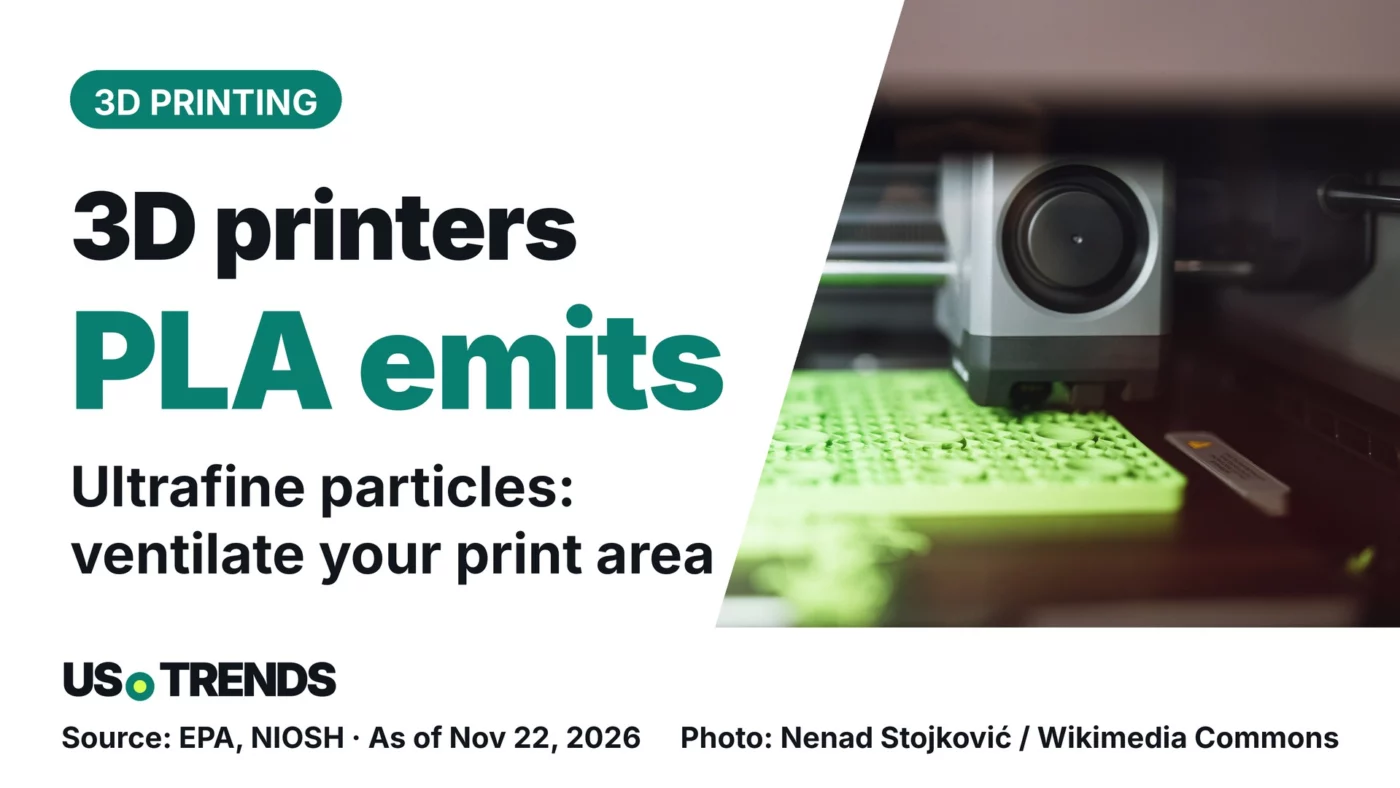
Desktop 3D printers give off ultrafine particles even with PLA filament – what EPA and NIOSH research means for your print area.
Key points
- The U.S. Environmental Protection Agency (EPA) reports that most particles from both PLA and ABS filament are ultrafine, between 1 and 100 nanometers.
- According to EPA, ABS produced greater particle numbers than PLA, but PLA is not emission-free.
- NIOSH recommends proper ventilation and HEPA filtration as engineering controls and says the health effects are not fully understood.
3D printers can release ultrafine particles even when they print with PLA. If you run one at home, decide where it goes and how the room is ventilated before the first print.
PLA, short for polylactic acid, is often marketed as the easy, low-odor filament for beginners. It does tend to emit less than ABS. But lower emissions are not the same as none, and federal research makes that point clearly.
The findings are not a new warning about a specific printer model. They describe how fused-filament printing works in general, which is why they apply to the printer you already own or plan to buy.
EPA: most particles are ultrafine
EPA researchers have been studying emissions from 3D printers for years. Most particles from both PLA and ABS were ultrafine, sized between 1 and 100 nanometers, small enough to reach deep into the respiratory system. Printing also releases volatile organic compounds, some of which the agency describes as hazardous when inhaled.
ABS, which is made from petroleum, produced greater particle numbers than PLA, which comes from renewable sources. EPA reviewed 16 different 3D printer emission studies and modeled exposure for children from three months to 18 years old. The highest predicted mass deposition was in the 9-to-18 age range, mostly in the lungs.
Measured emissions are not a health forecast
Detecting particles does not mean every print job causes harm. In a study by the National Institute for Occupational Safety and Health (NIOSH), levels in a ventilated conference room with up to 20 printers were much lower than in a test chamber. The researchers attributed that to dilution in the larger, ventilated space.
NIOSH also notes that there are no occupational exposure limits for 3D printer emissions and that possible toxic effects are not fully understood. A single test setup therefore cannot clear every home office or garage.
How to set up your print area
In its guidance Safe 3D Printing is for Everyone, Everywhere, NIOSH ranks controls by how well they work. It is written for schools, libraries, makerspaces and small businesses, but the order of steps also makes sense at home.
Getting your print area ready
- Read the manuals
Check the printer manual and the filament maker's data on material and nozzle temperature.
- Pick a less hazardous material
NIOSH lists substituting less hazardous materials as more effective than protective gear; EPA found PLA produced fewer particles than ABS.
- Ventilate the room
NIOSH names proper ventilation as an engineering control for source control.
- Consider filtration
NIOSH recommends HEPA filters alongside ventilation; some printers offer optional emission control features.
- Supervise young users
EPA's modeling showed the highest predicted deposition in children aged 9 to 18.
Avoid sitting right next to a running printer for long stretches, and keep the room well aired. If it is unclear how an enclosure or filter on your model should be used, ask the manufacturer before you start printing.
Frequently asked questions
Is PLA fume-free when 3D printing?
No. EPA found that most particles from both PLA and ABS are ultrafine. ABS produced greater particle numbers.
Can one study tell me my personal risk?
No. Room size, ventilation and print settings differ. NIOSH says the health effects are not fully understood.
What does NIOSH recommend?
Less hazardous materials where possible, proper ventilation and HEPA filtration. Protective equipment is a last resort.
Your view: Where does your 3D printer sit, and how do you ventilate the room? Tell us about your experience in the comments.
Sources and date
- U.S. Environmental Protection Agency: EPA Researchers Continue to Study the Emissions of 3D Printers (research article, June 15, 2021, updated October 8, 2026)
- NIOSH: Characterizing 3D Printing Emissions and Controls in an Office Environment (research bulletin, August 16, 2018)
- NIOSH: Safe 3D Printing is for Everyone, Everywhere (science bulletin, July 29, 2024)
As of: 11/22/2026
Transparency note: AI-assisted tools were used in researching, structuring and writing this article. The sources used are listed in the article. Publication takes place only after manual editorial approval.
Share this article