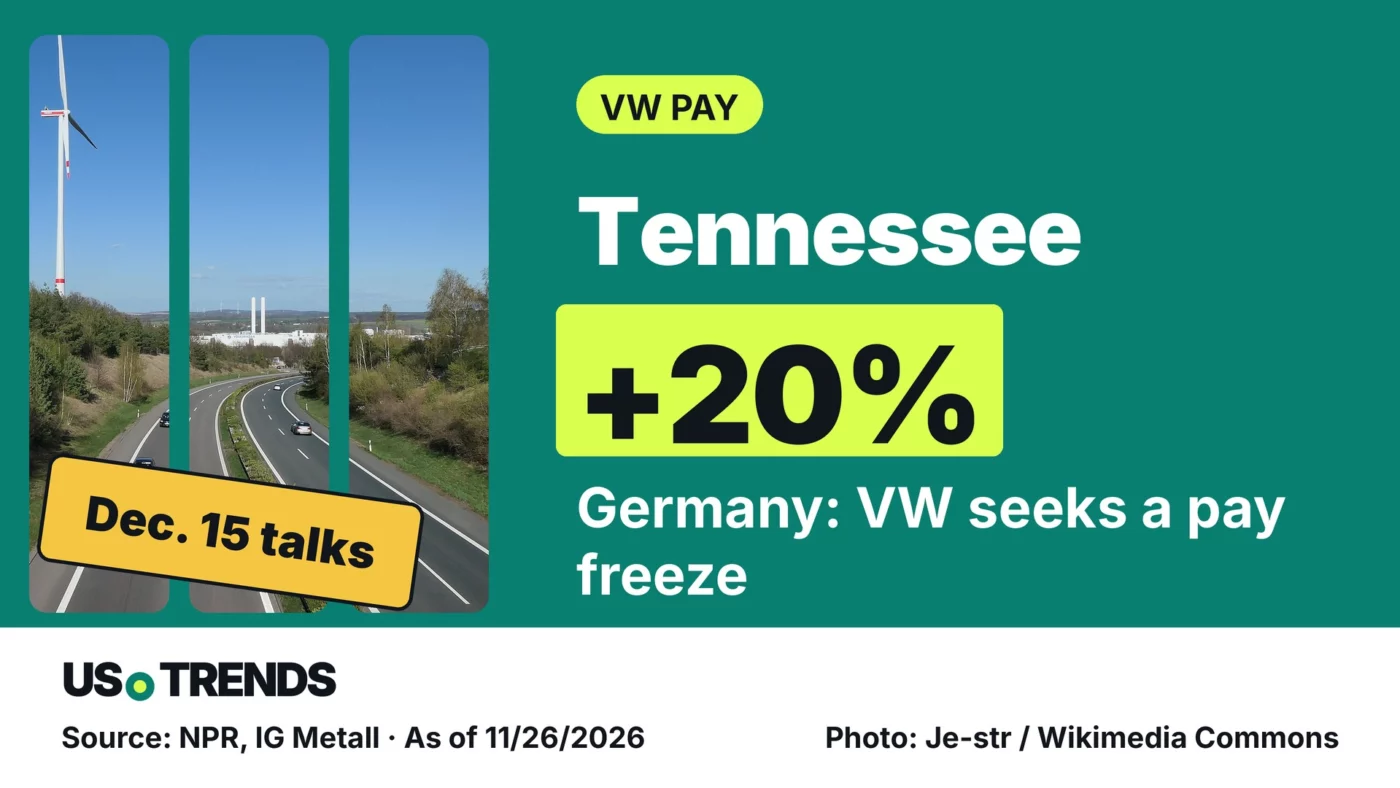
Volkswagen wants a two-year pay freeze in Germany, while its Tennessee workers have a contract with 20% raises through 2030.
Key points
- The first round of VW’s German pay talks ended on November 24, 2026 in Emden after about 90 minutes, with no result.
- VW asks for no pay rises in 2027 and 2028 for about 120,000 employees at nine German sites; talks resume December 15 in Zwickau.
- In Chattanooga, Tennessee, workers ratified their first UAW contract in February 2026 with 96% approval and 20% raises through February 2030.
- Warning strikes in Germany are allowed from January 1, 2027.
Volkswagen’s first round of pay talks with Germany’s IG Metall union ended without a result on November 24, 2026. The company wants a two-year pay freeze, while its workers in Tennessee hold a contract with 20% raises.
For US readers, the story is a contrast between two sets of workers at the same carmaker. The German talks concern a company-specific pay agreement that VW terminated at the end of the year, while the Tennessee deal is a first contract under US labor law. The two negotiations are separate; none of the sources we checked links them.
Germany: first round ends after 90 minutes
According to IG Metall, the first round took place at the Nordseehalle in Emden and lasted about an hour and a half. Roughly 4,500 employees demonstrated outside. The agreement covers about 120,000 people at nine German VW locations, including Wolfsburg, Emden, Hanover and Zwickau, plus some subsidiaries such as Volkswagen Financial Services.
Union negotiator Thorsten Gröger called the company’s package “not a basis for negotiation, but a declaration of war.” He said IG Metall expects proposals from VW’s board before the next round; without them, the union has announced a “tough confrontation” for early January.
We had no statement from Volkswagen on the first round at press time. Before the talks, the company set out its position in a press release: no pay rise for 2027 and 2028, an end to a collectively agreed supplement worth 27.5% of average monthly earnings (or, alternatively, six days off), an end to a monthly allowance of €167, and weekly hours, now 35, that flex with plant utilization. VW points to tariffs, a shrinking Chinese market and tougher competition in Europe.
The union’s math: pay could fall more than 20%
IG Metall calculates that the demands could push pay for some grades more than 20% below the metal-industry benchmark and, in the lowest grade, close to Germany’s statutory minimum wage. That is the union’s estimate; we found no confirmation or rebuttal from VW.
Tennessee: 20% raises through February 2030
Workers at VW’s Chattanooga plant ratified their first UAW (United Auto Workers) contract in February 2026, NPR reported. About 96% voted yes, after 73% backed unionizing in April 2024.
The contract brings a $6,550 bonus and 20% raises over its life, which ends in February 2030. By then the top production wage reaches $39.41 an hour and the top skilled-trades wage $49.86, plus cost-of-living adjustments. Health-care premiums fall by 20% with no increases for four years, workers get two extra days off, and VW committed to keep the plant open for the contract’s duration, according to NPR.
Two negotiations, one carmaker
First US contract ratified
96% approve 20% raises through February 2030.
German talks open in Emden
The first round ends without a result.
Second German round
Talks continue in Zwickau.
German no-strike period ends
Warning strikes are allowed from January 1.
Why the two deals are hard to compare
The German talks renegotiate an existing company agreement for 35-hour-week staff, and the union’s own demands are prospects for every site and binding agreements. The Tennessee deal is a first contract at a plant that had no union before. Pay levels, benefits and legal frameworks differ, so a raise in one country says little about what the other side will accept. What the sources do show is that VW is pushing for cost cuts in Germany while a raise schedule runs in Tennessee through 2030.
What to watch next
Mark two dates: December 15, when talks resume in Zwickau, and December 31, when the German no-strike period ends. No strike date has been set, and nothing has been agreed. US readers who follow the Chattanooga plant can note that its contract runs until February 2030 regardless of the German outcome, based on the terms NPR reported.
Frequently asked questions
When do VW and IG Metall talk again?
The next round is on December 15, 2026 in Zwickau, according to IG Metall.
Can VW workers in Germany strike?
Not yet. The no-strike period ends on December 31, 2026, and warning strikes are allowed from January 1, 2027. No date has been set.
What did Chattanooga workers win?
A $6,550 bonus, 20% raises through February 2030 and a top production wage of $39.41 an hour by 2030, according to NPR.
Does the German dispute change the Tennessee contract?
None of our sources links the two. The Tennessee contract is a separate agreement that runs to February 2030.
Your view: Should a global carmaker’s pay deals in different countries move closer together, or should they reflect local conditions? Tell us in the comments.
Sources and date
- IG Metall: Collective bargaining round Volkswagen 2026/2027 (information page, updated November 24, 2026)
- Volkswagen AG: 2026 collective bargaining negotiations: Volkswagen AG calls for significant relief in labor costs (press release, November 19, 2026)
- NPR via KPBS: In a historic vote, Tennessee Volkswagen workers get their first union contract (news report, February 19, 2026)
As of: November 26, 2026
Transparency note: AI-assisted tools were used in researching, structuring and writing this article. The sources used are listed in the article. Publication takes place only after manual editorial approval.
Share this article
Read next

Your curiosity
Our next story
Bring your ideas for AI and digital media
Discover open positions Research
 ▶ Reel