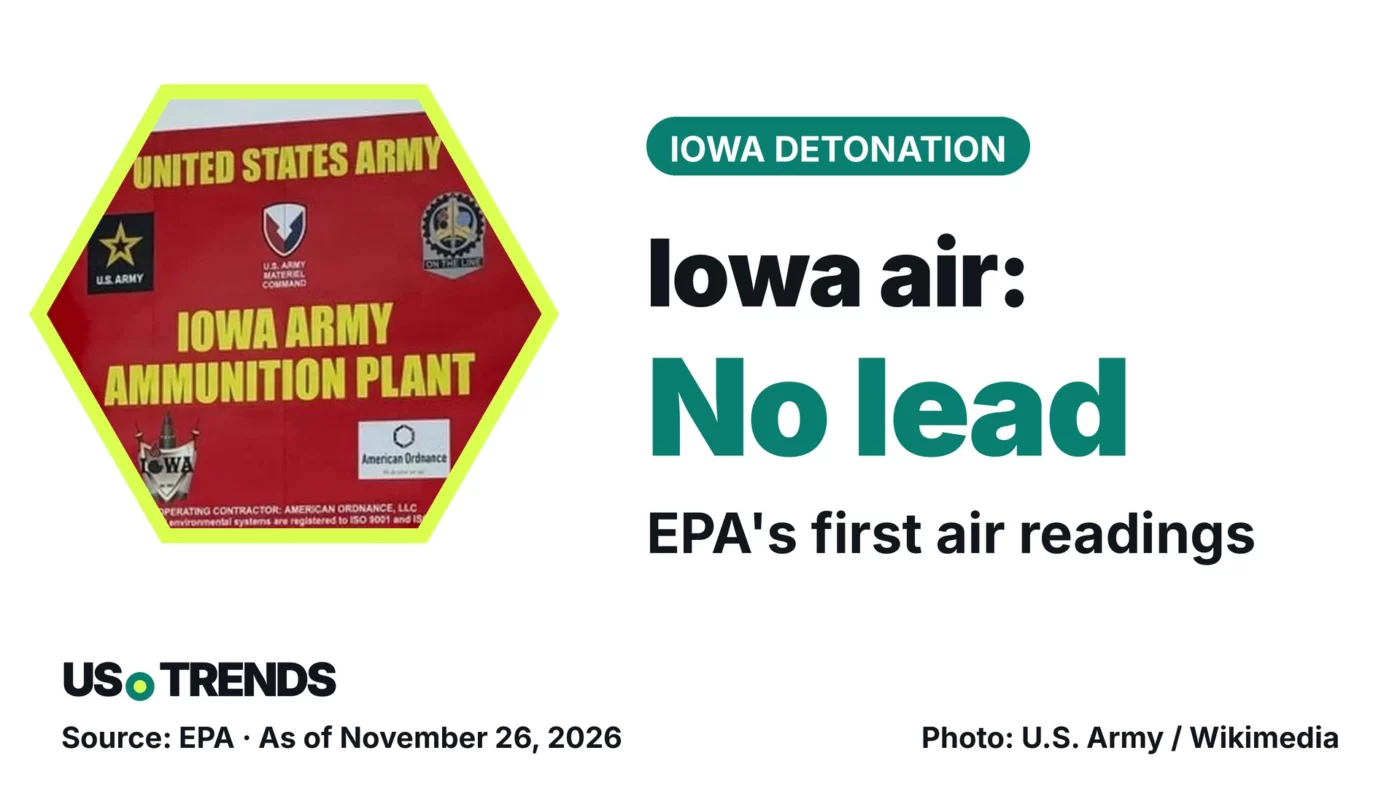
The EPA’s first air readings show no airborne lead, but residents near Middletown still wait for local all-clear notices.
Key points
- The Army destroyed about 68 drums of unstable lead azide at the Iowa Army Ammunition Plant in Middletown on Nov. 25.
- One hour later, the EPA said all of its real-time air monitors in the region showed zero detection of airborne lead.
- The EPA says it will keep sampling air, land and water and will start cleanup “if necessary.”
- The Army did not describe how residents will be told they can return home.
The Army destroyed about 68 drums of unstable lead azide at the Iowa Army Ammunition Plant on Nov. 25. One hour later, the EPA said all of its real-time air monitors in the region showed zero detection of airborne lead.
That is the claim in a news release from the Environmental Protection Agency (EPA) dated Nov. 25, 2026. The reading covers the air and one point in time. It does not settle questions about soil, water or surfaces.
What the EPA has measured so far
The EPA says its monitors kept collecting data during the entire event and reported zero detection “throughout the region” an hour after the blast. The release does not say how many monitors the agency runs. The agency posted an online dashboard where data appears as it comes in.
EPA Administrator Lee Zeldin said about 300 employees and contractors were on the ground. The agency also collected 1,200 samples of air, land, dust and water before the detonation. The release reports no results from those samples, and the EPA promises more monitoring and remediation “if necessary.”
Why the Army blew up the drums where they stood
According to the Army’s announcement, the drums held more than 9,700 pounds of net explosive weight in earth-covered magazines. The lead azide had degraded and crystallized, which makes it extremely sensitive to friction, vibration, heat and shock. Crystal buildup on the lids kept the drums from being opened or moved, and the Army judged chemical neutralization unsafe.
To limit what reached the air, the Army surrounded the bunkers with sand-filled barriers about two stories high. It also used foam and gel blocks, two walls of four 16,000-gallon water tanks, PFAS-free suppressing foam and misting units. The work ran under an emergency treatment permit from the EPA, issued under the Resource Conservation and Recovery Act (RCRA, the federal law on hazardous waste, 42 U.S.C. § 6901 ff.).
How the Iowa detonation unfolded
Missouri activates a response team
Gov. Mike Kehoe calls up a multi-agency team covering air, water, agriculture and public health.
Army announces the date, relocation begins
Residents in the recommended relocation zone near Middletown start leaving.
Detonation and first EPA readings
One hour after the blast, the EPA reports zero detection of airborne lead at its real-time monitors.
The timeline separates the Army’s plan from the EPA’s measurements. A plan describes what crews intended to do. Only the readings that follow show what actually reached the air.
Who was asked to leave, and what happens next
The Army recommended, but did not require, that residents of Middletown and nearby areas within a five-mile cone southwest of the plant relocate. A one-mile safety buffer was added. Relocation began Nov. 24, and FEMA-funded hotel stays run through Friday, Nov. 27, with extensions on request, plus food, water and transportation for those who cannot travel on their own.
People outside that zone but inside the wider advisory area were told to stay indoors, close windows and doors and set their HVAC systems to recirculate. The Army named infants, children under six, pregnant women and people with chronic illnesses as especially vulnerable.
The Army’s article does not say when or how an all-clear will be issued. It says residents should wet-wipe exterior surfaces afterward. Homes that test above the RCRA standard of 200 milligrams of lead per kilogram of soil will have soil removed and surfaces cleaned at government expense. Claims for blast-vibration damage go to the U.S. Army Claims Service.
Missouri expects low risk
The Missouri Department of Natural Resources says the plant lies 57 miles north of the state line. Its page, last dated Nov. 24, expects no sustained lead levels that threaten health or the environment. The state has contacted 10 drinking water systems with 13 intakes inside a 100-mile radius, and surface water systems are running enhanced monitoring.
Missouri’s health department rates the public health risk as low. For anyone worried about exposure, it advises keeping windows closed, shutting fresh-air intakes at home and in cars for 24 to 48 hours after the blast and covering sandboxes and playground equipment. Claims against the Army must be filed within two years on Standard Form 95.
What you can do now
Check the Army’s Iowa Army Ammunition Plant page and the EPA’s incident page for updates rather than relying on social media. Residents with questions about environmental sampling can call the EPA line at 1-833-649-9624. People who need housing help can call the FEMA helpline at 1-800-621-3362 or register at DisasterAssistance.gov. The Disaster Distress Helpline (800-985-5990) offers support by call or text around the clock.
Frequently asked questions
Has lead been detected after the Iowa detonation?
One hour after the blast, the EPA reported zero detection of airborne lead at all of its real-time monitors in the region. It has announced further sampling of air, land and water.
Why was the lead azide not moved?
The Army says the crystallized material is extremely sensitive to friction, vibration, heat and shock, and that crystals on the lids kept the drums from being opened or moved.
Is relocation mandatory?
No. The Army describes relocation within the five-mile cone southwest of the plant as recommended, not mandatory.
Your view: What would you need to see from officials before you trusted an all-clear after an event like this? Share your experience in the comments.
Sources and date
- EPA: Initial air monitoring shows zero detection of airborne lead following controlled detonation (news release, Nov. 25, 2026)
- U.S. Army: Army announces controlled detonation of degraded explosive material at Iowa Army Ammunition Plant (announcement, Nov. 24, 2026)
- Missouri Department of Natural Resources: Iowa lead azide detonation (agency page, update of Nov. 24, 2026)
As of: November 26, 2026
Transparency note: AI-assisted tools were used in researching, structuring and writing this article. The sources used are listed in the article. Publication takes place only after manual editorial approval.
Share this article
Read next


Your curiosity
Our next story
Bring your ideas for AI and digital media
Discover open positions Research
 ▶ Reel