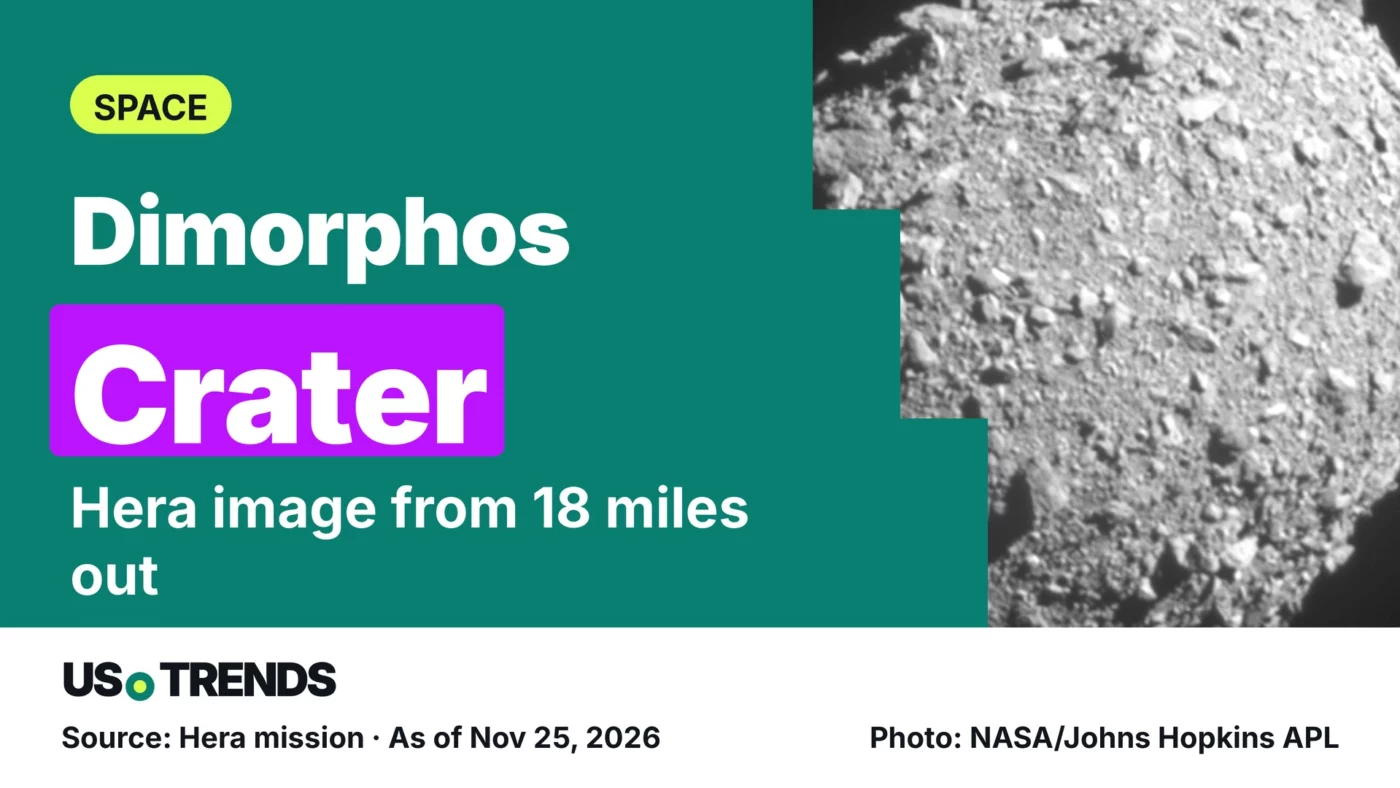
A close-up from 18 miles away shows the crater NASA’s DART left in 2022, and it appears to cover the entire side that was hit.
The European Space Agency’s Hera spacecraft has sent back a close-up of the crater NASA’s DART probe slammed into the asteroid moon Dimorphos in 2022. It appears to be as wide as the side of the asteroid that was struck.
Dimorphos is about 495 feet (151 meters) across and orbits the larger asteroid Didymos at a distance of roughly 0.6 miles (1 kilometer), according to the Hera mission. The new image answers a question the European Space Agency (ESA) had left open only days earlier.
What the Hera image shows
The picture comes from the Asteroid Framing Camera aboard Hera. According to the mission’s announcement, it was taken on November 7 from 29 kilometers (about 18 miles) away, at a resolution of 2.7 meters (about 9 feet) per pixel. The impact left a crater that seems to be as wide as the struck side of the asteroid, which the mission compares in size to a stadium.
Inside the crater, researchers can make out “strange structures,” including what looks like a cigar-shaped feature in the middle. What they are will have to be settled by further study.
The lead image is not the Hera picture. It is a NASA DART photo of Dimorphos taken 11 seconds before impact, so it shows the asteroid moon before the crater existed.
What happened in 2022
The ESA describes the impact this way: the 580-kilogram (about 1,280-pound) DART spacecraft hit Dimorphos on September 26, 2022, at 6.1 kilometers per second (about 3.8 miles per second) and shortened its orbit by roughly 33 minutes. The collision threw out a cloud of debris stretching more than 10,000 kilometers (about 6,200 miles).
On November 17, ESA was still asking whether the impact had left a crater or reshaped the whole body, calling it one of the key open questions. The new image shows a crater.
Conversions to U.S. units are the editorial team’s own calculations.
What Hera does next
Hera launched on October 7, 2024. Over the coming months, ESA says, the spacecraft is to study the impact site in detail. It will release two shoebox-sized CubeSats for a closer look and is due to land on the surface at the end of its mission. Planetary defense is one of the mission’s main goals, according to the Hera portal.
What to keep in mind: only the data from the close-up survey will show how deep the crater is and what shape the structures at its center take. The mission has promised more images.
Your view: Should we deflect an asteroid by impact to protect Earth over the long run? Tell us what you think in the comments.
Sources and date
- Hera mission: Mission announcement on the crater on Dimorphos (mission portal, accessed November 25, 2026)
- ESA: Hera surveying asteroids with superhuman vision (ESA article, November 17, 2026)
- NASA: DART’s Final Images Prior to Impact (image page, September 27, 2022)
As of: 11/25/2026
Transparency note: AI-assisted tools were used in researching, structuring and writing this article. The sources used are listed in the article. Publication takes place only after manual editorial approval.
Share this article
Read next



Your curiosity
Our next story
Bring your ideas for AI and digital media
Discover open positions Research
 ▶ Reel