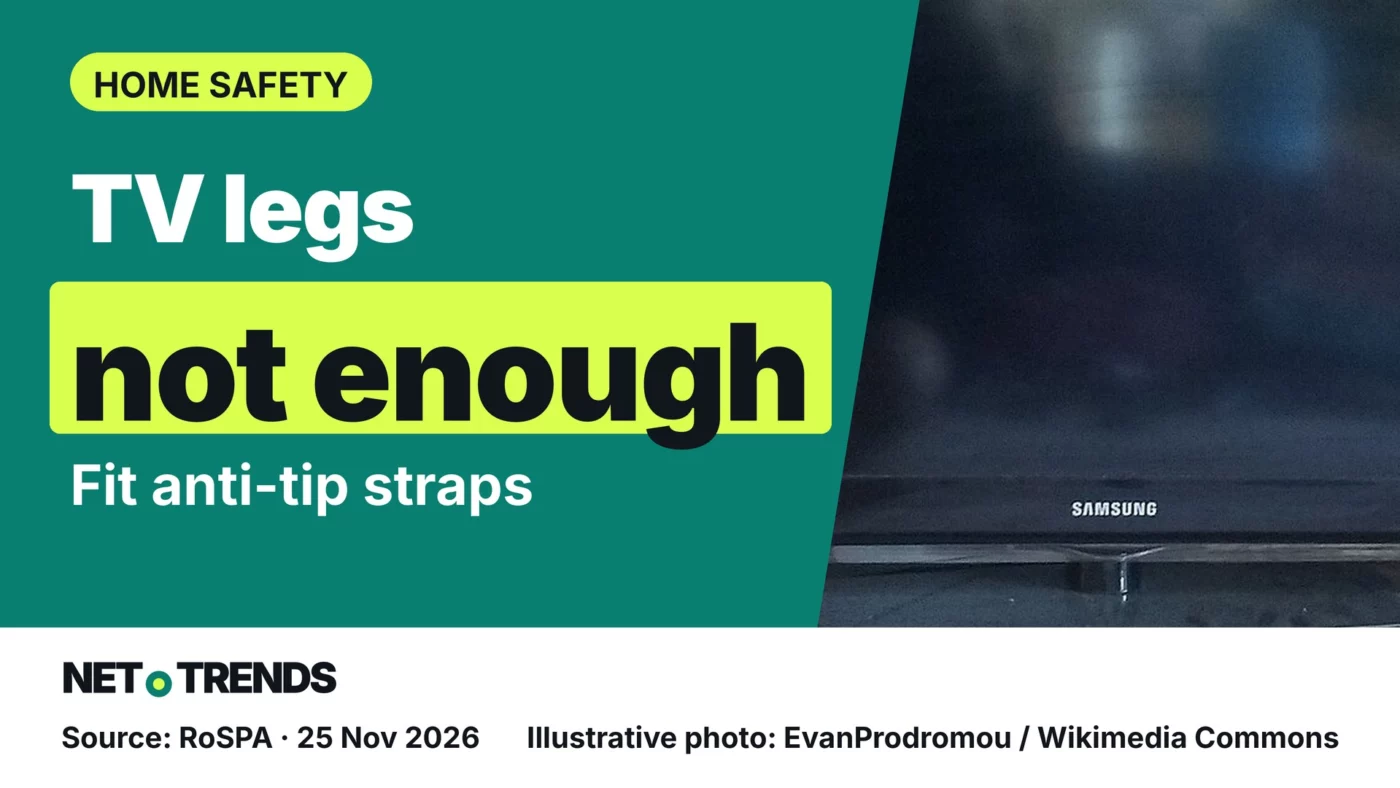
A new television needs more than a sturdy stand: check the furniture, fit an anti-tip strap and sort the cables before you set it up.
Key points
- The stand supplied with a TV carries the set, but it does not stop it tipping forward.
- RoSPA advises anti-tip straps tethered to wall brackets, or wall mounting on a solid wall or timber studs.
- The furniture has to suit the new, bigger set, and the manual for your exact model decides how to secure it.
If you are eyeing a bigger television in the Black Friday sales on 27 November 2026, decide how you will secure it before it comes home. The Royal Society for the Prevention of Accidents (RoSPA) says a free-standing flat screen should sit on the wide base supplied with it and be fitted with anti-tip straps.
A larger screen has to fit the room, but it also has to stand safely on whatever you put it on. That is easy to overlook when the old set has sat on the same unit for years.
RoSPA’s advice is general guidance for flat-screen televisions, not a warning about a particular model. Where manufacturers give model-specific rules, those come first.
Stand or strap: two different jobs
The stand holds the set up. An anti-tip strap does a different job: it ties the back of the television to a bracket fixed to the wall, so the set cannot topple forward if it is knocked or pulled. RoSPA says straps are inexpensive and sold by UK child-safety suppliers.
Manufacturers draw the same line. Philips’ manual for its 75PUT7908 describes a secure connection to the wall and requires suitable anti-tip protection for models weighing seven kilograms or more, with installation by a qualified technician. That seven-kilogram figure belongs to that manual and is not a universal rule for other sets.
So read the manual for the exact model number you buy. A picture of a similar set will not tell you which screws and fixing points are right.
Check the furniture before you buy
Safety notes for a Samsung Crystal UHD television set out three basics: use the recommended stand feet and installation method, choose furniture strong enough to carry the set, and do not let it overhang the edge. Put the unit’s size and load rating next to the new television’s specifications before you order.
The fact that the old screen sat happily on the sideboard does not settle it for a bigger successor. Check in particular where the feet sit and how much room they need.
An older specialist stand is not automatically reusable either. Sony’s instructions for the SU-FL300M and SU-FL300L assign those stands to specific televisions and point to the set’s own manual for anything else.
If you prefer to wall mount, RoSPA says to fix brackets into a solid wall, or into timber studs on a plasterboard wall. If you are unsure, hire a skilled tradesperson and follow the manufacturer’s instructions.
Why it matters with small children
RoSPA draws on the UK home accident database, which closed in 2002. Its final year of data shows about 9,300 people went to hospital after TV-related accidents at home, 2,300 of them children under five. The most common TV-related accident for under-fives was being struck by a falling television.
Since July 2008, RoSPA says it has been aware of eight reported deaths of babies and young children caused by televisions falling on them. These figures are dated, and the sources we found give no newer UK total.
Philips also warns in its manual that toys and remote controls can tempt children to climb, and that cables should neither invite pulling nor create a trip hazard. RoSPA advises discouraging toddlers from pulling themselves up on a TV or the furniture it stands on.
What to prepare before you set it up
Gather the paperwork and the furniture details first. The checklist below organises the preparation; it does not replace the installation instructions.
Is the TV spot ready?
- Get the model documents out
Match the exact model name with the manual and safety notes.
- Check the surface
Compare the unit's size and load rating with the television's specifications.
- Settle the fixing
Work out the securing method the manual requires and where it can be fixed safely.
- Prepare the surroundings
Plan the cable routes and clear anything that might tempt children to climb.
If you cannot tell whether the wall, the unit or the fixing is suitable, ask a skilled tradesperson before you mount anything.
Frequently asked questions
Is the stand that comes in the box enough?
It carries the set, but it does not replace any extra anti-tip securing the manual provides for. RoSPA recommends fitting anti-tip straps as well.
Can I keep my current TV unit?
Only if it suits the new television. Check the load rating, the surface size and the rules for the stand feet.
Does the seven-kilogram limit apply to every TV?
No. That limit comes from the Philips manual cited here. For other models, their own safety notes apply.
Your view: What did you have to change at home the last time you swapped your television? Tell us in the comments.
Sources and date
- RoSPA: Flat-screen televisions (advice page, no publication date shown).
- Philips: User manual 75PUT7908 (manufacturer’s manual, safety section, no separate publication date).
- Samsung: Safety notes, Crystal UHD 2024 (manufacturer’s document hosted by a retailer, no separate publication date).
- Sony: SU-FL300M/SU-FL300L (manufacturer’s instructions, 2007).
As of: 26 November 2026
Transparency note: AI-assisted tools were used in researching, structuring and writing this article. The sources used are listed in the article. Publication takes place only after manual editorial approval.
Share this article
Read next


Your curiosity
Our next story
Bring your ideas for AI and digital media
Discover open positions Research
 ▶ Reel