Under section 20B of the Landlord and Tenant Act 1985, a landlord who leaves it more than 18 months before formally billing a cost usually cannot recover it from leaseholders – and from 6 November 2026 the first stage of new transparency rules for service charges begins.
Key points
- Under section 20B of the Landlord and Tenant Act 1985, a landlord of a leasehold flat in England and Wales who demands payment for a cost more than 18 months after it was incurred generally cannot collect that part of the service charge.
- The deadline does not apply if, within those 18 months, the landlord notified the leaseholder in writing that the cost had been incurred and would later be charged.
- From 6 November 2026, regulations under the Leasehold and Freehold Reform Act 2024 start coming into force in stages; from 1 April 2027 leaseholders gain a statutory right to request service charge and management information, plus a “future demand notice” for late-notified costs.
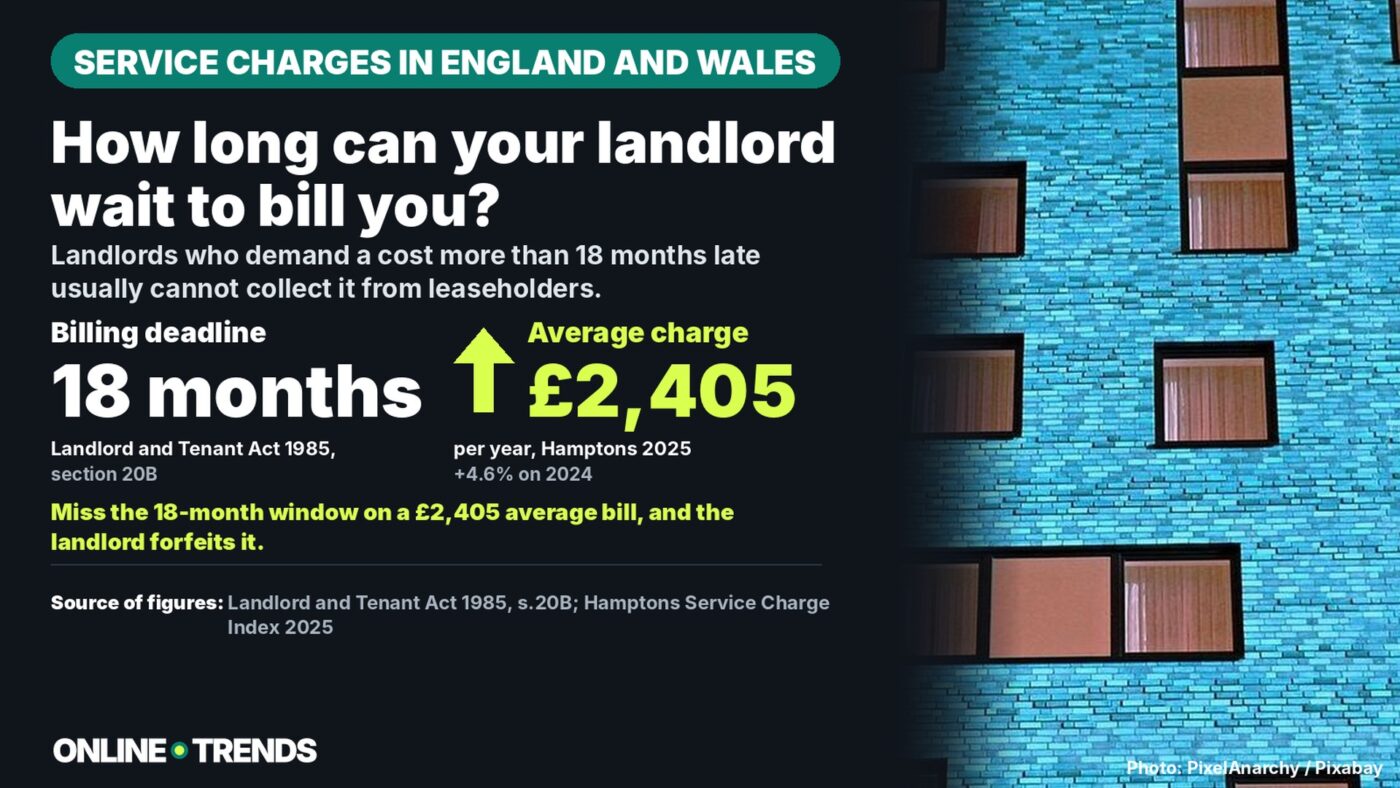
- The average service charge for a flat in England and Wales was £2,405 a year in 2025 – just over £200 a month, and 4.6% higher than a year earlier – according to estate agency Hamptons; leaseholders in older, taller blocks pay far more on average.
Leaseholders of flats in England and Wales have their own version of a billing deadline. Under section 20B of the Landlord and Tenant Act 1985, a freeholder or managing agent who waits more than 18 months to demand payment for a cost normally forfeits the right to recover it through the service charge.
The rule works differently from a German tenant’s annual Nebenkostenabrechnung under § 556 BGB (in German) – it applies to leaseholders who own a flat on a lease, not to tenants renting under an assured shorthold tenancy, who in the UK usually pay energy and water suppliers directly rather than receiving an annual landlord recharge. But the underlying principle is familiar: miss the window, lose the money.
Why the 18-month rule matters
Section 20B of the Landlord and Tenant Act 1985 says that if relevant costs “were incurred more than 18 months before a demand for payment of them is served” on the leaseholder, the leaseholder “shall not be liable to pay so much of the service charge as reflects” those costs. In plain terms: a landlord cannot sit on a bill for a year and a half and then spring it on leaseholders.
There is an exception. If, within that 18-month window, the leaseholder was told in writing that the costs had been incurred and that they would eventually have to contribute through a service charge, the landlord keeps the right to collect later – without yet having to state the exact amount. The High Court set out what such a notice must contain in London Borough of Brent v Shulem B Association Ltd [2011] EWHC 1663 (Ch): it must give an actual figure for costs already incurred, not an estimate, and say that the leaseholder will have to contribute via the service charge.
New transparency rules arrive from November 2026
The Leasehold and Freehold Reform Act 2024 adds further protection on top of the 18-month rule, and the implementing regulations are being switched on in stages. From 6 November 2026, the government gains the legal powers needed to set the detailed rules, but no new duties yet apply to landlords.
From 1 April 2027, leaseholders get a standalone statutory right to request service charge and management information, a new “future demand notice” process for costs not demanded within 18 months, and a reformed litigation-costs regime that stops leaseholders automatically paying a landlord’s legal costs even when the landlord wins. From 1 November 2027, prescribed formats for service charge demands, accounts and annual reports apply to private landlords, together with a ban on landlords recovering insurance commissions through the service charge. Social landlords follow a year later, from 1 November 2028.
What service charges actually cost in 2026
According to estate agency Hamptons’ 2025 Service Charge Index, the average service charge for a flat in England and Wales reached £2,405 a year in 2025 – equivalent to £200.42 a month, and 4.6% higher than at the end of 2024. That is the headline national average across all flats, including older conversions and new-build blocks.
Costs vary sharply by building type. The Property Institute’s own Service Charge Index, covering more than 117,000 leasehold homes managed by 13 agents, puts the average annual service charge for leaseholders in blocks over 18 metres tall and more than 25 years old at £7,337 – well above the national figure, reflecting fire-safety, lift and cladding-related costs that are more common in older, taller buildings.
What leaseholders should do now
Most leaseholders do not need to do anything before a demand arrives – the 18-month rule works in their favour by default. A few steps are worth taking once a service charge demand or a “notice of costs incurred” lands on the doormat.
Practical checklist
- Note the date a demand or a written notice of costs arrives – it is the reference point for the 18-month calculation.
- Check whether the demand relates to costs incurred more than 18 months earlier and, if so, whether a valid written notice was sent within that window.
- Ask the landlord or managing agent for a breakdown of the costs; from April 2027 this becomes a clear statutory right rather than something to request informally.
- Pay a disputed charge under protest where the amount is genuinely in doubt, and raise it with the First-tier Tribunal (Property Chamber) if it cannot be resolved directly.
- For advice on an individual case, contact LEASE (the Leasehold Advisory Service) or Citizens Advice – this article is not a substitute for legal advice.
Frequently asked questions
What happens if a service charge demand arrives more than 18 months late?
Under section 20B of the Landlord and Tenant Act 1985, the leaseholder is generally not liable to pay the part of the service charge that reflects costs incurred more than 18 months before the demand was served.
Is there any way round the 18-month limit?
Yes. If the leaseholder was told in writing, within the 18 months, that the costs had been incurred and would later be charged, the landlord can still recover them once a proper demand follows.
How much does the average leaseholder pay in service charges?
Hamptons puts the England and Wales average at £2,405 a year in 2025 (£200.42 a month), up 4.6% on 2024. Leaseholders in tall, older blocks pay far more on average – £7,337 a year, according to The Property Institute’s Service Charge Index.
What changes from 6 November 2026?
That date switches on the government’s powers to make detailed regulations under the Leasehold and Freehold Reform Act 2024. The leaseholder’s statutory right to request information and the new “future demand notice” follow from 1 April 2027, with standardised demand and accounts formats from 1 November 2027.
Sources and status
- legislation.gov.uk: Landlord and Tenant Act 1985, section 20B.
- LEASE (Leasehold Advisory Service): Service charge demands and the 18-month rule, including London Borough of Brent v Shulem B Association Ltd [2011] EWHC 1663 (Ch).
- CMS Law: Leasehold reform: dates set for service charge and litigation costs changes, 29 October 2026.
- Which?: Leaseholders to get stronger rights to challenge extortionate service charges.
- Hamptons: 2025 Service Charge Index, published March 2026.
- Inside Housing / The Property Institute: Leaseholders in older, taller buildings face annual service charge of over £7,000.
Research and data as of 2 November 2026.
Transparency note: AI-assisted tools were used in researching, structuring and writing this article. The sources used are listed in the article. Publication takes place only after manual editorial approval. Country edition based on an article by Net Trends, researched for the UK. Original image note: stock photo of an apartment building.
Share this article