CPU, DRAM and SSDs now make up around 68% of a laptop’s component costs, TrendForce says
Key points
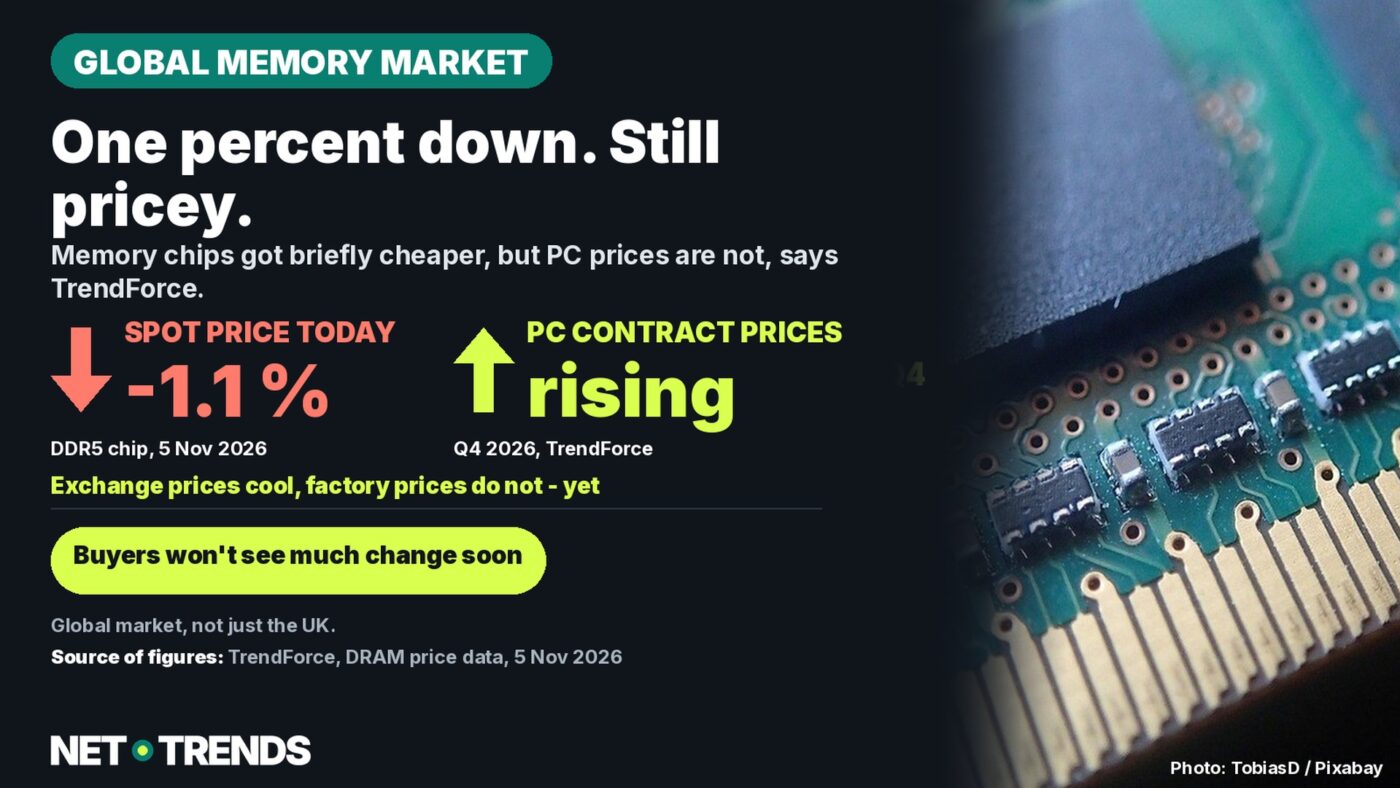
- The spot price for DDR5 memory chips fell by 1.09% on 5 November 2026, according to TrendForce – a small dip after months of steady price pressure.
- That barely matters for computer makers: the contract prices at which PCs and laptops are actually built keep climbing in the fourth quarter of 2026, TrendForce says, even if more slowly than before.
- CPU, memory and SSD now make up around 68% of the component cost of a laptop with a $900 list price, TrendForce says – with consequences for prices and specs in 2027.
A memory chip costs a little less this Thursday than it did the day before. For PC buyers, that barely changes anything: the prices manufacturers pay to fit out their devices keep rising in the fourth quarter, according to TrendForce.
On 5 November, the average spot price for a DDR5 memory chip in the common 16-gigabit class stood at $60.667, a drop of 1.09% from the previous trading session. The older DDR4 generation also eased slightly. This is the market where memory makers and large buyers trade short-term, usually in smaller volumes – an early indicator, but not the number that ends up on the bill for a new laptop.
What TrendForce reported for 5 November
The Taiwanese market researcher TrendForce continuously tracks spot-market data for memory chips on its pricing page, updated several times a week. On 5 November 2026 at 18:10 Taiwan time, the overview for the most-traded DDR5 chip class (16 gigabit, 2Gx8, 4800/5600 MT/s) showed an average price of $60.667 per chip, 1.09% less than the previous session. DDR4 chips in the 16-gigabit class fell 0.30% to $81.679, while the smaller 8-gigabit class dropped 0.46% to $46.036.
Spot prices are the day-to-day trade between memory makers such as Samsung, SK Hynix or Micron and smaller buyers. They react quickly to news and sentiment but move only a small part of the world’s memory supply. The bulk of the chips that go into PCs, laptops and smartphones runs through contract prices – negotiated between memory makers and large buyers such as Dell, HP, Lenovo or Apple, usually a quarter in advance.
Why contract prices keep rising anyway
That is exactly where TrendForce sees no relief. The firm writes in its latest market overview that contract prices for PC memory keep climbing in the fourth quarter of 2026 too, even if the increases are smaller than in previous quarters, because negotiations between manufacturers and large buyers have become noticeably tougher.
“Contract prices for PC memory will keep rising in the fourth quarter, though the increases will be smaller than before given tough negotiations.”
TrendForce, Taiwanese market research firm for the semiconductor industry
TrendForce has published some of the latest contract prices itself: for memory modules as of 26 October 2026, a 16-gigabyte DDR5 UDIMM cost $241.667 on average, 0.70% more than a month earlier. A larger 32-gigabyte RDIMM module held steady at $2,165. For the SO-DIMM modules that matter for laptops, an 8-gigabyte DDR5 chip stood at $133 as of 30 September 2026, also unchanged from the month before – while a comparable 16-gigabyte DDR4 SO-DIMM rose 1.85% to $275 over the same period.
| Memory module | Price (US dollars) | Change | As of |
|---|---|---|---|
| DDR5 UDIMM, 16 GB, 4800/5600 | $241.67 | +0.70% | 26 Oct 2026 |
| DDR5 RDIMM, 32 GB, 4800/5600 | $2,165.00 | 0.00% | 26 Oct 2026 |
| DDR4 UDIMM, 16 GB, 3200 | $164.20 | −0.85% | 26 Oct 2026 |
| DDR5 SO-DIMM, 8 GB (contract price) | $133.00 | 0.00% | 30 Sep 2026 |
| DDR4 SO-DIMM, 16 GB (contract price) | $275.00 | +1.85% | 30 Sep 2026 |
Source: TrendForce, DRAM price overview, retrieved 5 November 2026. SO-DIMM modules are mainly used in laptops, UDIMM/RDIMM in desktop PCs and servers.
The numbers mainly show one thing: laptop memory (SO-DIMM) stayed calm in September, while older DDR4 chips kept getting more expensive and the large desktop and server modules (RDIMM) held at a high level. A stable month is not an all-clear, though – TrendForce still calls the situation tight.
68% of component costs: laptop makers under pressure
TrendForce spelled out just how much memory now drives a laptop’s price in an analysis from 8 October 2026: for a mainstream laptop with a $900 list price, processor, memory and SSD together made up around 68% of component costs in the third quarter of 2026.
TrendForce sees laptop makers facing a choice: raise prices, let margins shrink, or cut back on specs – for instance, the amount of memory built in. The researcher expects global laptop sales to fall by a low single-digit percentage in 2027; if manufacturers pass on the high component costs unchecked and that further extends how long people keep using their existing devices, TrendForce says a drop in the high single digits is possible too. In the company’s view, 2026 demand was unusually driven by purchases brought forward and better processor availability – not a sign of a genuine recovery.
TrendForce also points to demand for server memory for AI applications as a contributing factor, tying up a growing share of global manufacturing capacity. In a further statement from 29 October 2026, TrendForce describes how the shift of artificial intelligence from pure training towards ongoing use (“inference”) and AI agents is triggering a new wave of processor demand – with knock-on effects for demand for DDR5 memory and other components such as high-capacity capacitors on circuit boards. For the fourth quarter of 2026, large laptop contract manufacturers expect orders to fall on average by 10 to 15% year on year.
What it means for buying a PC or laptop
A look at UK online shops shows how the situation is being felt on the ground: a 32-gigabyte (2×16 GB) DDR5-6000 CL30 memory kit from Kingston (black version) cost £729.36 including VAT at the online retailer MemoryC on 5 November 2026 – a price hard to explain without the ongoing memory shortage.
Worked example: what 32 gigabytes of DDR5 memory costs right now
- Product: Kingston Fury Beast, 32 GB (2×16 GB) DDR5-6000 CL30
- Price on 5 November 2026: £729.36 including VAT at the online retailer MemoryC
- Context: TrendForce puts the global contract price for a comparable 16-gigabyte DDR5 module as of 26 October 2026 at around $242 per chip – two modules would come to roughly $484 at manufacturer level, converted at the ECB reference rate of 4 November 2026 (£1 = €1.1976, i.e. $1 = £0.7406) to about £358.50 – well below the UK retail price, which also carries trade margin, logistics, VAT and brand mark-up.
Editorial worked example based on the sources cited in this article, not a recommendation to buy any specific product.
Anyone who needs a new computer in the coming months can hardly wait this out: TrendForce expects contract prices to keep rising rather than fall, and a single day’s dip on the spot market says little about where list prices will be in three or six months. Those under no time pressure can keep an eye on SO-DIMM figures, which have recently looked more stable than desktop and older DDR4 modules.
Buy now or wait? Four questions before buying a PC or laptop
- How much memory do I really need – will 16 instead of 32 gigabytes cover my planned use?
- Can the laptop’s memory even be upgraded later, or is it soldered in place?
- Does the price comparison include total cost including delivery, not just the bare product price?
- Is there a specific offer with an end date, or is the pressure to buy based only on the general market situation?
The answers below sum up the main follow-up questions on spot and contract prices once more.
Frequently asked questions
Are PCs and laptops about to get cheaper again?
Not in the short term, based on TrendForce’s figures. The slight drop in spot prices on 5 November 2026 affects only the small, quickly traded segment of the memory chip market. The contract prices that actually drive retail prices keep rising in the fourth quarter of 2026, TrendForce says, even if more slowly than before.
What is the difference between a spot price and a contract price?
The spot price is for short-term, usually smaller purchases on the open market and reacts quickly to news. The contract price is negotiated between memory makers and large buyers such as laptop or PC brands, usually a quarter in advance, and determines the actual cost of building new devices.
Why has memory been in such demand and so expensive for months?
TrendForce names growing demand for server memory for AI applications as one key reason, tying up an increasing share of global manufacturing capacity for memory chips. According to the firm, that squeezes supply for PCs, laptops and other end devices.
Is it worth buying a laptop with little memory to save money?
That depends on how you plan to use it and is a personal judgement call. TrendForce notes that, given high component costs, some manufacturers are considering less generously specced models. Anyone who wants to keep a device for a long time should check whether its memory can be upgraded later.
Are you seeing rising prices yourself when buying PC accessories or a new laptop? Feel free to share your experience in the comments.
Sources and status
- TrendForce: DRAM price overview (spot and contract prices), retrieved 5 November 2026
- TrendForce: “Rising Costs Threaten Notebook Demand in 2027”, press release, 8 October 2026
- TrendForce: “AI Inference Drives CPU and DDR5 Demand”, press release, 29 October 2026
- MemoryC.co.uk: Kingston Fury Beast 32GB DDR5-6000 CL30 product page, price retrieved 5 November 2026
- European Central Bank: EUR/USD and EUR/GBP reference rates, as of 4 November 2026
Research and data as of: 5 November 2026.
Transparency note: AI-assisted tools were used in researching, structuring and writing this article. The sources used are listed in the article. Publication takes place only after manual editorial approval. Country edition based on an article from Net Trends, researched for the UK.
Share this article