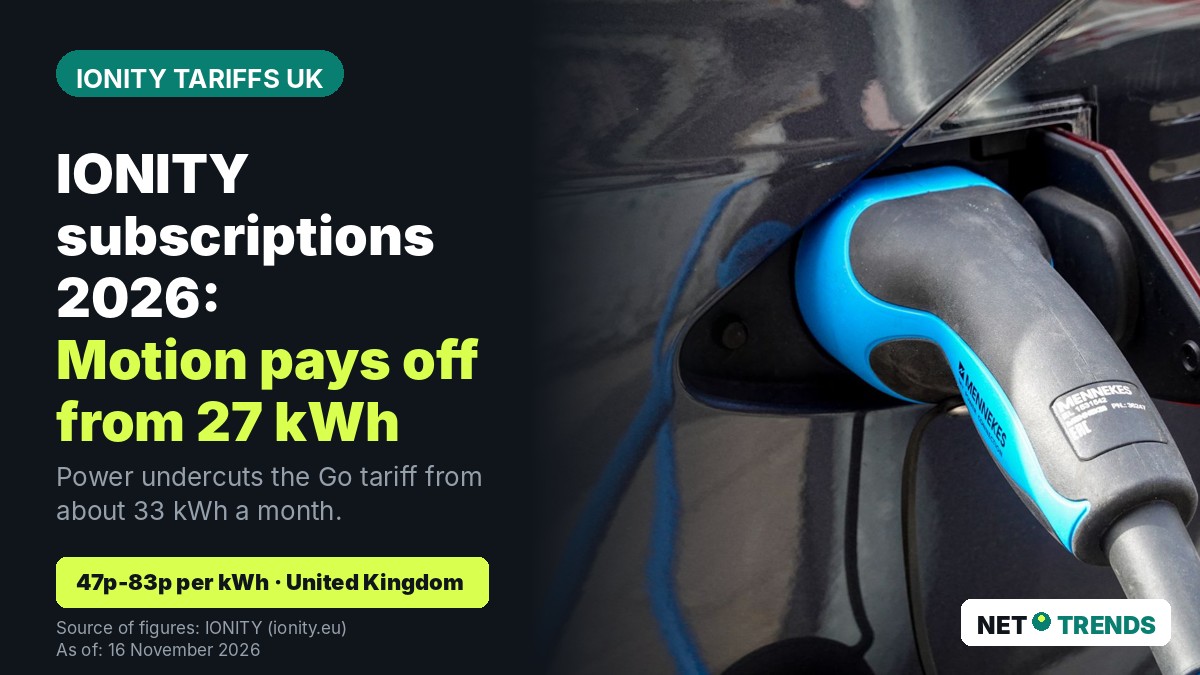
IONITY prices its UK tariffs separately in pounds. Whether Motion or Power pays off depends on how much you charge each month.
Key points
- IONITY lists UK minimum prices of 79p per kWh on the Go tariff and 83p on spontaneous Direct charging.
- Motion costs £5.49 a month and lowers the price to 59p per kWh; the break-even point against Go is around 27 kWh a month.
- Power costs £10.50 a month at 47p per kWh – cheaper than Go from about 33 kWh a month.
- These are minimum prices; individual charge points can be pricier. The price shown for the chosen location is what counts.
Charging only occasionally at IONITY points in the UK doesn’t automatically make a subscription worthwhile. At current minimum prices, Motion beats Go from around 27 kWh a month, and Power from about 33 kWh.
What IONITY tariffs are there in the UK?
IONITY’s UK price table lists four ways to charge. Spontaneous Direct charging without registration starts at 83p per kWh, and the app-based Go tariff at 79p – both without a monthly fee. Motion costs £5.49 a month and brings the minimum price down to 59p per kWh, while Power costs £10.50 a month at 47p per kWh.
The UK figures sit in pounds rather than euros, so they aren’t directly comparable to the German or Austrian cent prices. IONITY states that prices at individual charge points can be higher and may change at any time.
From what usage does a subscription pay off?
How the break-even point is calculated
Go: 79p per kWh. Motion: 59p per kWh plus a £5.49 monthly fee – a 20p per kWh difference, break-even at around 27 kWh. Power: 47p per kWh plus £10.50 – a 32p difference versus Go, break-even at around 33 kWh.
Between Motion and Power themselves, the break-even point sits at around 42 kWh a month.
What does a month of charging cost?
This model calculation uses only the minimum prices published on IONITY’s UK page, without any higher charge-point surcharges.
| Monthly usage | Direct | Go | Motion (£5.49) | Power (£10.50) |
|---|---|---|---|---|
| 30 kWh | £24.90 | £23.70 | £23.19 | £24.60 |
| 40 kWh | £33.20 | £31.60 | £29.09 | £29.30 |
| 60 kWh | £49.80 | £47.40 | £40.89 | £38.70 |
At 30 kWh, Go is cheapest. From 40 kWh, Motion takes the lead. At 60 kWh, Power is cheapest at £38.70, just ahead of Motion.
Which tariff suits whom?
Go suits occasional charging with no monthly fee. Motion pays off from around 27 kWh a month, Power from about 33 kWh. Anyone charging regularly and well above these thresholds should check prices at their planned locations in the app first, since individual stations can charge more than the minimum price.
Häufige Fragen
From what usage does IONITY Motion pay off in the UK?
At current UK minimum prices, the break-even point between Motion and Go sits at around 27 kWh a month.
When is IONITY Power cheaper than Go in the UK?
Based on the published minimum prices, Power becomes cheaper than Go from about 33 kWh a month.
Do the minimum prices apply at every IONITY charge point in the UK?
No. IONITY states that individual charge points can be more expensive; the actual price for a location is shown in the app before charging starts.
Sources and status
- IONITY: subscriptions and UK minimum prices, accessed 16 November 2026.
- IONITY: access, payment and notes on station pricing (in German), accessed 16 November 2026.
Figures as of 16 November 2026. The totals are Net Trends model calculations based on IONITY’s published UK minimum prices.
Transparency note: AI-assisted tools were used in researching, structuring and writing this article. The sources used are listed in the article. Publication takes place only after manual editorial approval.
Share this article


Comment Tell us what you think →