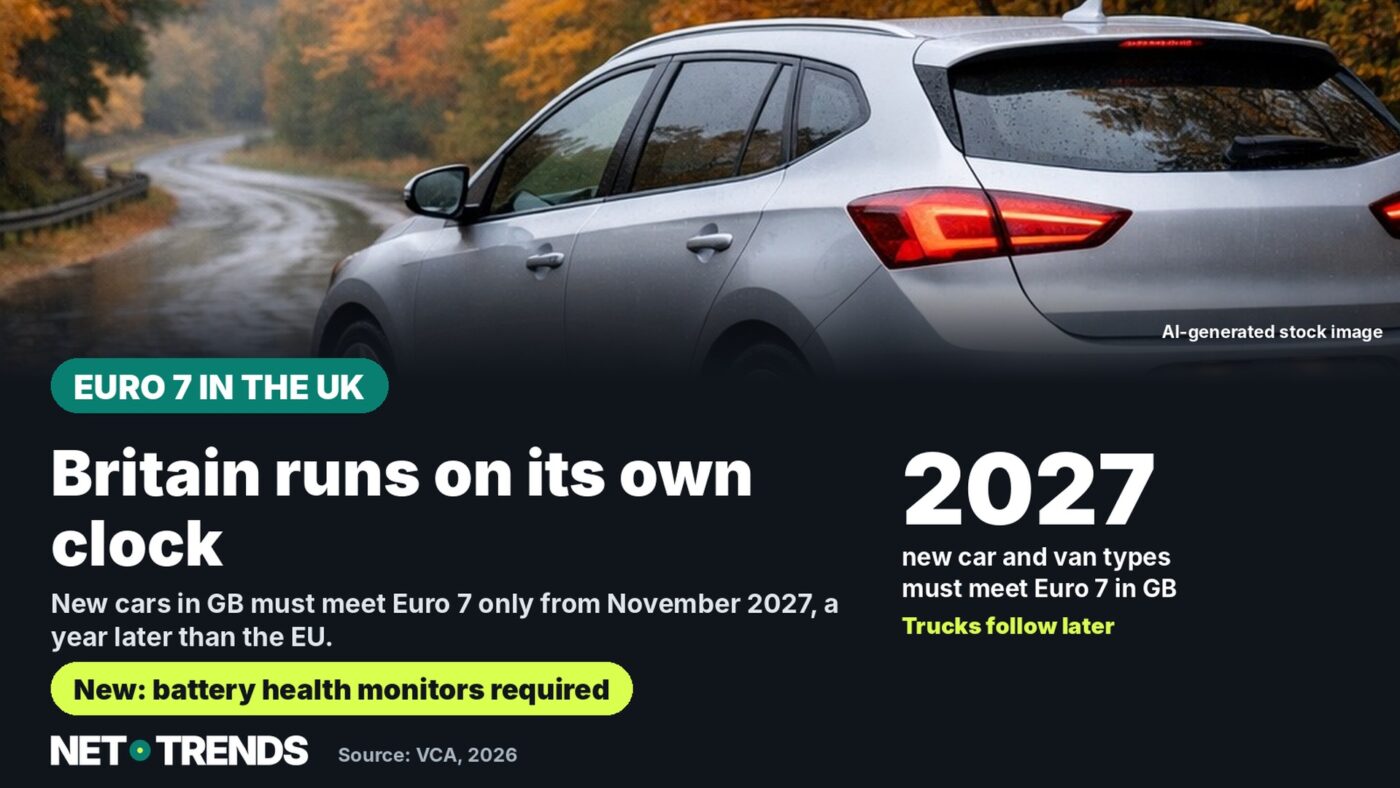
GB is adopting Euro 7 in full, but on its own slower timetable: new cars only need to comply from November 2027, a year later than the EU deadline.
Key points
- New car and light van types sold in Great Britain must meet Euro 7 from November 2027 – there is no separate 2026 step as in the EU.
- Trucks and buses follow on a later schedule, from 2028 and 2029.
- No existing car needs retrofitting. New electric and plug-in hybrid models also get mandatory battery health monitors and durability minimums.
Great Britain is not simply copying the EU’s calendar. According to the Vehicle Certification Agency (VCA), GB will apply Euro 7 in full, but new cars and vans only need to meet it from November 2027 – a year later than the EU’s first milestone, and with no separate “new type” stage in between.
That matters if you’re buying a car in the UK: the rule that starts biting in the EU this month does not yet apply the same way here. London’s Ultra Low Emission Zone (ULEZ) rules are separate and unaffected either way.
GB’s own Euro 7 timetable
The VCA’s Euro 7 guidance sets out a GB-specific schedule that differs from the EU’s Regulation (EU) 2024/1257:
- November 2027: new passenger car and light van types sold in GB must meet Euro 7 – there is no equivalent of the EU’s November 2026 “new type” stage.
- 2028/2029: trucks and buses follow on a later, staggered timetable.
- Up to July 2030: small-volume manufacturers get extra time to comply.
Unlike the EU, GB does not run a separate type-approval process layered on top of EU approval – it adopts the standard wholesale, just a year behind the EU’s first deadline for most passenger cars.
What counts as a “new type”
As in the EU, a “new type” is a genuinely new or substantially revised model, not simply a car built or registered after a given date. An unchanged model that already has valid approval does not automatically need to meet Euro 7 earlier just because the calendar moves on. If you’re ordering a new car for delivery close to November 2027, ask the dealer in writing which approval the specific vehicle holds and whether the planned registration date is realistic.
A car already registered in the UK is not affected by any of this. A later change of keeper does not turn it back into a new vehicle.
What changes technically
Euro 7 covers more than exhaust emissions: it also introduces limits on brake particle emissions and durability requirements for emissions-control systems over a longer mileage and lifespan. That affects electric cars too – they have no exhaust emissions, but brake and tyre wear still occur.
Battery rules for electric cars
New electric and plug-in hybrid models in GB will need to meet minimum battery durability thresholds – at least 80% of original capacity after 5 years or 100,000 km, and at least 72% after 8 years or 160,000 km, whichever comes first. GB’s rules go a step further than the EU’s: VCA guidance also requires a standardised onboard battery state-of-health monitor, so owners and buyers can check battery condition more reliably.
Should you delay buying?
For most buyers in the UK, there is no reason to rush a purchase before any particular date in 2026. If you’re buying a car that’s already registered, Euro 7 doesn’t change anything about it. If you’re ordering a new model for delivery close to or after November 2027, it’s worth asking the dealer directly which type-approval applies and whether your registration date is realistic under it.
The regulation itself sets no fixed price premium. Prices depend on model, trim, powertrain, dealer offers and market timing, as always – treat any claimed “Euro 7 surcharge” with scepticism unless a dealer can show it transparently for the specific vehicle.
Checklist before you buy
For a new car near the GB deadlines
- Is the car already registered, or is it a new type awaiting its first registration?
- When is first registration realistically planned, especially if delivery could slip past November 2027?
- Which type-approval and emissions standard are shown in the vehicle documents?
- Can the dealer confirm in writing that the specific car can be registered by the planned date?
- For electric or plug-in hybrid models: what battery warranty applies, and from when?
Frequently asked questions
Does my older car need retrofitting for Euro 7?
No. The rules apply to new type-approvals and new vehicles. Cars already registered in GB face no retrofit requirement.
Why does GB have a different date to the EU?
GB sets its own implementation timetable for vehicle standards. The VCA has confirmed GB will apply Euro 7 in full, but on its own schedule – November 2027 for new car and van types, rather than the EU’s November 2026 first stage.
Does ULEZ change because of Euro 7?
No. London’s Ultra Low Emission Zone operates under separate rules and is not affected by the Euro 7 timetable.
Do all used electric cars need to meet the battery durability rules?
No. The thresholds apply to new vehicle types and new vehicles going forward, not retroactively to cars already registered.
Sources and last checked
- Vehicle Certification Agency (VCA): official Euro 7 guidance for Great Britain
- electrive.net: “GB übernimmt Euro-7-Norm der EU”, 28 October 2026
- EUR-Lex: Regulation (EU) 2024/1257 (Euro 7), for comparison with the EU timetable
Research and data as of: 16 November 2026.
Transparency note: AI-assisted tools were used in researching, structuring and writing this article. The sources used are listed in the article. Publication takes place only after manual editorial approval.
Share this article


Comment Tell us what you think →