NESO’s October 2026 forecast: transmission charges set to add £20 to the average household energy bill in 2027/28
Key points
- Germany’s Bundestag heard experts on Friday, 6 November 2026, on a bill to extend — but shrink — the federal subsidy for electricity transmission network costs from 2027 to 2029.
- Great Britain has no equivalent Exchequer subsidy for transmission costs: these are recovered in full from suppliers, and ultimately customers, under price controls set by the energy regulator Ofgem.
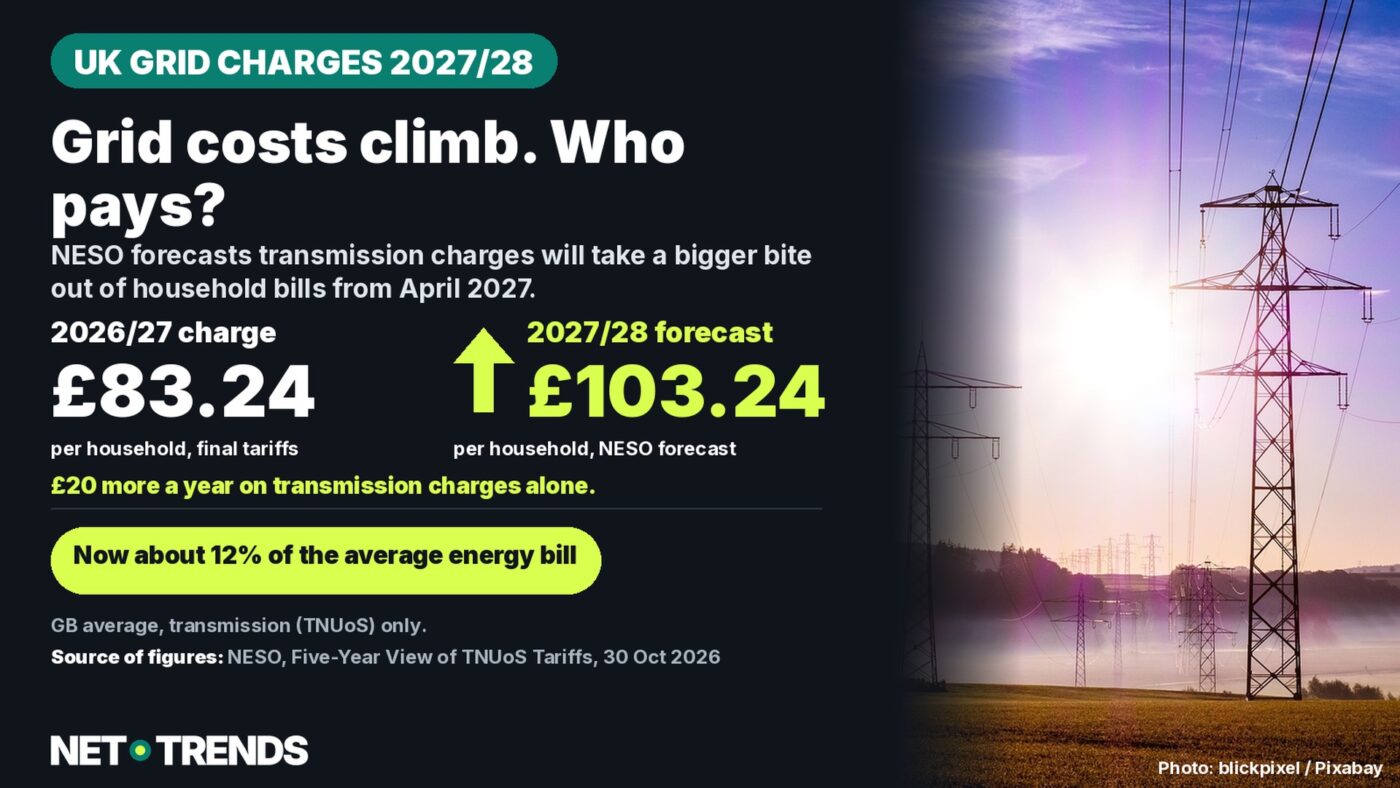
- NESO, the system operator that calculates Great Britain’s transmission charges, forecasts the average household’s share of transmission costs (TNUoS) will rise to £103.24 in the 2027/28 charging year — £20.00 more than in 2026/27.
- That would take transmission charges to around 12% of a typical annual energy bill, up from 8.8% the year before, according to NESO’s Five-Year View published on 30 October 2026.
Germany’s parliament is debating how much of the country’s electricity network costs the state should keep covering. Great Britain has no comparable subsidy — but its own transmission charges are forecast to rise sharply for 2027/28, according to the system operator’s own figures.
On Friday, the Bundestag’s economic affairs committee heard five experts on a government bill that would cut Germany’s federal contribution to transmission network costs from €6.5bn to around €5.53bn a year, with the country’s four transmission operators warning of higher charges unless the legislation is settled by 7 December. Britain’s networks are funded differently — but the direction of travel for 2027 looks similar.
For UK households, network costs already make up a meaningful share of every energy bill, charged through suppliers rather than as a separate subsidy debate in Parliament. The latest official forecast for 2027/28, published at the end of October 2026, shows that share growing further.
What Germany’s Bundestag is debating
The hearing concerned a draft law (in German) that would set Germany’s federal subsidy for transmission network costs at roughly €5.53bn for 2027, down from €6.5bn in 2026, with around €16.56bn earmarked in total for 2027 to 2029 from the government’s climate fund. Germany’s four transmission operators — 50Hertz, Amprion, TenneT and TransnetBW — have already published provisional 2027 charges built around that subsidy: 3.54 cents per kilowatt-hour on average, against 6.52 cents without it. They say they need legal certainty by 7 December 2026 to finalise the figures.
There is no British equivalent of this subsidy or this parliamentary process. Great Britain’s transmission charges are not debated and voted on in Parliament each year; they are calculated by the system operator under rules overseen by the energy regulator, and recovered entirely from suppliers and, in turn, their customers.
How network charges work in Great Britain
In Great Britain, the costs of building, maintaining and running the high-voltage transmission grid are recovered through Transmission Network Use of System (TNUoS) charges, billed to electricity suppliers and generators. The charging methodology sits in the industry’s Connection and Use of System Code (CUSC) and is kept under review by NESO, the National Energy System Operator (formerly part of National Grid), working with other industry parties; changes to the methodology need the consent of Ofgem’s governing board, the Authority.
Separately, the distribution network operators that run the local, lower-voltage grid recover their own Distribution Use of System (DUoS) charges. Both TNUoS and DUoS sit inside suppliers’ costs and are passed on to households as part of the regulated energy price cap, not as a line households see broken out on their bill. Ofgem controls how much revenue the network companies and NESO are allowed to recover in total, through multi-year price controls known as RIIO; NESO then calculates and publishes the specific annual tariffs within that envelope.
NESO’s 2027/28 forecast: £20 more per household
On 30 October 2026, NESO published its Five-Year View of TNUoS Tariffs, covering the charging years 2027/28 to 2031/32. Total TNUoS revenue is forecast to reach £9.5bn in 2027/28, rising to £13.8bn by 2031/32, as the grid is expanded to connect more offshore wind and other low-carbon generation.
The figure that matters most for households: NESO puts the average domestic customer’s share of TNUoS costs at £103.24 in the 2027/28 charging year — £20.00 higher than the final tariffs for 2026/27. That takes transmission charges to around 12% of a typical annual electricity bill, up from 8.8% in 2026/27.
„Network costs have increased … because of the RIIO-3 price control framework, which focuses on upgrading power and gas grids, with the aim of keeping future bills more stable.“
Ofgem, price cap announcement for October to December 2026
That framework is already visible in current bills. Ofgem’s price cap for a typical dual-fuel household paying by direct debit rose 4% — about £60 — to £1,723 a year from October 2026, a change Ofgem attributed mainly to higher wholesale gas prices linked to the conflict in the Middle East, while separately noting that network costs under RIIO-3 had added £66 a year.
What the 2027/28 transmission forecast means
- Average household TNUoS cost, 2026/27 (final tariffs): £83.24
- Average household TNUoS cost, 2027/28 (NESO forecast): £103.24
Working: £103.24 minus £83.24 leaves £20.00 more per household — moving transmission charges from 8.8% to around 12% of a typical annual bill, on NESO’s own figures. This is a forecast, not a final tariff: NESO stresses the report is published for information under its licence conditions and does not itself set the 2027/28 charges.
What UK energy customers can do
Network charges are not something an individual household can shop around on the way they can shop around for a supplier.
Checklist: what you can and cannot change
- Your transmission and distribution network is fixed by where you live — unlike your energy supplier, it cannot be switched.
- TNUoS and other network costs are charged to suppliers, who build them into the regulated price cap or their tariffs — they are not a separate item you pay directly.
- NESO’s 2027/28 figures are a forecast published in October 2026, not the final tariffs for that charging year; treat them as a strong indication of direction, not a locked-in price.
- If you want more certainty than the price cap offers, compare fixed-term tariffs now — they won’t change if network or wholesale costs rise further before 2027/28.
Should network costs in Great Britain be shared more broadly, the way Germany’s federal subsidy is meant to work — or should they stay fully with energy customers? Let us know what you think in the comments.
Frequently asked questions
What are TNUoS charges?
Transmission Network Use of System (TNUoS) charges recover the cost of building, maintaining and operating Great Britain’s high-voltage electricity transmission grid. They are billed to suppliers and generators under industry rules overseen by NESO and Ofgem, and suppliers pass the cost on to customers through their bills.
How much will transmission costs add to UK household bills in 2027/28?
NESO’s Five-Year View, published 30 October 2026, forecasts the average domestic household’s TNUoS cost at £103.24 for 2027/28 — £20.00 more than in 2026/27 — taking transmission charges to around 12% of a typical annual bill, up from 8.8%.
Does the UK government subsidise network costs the way Germany does?
No. Unlike Germany’s federal subsidy for transmission network costs, Great Britain has no equivalent annual Exchequer grant earmarked for TNUoS. Network costs are recovered in full from suppliers, and ultimately customers, under Ofgem’s price controls.
Can I switch to a different network operator to avoid higher charges?
No. Both the transmission network and your local distribution network are fixed by where you live and cannot be switched. Only your energy supplier and tariff are a matter of choice.
Sources and status
- Deutscher Bundestag: Public hearing on the transmission network cost subsidy bill (in German), 6 November 2026
- Deutscher Bundestag: Background on the Energiewirtschaftsgesetz amendment (in German)
- NESO: Five-Year View of TNUoS Tariffs 2027/28–2031/32, published 30 October 2026
- NESO: The charges for using Great Britain’s electricity system
- Ofgem: Energy price cap will rise 4% from October 2026, published 26 August 2026
Research and data as of: 6 November 2026.
Transparency note: AI-assisted tools were used in researching, structuring and writing this article. The sources used are listed in the article. Publication takes place only after manual editorial approval. Country edition based on an article from Net Trends, researched for the UK.
Share this article