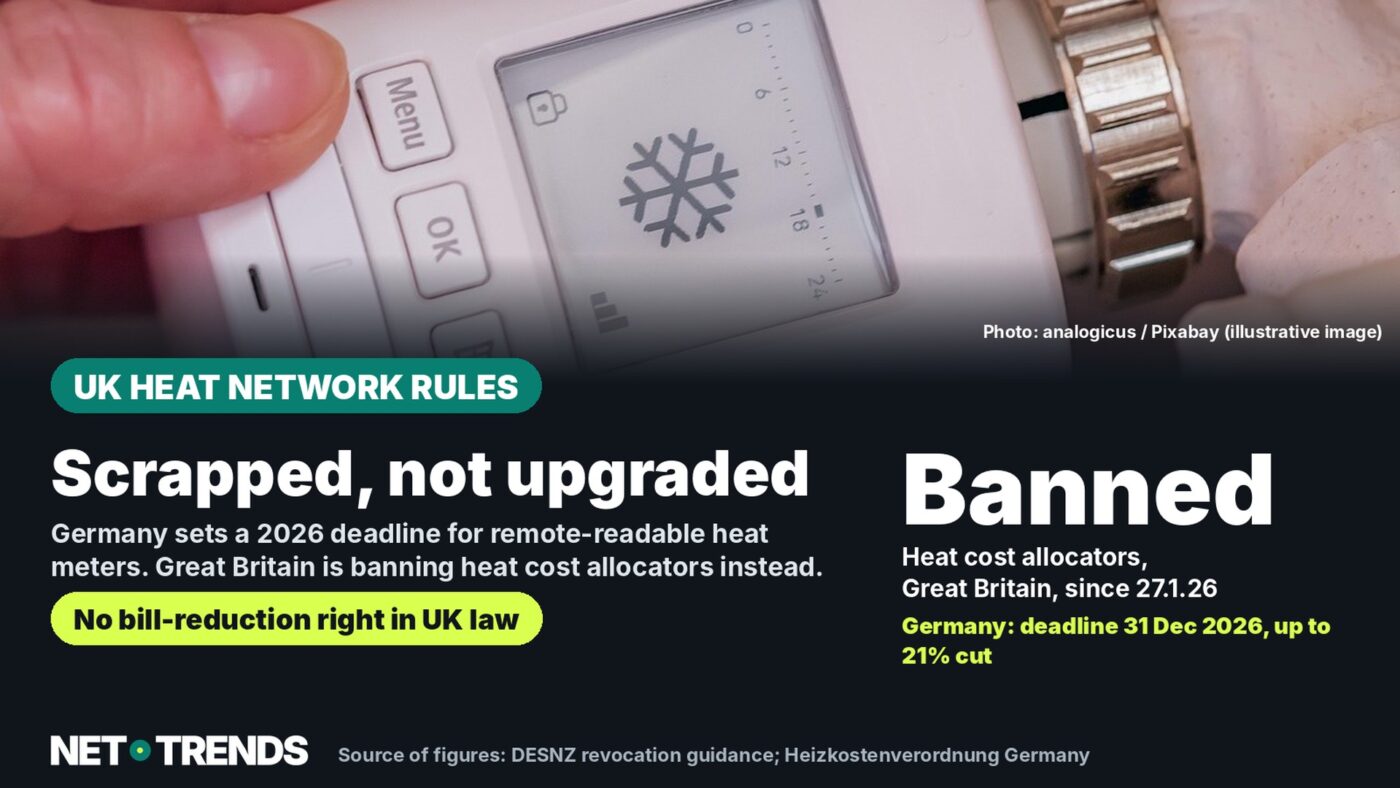
Germany gives landlords until 31 December 2026 to make old heat meters remote-readable, or tenants can cut their bill by up to 21%. Great Britain is moving the other way: scrapping heat cost allocators altogether.
Key points
- In Germany, landlords of buildings with central heating must make old, non-remote-readable heat and hot water meters remote-readable by 31 December 2026, or tenants can cut their share of the heating bill by up to 21%.
- Great Britain has no matching deadline or billing-reduction right. Instead, since 27 January 2026, large parts of the old Heat Network (Metering and Billing) Regulations 2014 have been revoked under a new regime led by Ofgem.
- Under the new rules, heat cost allocators can no longer be used to show compliance at all in Great Britain – landlords must fit actual heat meters where that is “viable”, with no fixed retrofit deadline published yet.
Germany is forcing landlords to make old heat meters remote-readable by the end of 2026, with a bill-cutting right for tenants if they miss it. Great Britain has no such deadline or penalty – it is instead phasing out the devices Germany is upgrading.
What applies in Germany by the end of 2026
Under section 5 of Germany’s Heizkostenverordnung (Heating Costs Ordinance), landlords of buildings with central heating or central hot water must make old, non-remote-readable heat and hot water meters remote-readable by 31 December 2026. Under section 12 of the same ordinance, tenants can cut their share of the heating bill by 3% if remote reading is missing, a further 3% if the monthly consumption statement is missing, and up to 15% if billing is not consumption-based at all – up to 21% combined. The German rule implements an EU Energy Efficiency Directive requirement that the UK, no longer an EU member, does not have to follow.
The UK’s old heat network rules
Great Britain’s equivalent framework was the Heat Network (Metering and Billing) Regulations 2014, which required heat suppliers on communal or district heat networks to fit heat meters, or – where meters were not cost-effective – heat cost allocators (HCAs), and to bill customers based on actual consumption under regulation 9. These 2014 Regulations implemented the same EU Energy Efficiency Directive that underpins Germany’s rule, but, unlike the German ordinance, they never set a remote-readability deadline for existing devices.
Why Great Britain is scrapping heat cost allocators instead
As of 27 January 2026, large parts of the 2014 Regulations have been revoked in Great Britain under the new heat network regulatory framework created by the Energy Act 2023, with Ofgem taking over as the heat networks regulator. According to the official revocation guidance from the Department for Energy Security and Net Zero (DESNZ), regulation 6 – which had allowed HCAs as a compliance option – has been revoked outright. Heat suppliers can no longer rely on heat cost allocators at all; they must fit “viable” heat meters instead. No fixed nationwide deadline for this transition has been published so far, and the new billing and transparency conditions that replace regulation 9 are still being finalised by Ofgem. A draft technical standard from DESNZ, the Heat Network Technical Assurance Scheme metering and monitoring standard, sets data-collection intervals of 5 to 30 minutes that in practice require automated or remote reading, but it has no compliance deadline yet and was still in draft at the time of writing.
Crucially, the gov.uk heat networks guidance and the DESNZ revocation document make no mention of a tenant right to cut their bill for landlord non-compliance, comparable to Germany’s 21%. The only redress route named officially is the free Energy Ombudsman service, which can award compensation on a case-by-case basis rather than a fixed statutory percentage; non-compliance can also be reported to DESNZ.
Northern Ireland: the old rules still apply
The revocation only applies to Great Britain (England, Scotland and Wales). In Northern Ireland, the 2014 Regulations – including the option to use heat cost allocators and the consumption-based billing duty under regulation 9 – continue to apply in full, so the comparison with Germany’s remote-readability deadline looks different there than in the rest of the UK.
Checklist for UK heat network customers
- In Great Britain: Check whether your heat supplier still uses a heat cost allocator – under the new rules, this can no longer be used to show compliance, and suppliers must move to actual heat meters where viable.
- In Great Britain: There is no statutory bill-reduction right if your supplier is slow to switch; use the free Energy Ombudsman service, or report non-compliance to DESNZ, if billing looks wrong.
- In Northern Ireland: The 2014 Regulations, including HCAs and consumption-based billing under regulation 9, still apply unchanged.
- Everywhere in the UK: Do not expect Germany’s 31 December 2026 deadline or its 21% reduction right to apply here – the UK rules are different and still being finalised.
Frequently asked questions
Does the UK have a deadline like Germany’s 31 December 2026 for remote-readable heat meters?
No. Great Britain has no comparable fixed deadline. Instead, since 27 January 2026, heat cost allocators have been banned outright as a compliance option, with no published nationwide retrofit deadline yet.
Can UK tenants cut their heating bill like German tenants can?
No automatic, fixed-percentage billing-reduction right comparable to Germany’s 21% exists in UK law. Dispute resolution runs through the free Energy Ombudsman service or a report to DESNZ.
Does this apply across the whole UK?
No. The 2026 changes apply to Great Britain only. Northern Ireland continues to follow the original Heat Network (Metering and Billing) Regulations 2014.
Who regulates heat networks in Great Britain now?
Ofgem, under the framework created by the Energy Act 2023 and the Heat Networks (Market Framework) (Great Britain) Regulations 2025.
Your experience: Has your heat network supplier told you it is switching from a heat cost allocator to a proper meter? Let us know in the comments.
Sources and status
- Heizkostenverordnung (Germany), section 5 (in German)
- Heizkostenverordnung (Germany), section 12 (in German)
- Heat Network (Metering and Billing) Regulations 2014
- GOV.UK: Heat networks (metering and billing) guidance
- DESNZ: revocation guidance for the Heat Network (Metering and Billing) Regulations 2014
- DESNZ: draft Heat Network Technical Assurance Scheme metering and monitoring standard
Research and data as of 5 November 2026.
Transparency note: AI-assisted tools were used in researching, structuring and writing this article. The sources used are listed in the article. Publication takes place only after manual editorial approval. This is a country adaptation based on an article from Net Trends, researched for the United Kingdom.
Share this article