Chinese brands took 15.8% of Europe’s new-car market in September 2026 – Porsche’s deliveries in China fell by a third
Key points
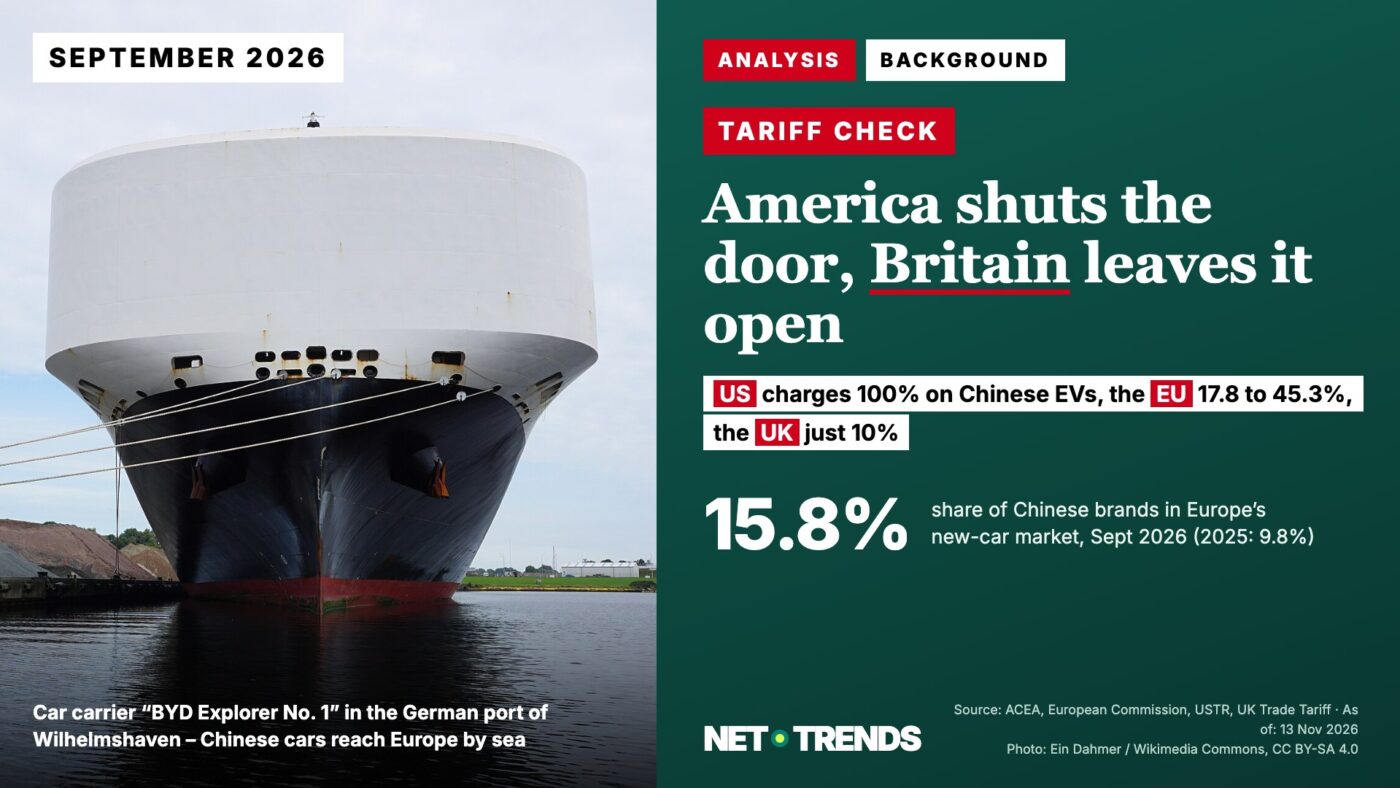
- US: Since 27 September 2024, electric cars from China have faced a 100% tariff.
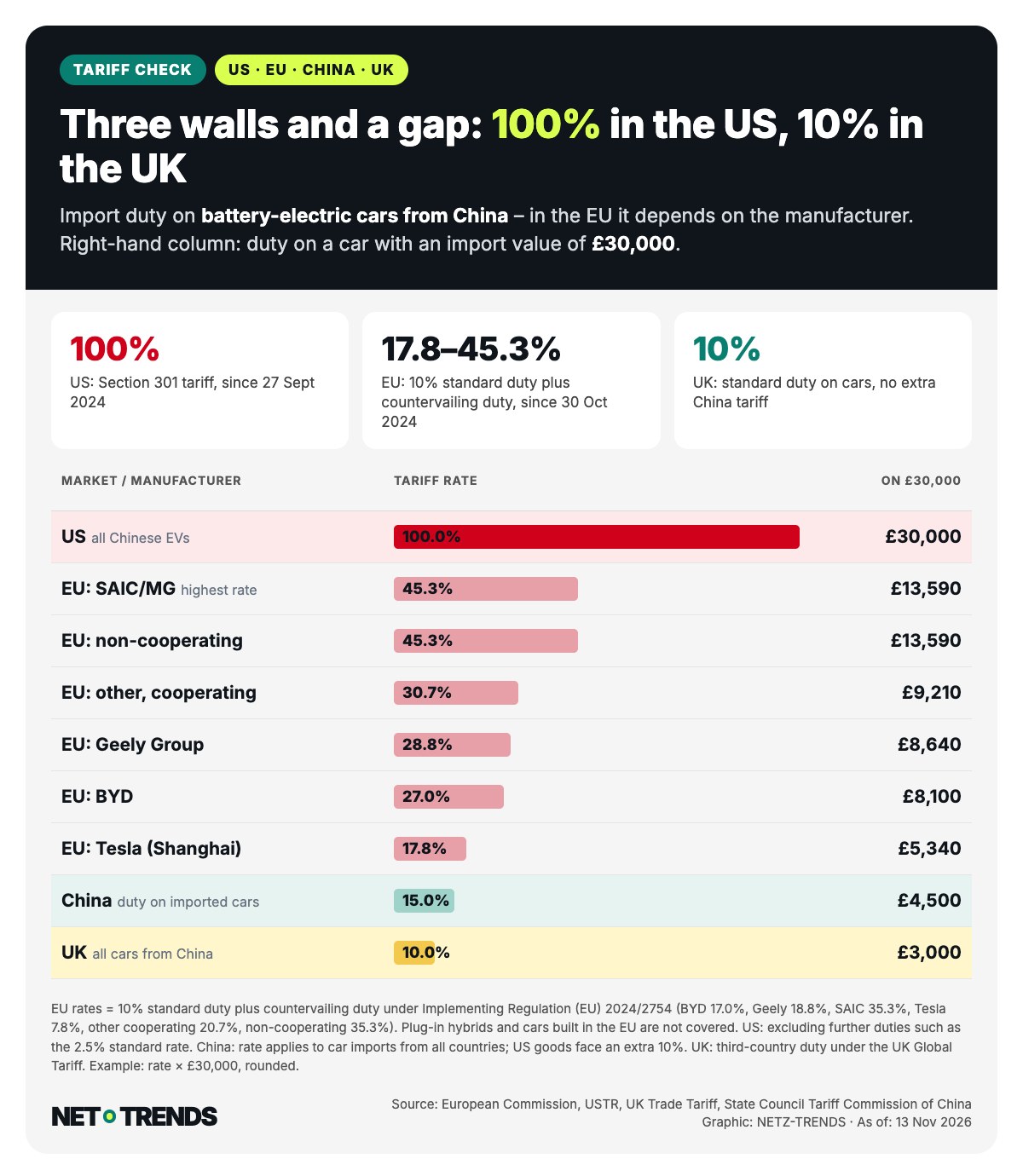
- EU: Since 30 October 2024, importers have paid 17.8 to 45.3% depending on the maker – BYD 27.0%, SAIC/MG 45.3%.
- UK: No extra tariff – cars from China pay the standard 10% duty.
- Impact: Chinese brands reached 15.8% of Europe’s new-car market in September 2026, VW Group lost 3.1 points. Porsche delivered 33% fewer cars in China.
The US keeps Chinese electric cars out with a 100% tariff, the EU charges 17.8 to 45.3% and the UK sticks to its standard 10%. Chinese carmakers are growing fast across Europe – while German groups lose market share and, in China, sales.
Three trading blocs, three answers to the same question: what to do about cheap electric cars from China that, according to the European Commission, are built with state subsidies? Washington has all but shut the door. Brussels keeps it partly closed with tiered duties.
London has so far added nothing on top of its usual import duty. This analysis shows what the figures mean for buyers in Britain, for BYD and MG, and for Volkswagen, BMW and Porsche – based on the latest data from manufacturers and the European carmakers’ association.
Three walls and a gap
The US government raised its Section 301 tariff on electric vehicles from China to 100% from 27 September 2024, four times the previous 25%. The decision by the Office of the United States Trade Representative (USTR) is published in the Federal Register.
The European Commission has levied countervailing duties under Implementing Regulation (EU) 2024/2754 since 30 October 2024. They come on top of the regular 10% import duty and apply for five years. According to the Commission, Tesla pays 7.8% on cars from Shanghai, BYD 17.0%, Geely 18.8% and SAIC – MG’s parent – 35.3%.
Britain left the EU before these duties were set and has not followed them. On the official UK Trade Tariff, new battery-electric cars from China carry the standard third-country duty of 10%, with no additional measure listed for China.
⬇ Download graphic (JPG, 1,200 × 1,380 pixels) – free to use with credit “Net Trends”.
Worked example: duty on an EV with an import value of £30,000
- US: 100% × £30,000 = £30,000
- EU, SAIC/MG: 45.3% × £30,000 = £13,590
- EU, BYD: 27.0% × £30,000 = £8,100
- UK, any Chinese maker: 10% × £30,000 = £3,000
Method: statutory rate × import value. Excludes VAT, shipping and other charges; in the US the 2.5% standard duty comes on top. A worked example, not a price forecast.
The gap is striking: the same car would pay ten times as much duty in the US as in Britain. Even at BYD’s EU rate, the duty is almost three times the UK figure.
China itself cut its import duty on cars from 25 to 15% on 1 July 2018, according to the State Council Tariff Commission (in Chinese). The rate applies to cars from the EU, the UK and the US alike. US goods face an extra 10%; on 9 November 2026 the commission extended the suspension of a further 24% levy by two months.
Chinese brands: 15.8% of Europe’s market
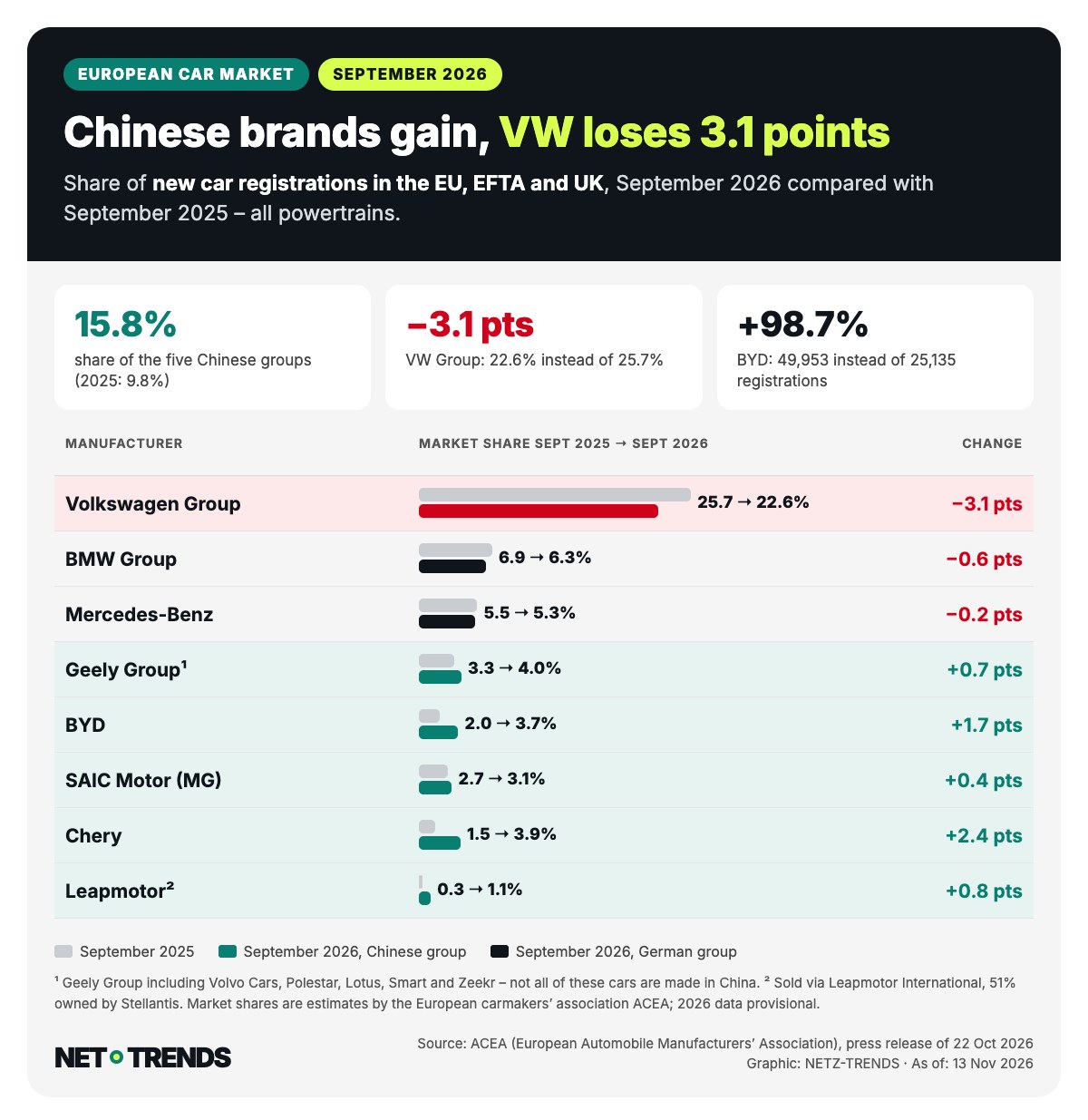
Despite the EU duties, Chinese carmakers are growing quickly in Europe. According to figures from the European carmakers’ association ACEA published on 22 October 2026, BYD, SAIC Motor, Chery, Geely Group and Leapmotor together took 15.8% of new car registrations in the EU, EFTA and UK in September.
A year earlier the figure was 9.8% – a rise of 6.0 percentage points. Chery gained most, from 1.5 to 3.9%. BYD almost doubled its registrations to 49,953 cars (up 98.7%).
⬇ Download graphic (JPG, 1,200 × 1,235 pixels) – free to use with credit “Net Trends”.
Two caveats apply. Geely Group includes Volvo Cars and Polestar, not all of whose cars come from China. Leapmotor is sold through a joint venture that is 51% owned by Stellantis.
In the UK, 350,536 new cars were registered in September 2026, according to ACEA – 12.0% more than a year earlier. Of these, 99,201 were battery-electric, a share of 28.3%. ACEA does not publish brand shares for individual countries in this release.
VW loses 3.1 points, Porsche slumps in China
German groups are on the other side of the ledger. Volkswagen Group took 22.6% of new registrations in the EU, EFTA and UK in September 2026, down from 25.7% – a loss of 3.1 percentage points. BMW slipped from 6.9 to 6.3%, Mercedes-Benz from 5.5 to 5.3%.
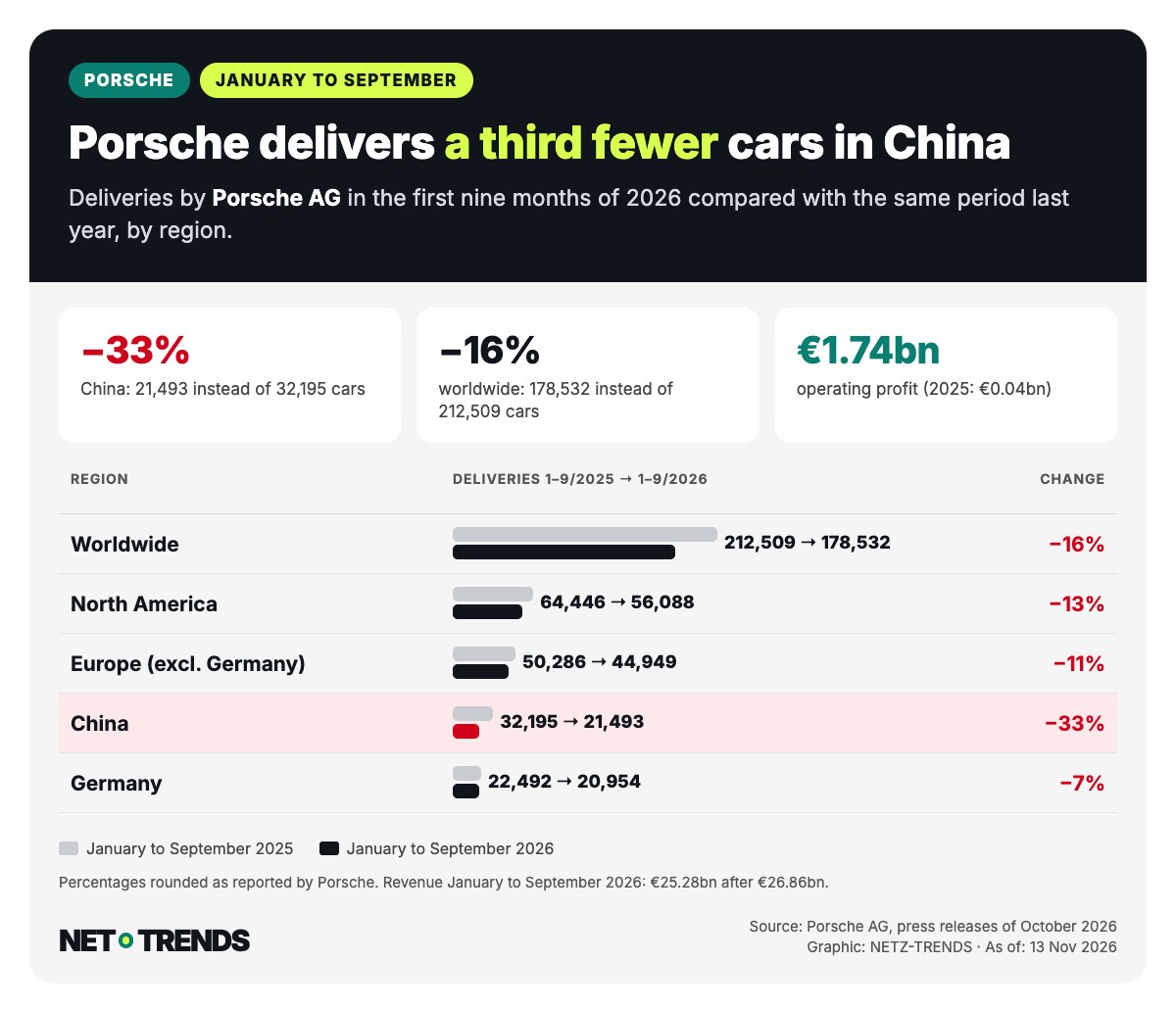
Porsche is hit harder in China, until recently one of its most important markets. The Stuttgart-based sports car maker says it delivered 21,493 cars in China from January to September 2026, 33% fewer than a year earlier.
⬇ Download graphic (JPG, 1,200 × 1,031 pixels) – free to use with credit “Net Trends”.
Worldwide, Porsche delivered 178,532 cars, down 16%. Deliveries in Europe outside Germany fell 11% to 44,949. The market environment in China remains challenging, the company said.
Profits, by contrast, recovered. According to its quarterly statement, operating profit rose to €1.74bn in the first nine months, from €0.04bn a year earlier. Revenue fell to €25.28bn.
Why the EU duties have gaps
A single average tariff for all Chinese cars cannot be given with any accuracy. The EU countervailing duties apply only to battery-electric cars. Plug-in hybrids and combustion-engine cars from China are not covered and pay only the regular 10%.
Cars built inside the EU do not count as imports from China either. The ACEA market shares, by contrast, cover all powertrains and all production sites.
For buyers in Britain the picture is simpler: every new car from China pays the same 10%, whether electric or not. The duty is built into the list price but not shown separately, so equipment, warranty and charging speed matter more when comparing offers.
Frequently asked questions
How high is the US tariff on Chinese EVs?
100% under Section 301, since 27 September 2024. Before that it was 25%. The regular US duty of 2.5% comes on top.
How high is the EU tariff on Chinese EVs?
Between 17.8% (Tesla from Shanghai) and 45.3% (SAIC/MG and non-cooperating makers), depending on the manufacturer. BYD pays 27.0%, Geely 28.8% – each including the 10% standard duty.
Does the UK have a special tariff on Chinese EVs?
No. According to the UK Trade Tariff, new battery-electric cars from China pay the standard 10% duty.
How much are German carmakers losing?
VW Group took 22.6% of Europe’s market in September 2026, 3.1 points less than a year earlier. Porsche delivered 33% fewer cars in China from January to September.
Whether the tariffs protect Europe’s carmakers in the long run remains open. So far the figures show one thing above all: Chinese brands keep growing in Europe, with or without a tariff surcharge.
Sources and status
- USTR: completion of the Section 301 review, September 2024 and Federal Register 2024-21217
- Implementing Regulation (EU) 2024/2754 of 29 October 2024 and European Commission notice on the rates
- UK Trade Tariff: commodity 8703801010, new battery-electric cars, origin China
- ACEA: new car registrations September 2026, 22 October 2026 (PDF)
- Porsche AG: deliveries January to September 2026 and Q3 2026 figures
- State Council Tariff Commission of China: car import duty cut from 1 July 2018 (in Chinese)
Research and data as of: 13 November 2026.
Transparency note: AI-assisted tools were used in researching, structuring and writing this article. The sources used are listed in the article. Publication takes place only after manual editorial approval. Country edition based on an article by Net Trends, researched for the United Kingdom.
Share this article