Tesla’s UK registrations climb as Volkswagen and other established brands lose ground
Key points
- Battery electric cars took 28.3 per cent of UK new car registrations in September 2026, the latest month for which the SMMT has published full figures, up from 23.3 per cent a year earlier.
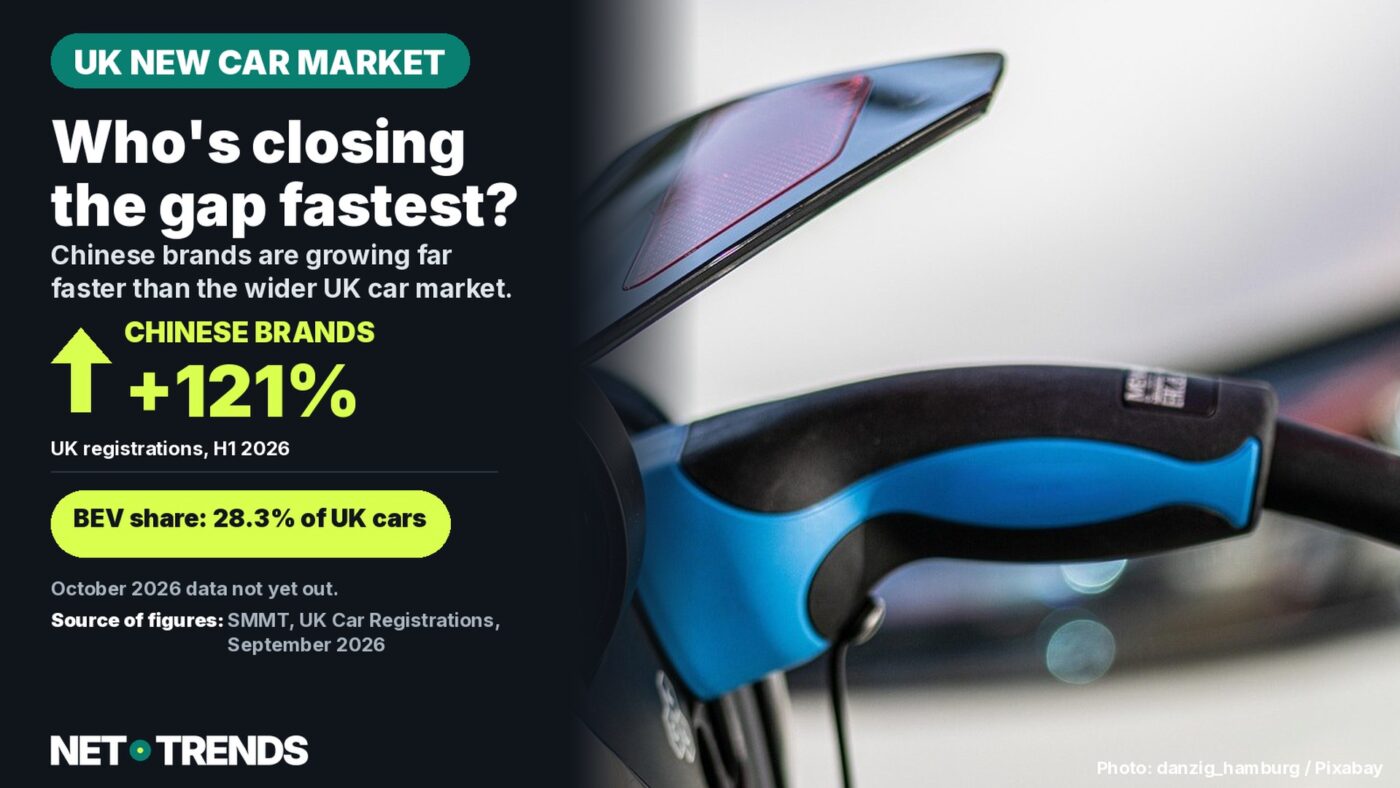
- Chinese brands grew roughly ten times faster than the wider market in the first half of 2026, with combined registrations up 121 per cent and a UK market share of about 15 per cent.
- Established brands show a mixed picture: Volkswagen’s UK market share slipped from 9.03 per cent to 7.92 per cent year on year, while Tesla’s share edged up from 2.18 to 2.43 per cent.
More than a quarter of new cars registered in the UK in September 2026 were fully electric. At the same time, Chinese manufacturers such as BYD and MG are taking a growing slice of the market from established rivals.
According to the Society of Motor Manufacturers and Traders (SMMT), battery electric vehicles (BEVs) reached a 28.3 per cent share of UK new car registrations in September 2026, up from 23.3 per cent in September 2025. The UK’s official Zero Emission Vehicle (ZEV) Mandate requires 33 per cent of each manufacturer’s 2026 registrations to be zero emission, so the market is still running behind that annual target, even allowing for flexibilities built into the scheme.
Separately, analysis of SMMT registration data by trade publications AM-Online and Fleet News shows Chinese-owned brands growing far faster than the overall market in the first half of 2026, while Volkswagen’s UK market share fell.
28.3 per cent: the BEV share in detail
Figures published by the SMMT show 350,536 new cars were registered in the UK in September 2026, up 12.0 per cent on September 2025. Of these, 99,201 were battery electric vehicles (BEVs) – a rise of 36.3 per cent year on year and a 28.3 per cent share of the month, up from 23.3 per cent a year earlier.
Plug-in hybrids (PHEVs) also grew strongly, up 55.5 per cent to 59,571 registrations (17.0 per cent share). Petrol registrations fell 6.7 per cent to 131,864 (37.6 per cent share), while conventional hybrids (HEVs) dipped 4.3 per cent to 45,839 (13.1 per cent share). Diesel rose 11.5 per cent to 14,061 registrations, though it remains a small 4.0 per cent slice of the market.
Over the first nine months of 2026, the SMMT recorded 1,739,271 total registrations, up 10.2 per cent on the same period of 2025. BEVs accounted for 454,947 of these (26.16 per cent of the year-to-date market, up from 22.14 per cent), still below the 33 per cent ZEV Mandate target for 2026 as a whole. As of 5 November 2026, the SMMT had not yet published full October 2026 figures, which are normally released on the fourth working day of the following month; this article therefore uses the most recently verified full month, September 2026, alongside the latest year-to-date totals.
Chinese brands grow two to four times faster
According to the SMMT data summarised by AM-Online, Chinese-owned brands registered almost 175,000 new cars in the UK in the first half of 2026 (January to June), a combined market share of around 15 per cent and growth of 121 per cent year on year – against 9.2 per cent growth for the market as a whole.
MG, now Chinese-owned, was the largest of these brands with 48,741 H1 2026 registrations and a 4.28 per cent market share, up from 4.09 per cent a year earlier. BYD grew faster still: its UK market share rose from 1.86 per cent in H1 2025 to 3.32 per cent in H1 2026, according to figures reported by AM-Online. Jaecoo registered 34,067 cars (2.99 per cent share, roughly four times its year-earlier volume), while Omoda (18,761, 1.65 per cent), Chery (17,979, 1.58 per cent) and Leapmotor (6,770, 0.59 per cent) also gained ground.
“Chinese brands are quietly becoming one of the biggest stories in the new car market, outpacing growth from every other manufacturer group.”
Analysis published by AM-Online, based on SMMT new car registration data for the first half of 2026
In true fleet sales, a closely watched segment, BYD was the leading Chinese brand with a 4.2 per cent share in H1 2026, ahead of MG on 3.9 per cent, while Chinese brands together held 16 per cent of true fleet registrations – more than double their share a year earlier.
Modelled estimate: scaling up BYD’s recent pace
- H1 2026 rate: BYD’s UK market share rose from 1.86% to 3.32% in a single year
- If that rate of increase continued: BYD’s share could approach 6% of UK registrations by H1 2027
- Caveat: this is Net Trends’s own illustrative calculation, not an SMMT or BYD forecast
This is a modelled estimate, not a prediction: whether BYD keeps growing at the same pace depends on new models, pricing by rivals, and the future shape of the ZEV Mandate’s trading system for manufacturers.
Tesla: a small but growing UK share
Tesla’s UK market share rose from 2.18 per cent in the first half of 2025 to 2.43 per cent in the first half of 2026, according to the AM-Online analysis of SMMT figures – a smaller gain than BYD’s, but still ahead of the wider market’s growth rate. Tesla does not appear separately in the SMMT’s published powertrain tables, and month-to-month Tesla volumes in the UK, as elsewhere, are known to swing sharply around quarter-end delivery pushes, so a single month tells you less than the year-on-year trend.
Unlike BYD and MG, Tesla sells exclusively battery electric models, so its registrations sit entirely within the 28.3 per cent BEV share reported for September 2026 rather than being split across BEV, PHEV and HEV lines.
Volkswagen and other established brands lose share
Volkswagen remained one of the UK’s largest manufacturers by volume, with 90,150 registrations in H1 2026 – roughly twice the registrations of the best-performing Chinese brand – but its market share fell from 9.03 per cent to 7.92 per cent year on year, according to the AM-Online figures. In true fleet sales specifically, Volkswagen held a 10 per cent share but its registrations declined compared with H1 2025.
BMW registered almost 63,000 cars in H1 2026, and its true fleet registrations also fell year on year, while Audi‘s true fleet registrations rose 16 per cent over the same period, bucking the trend among premium German brands. The SMMT’s own published powertrain figures show the shift is broader than any single brand: across the whole UK market, petrol registrations fell 3.8 per cent and diesel fell 7.1 per cent in the year to September 2026, while BEV and PHEV registrations rose 30.2 per cent and 41.8 per cent respectively.
Key UK brands at a glance
The table below combines SMMT’s official powertrain figures for September 2026 with brand-level UK market shares for the first half of 2026 (January to June), reported by AM-Online and Fleet News from SMMT registration data. The two periods are shown separately because the SMMT’s own brand-by-brand breakdown is published commercially through its DataShop rather than as a free monthly release.
| Brand | H1 2026 UK share | H1 2025 UK share | H1 2026 registrations |
|---|---|---|---|
| Volkswagen | 7.92 % | 9.03 % | 90,150 |
| MG | 4.28 % | 4.09 % | 48,741 |
| BYD | 3.32 % | 1.86 % | 37,795 |
| Jaecoo | 2.99 % | n/a (new) | 34,067 |
| Tesla | 2.43 % | 2.18 % | not stated |
| Omoda | 1.65 % | n/a | 18,761 |
| Chery | 1.58 % | n/a (new) | 17,979 |
| Leapmotor | 0.59 % | n/a | 6,770 |
Source: brand shares and volumes for H1 2026 (January–June) from SMMT registration data as reported by AM-Online and Fleet News; “n/a” means the brand’s H1 2025 share was not separately reported in the sources used. Overall market figures for September 2026 are from the SMMT directly.
What this means if you’re buying
For UK buyers, the rising BEV share and the arrival of more Chinese brands mean more choice, especially in the lower-priced segments where firms such as MG, BYD, Omoda and Jaecoo are concentrating their model ranges. A fast-growing registration figure says nothing on its own about a specific model’s warranty, dealer network or future resale value.
Checklist before buying an electric car in the UK
- Battery warranty: compare duration, mileage limit and the capacity-retention condition for each model, not just the headline years.
- Dealer and service network: check how many franchised dealers and approved repairers are near you, particularly for newer Chinese brands still building out their UK networks.
- Resale value: brands without a long UK sales history are harder to assess for residual values than long-established marques; independent valuation guides (CAP HPI, Glass’s) are a useful check.
- Grants and incentives: check current UK and, where relevant, devolved-nation support such as the Electric Car Grant and workplace or home charging schemes, which change the real purchase price.
- Charging access: test charging at home, at work and on your typical routes before you buy, not after – coverage and reliability still vary by area.
None of these points can be read off registration statistics – they show how many cars were registered, not how satisfied owners are or how a model performs day to day. Independent tests from bodies such as Which? remain a useful complement to the market data. Buyers weighing up new-car costs more broadly may also want to check current Vehicle Excise Duty (VED, commonly called road tax) and Benefit-in-Kind company car tax rates on gov.uk, both of which still favour battery electric cars over petrol and diesel equivalents.
Frequently asked questions
What share of UK new cars were battery electric in 2026?
According to the SMMT, battery electric vehicles (BEVs) took a 28.3 per cent share of UK new car registrations in September 2026, the most recent full month published, up from 23.3 per cent a year earlier. Over the first nine months of 2026, BEVs made up 26.16 per cent of registrations, year to date.
Which Chinese car brands are growing fastest in the UK?
In the first half of 2026, Jaecoo grew roughly fourfold and BYD’s market share nearly doubled, from 1.86 per cent to 3.32 per cent, according to analysis of SMMT data by AM-Online. MG remained the largest Chinese-owned brand by volume, with 48,741 registrations and a 4.28 per cent share.
Is the UK on track to meet its 2026 ZEV Mandate target?
The UK’s Zero Emission Vehicle Mandate requires 33 per cent of each manufacturer’s 2026 registrations to be zero emission. Year-to-date BEV registrations stood at 26.16 per cent as of September 2026, below that annual target, though manufacturers can use borrowing and trading flexibilities within the scheme set out by the Department for Transport.
Has Volkswagen lost market share in the UK?
Yes. Volkswagen’s UK market share fell from 9.03 per cent in the first half of 2025 to 7.92 per cent in the first half of 2026, according to SMMT data reported by AM-Online, even though its registration volume of 90,150 remained roughly double that of the best-performing Chinese brand.
Have your say: would you consider a Chinese-brand electric car for your next purchase, or would you rather stick with an established manufacturer? Let us know in the comments.
Sources and status
- SMMT: UK Car Registrations, September 2026 (powertrain and total market figures)
- AM-Online: Chinese brands lead biggest market share gains in first half of 2026
- AM-Online: New car sales figures, brand-level market share data
- Fleet News: Chinese manufacturers continue to gain UK market share
- Department for Transport / gov.uk: Updates to the Vehicle Emissions Trading Schemes (VETS) Order 2023 – ZEV Mandate targets
- Kraftfahrt-Bundesamt: Pressemitteilung Nr. 44/2026, October 2026 German registrations (in German), cited for comparison
By comparison, Germany’s Kraftfahrt-Bundesamt reported a record 37.0 per cent BEV share for October 2026, with BYD’s German registrations up 216.1 per cent year to date – both figures well above the UK’s equivalent numbers, though the two countries’ vehicle tax and incentive regimes differ substantially, which limits direct comparison.
Research and data status: 5 November 2026. October 2026 UK registration figures had not yet been published by the SMMT at the time of writing.
Transparency note: AI-assisted tools were used in researching, structuring and writing this article. The sources used are listed in the article. Publication takes place only after manual editorial approval. Country edition based on an article from Net Trends, researched for the United Kingdom.
Share this article