The European Commission has opened talks with Albania, Bosnia and Herzegovina, Kosovo, Montenegro, North Macedonia and Serbia on surcharge-free roaming – a scheme the UK left when it exited the EU’s roaming area.
Key points
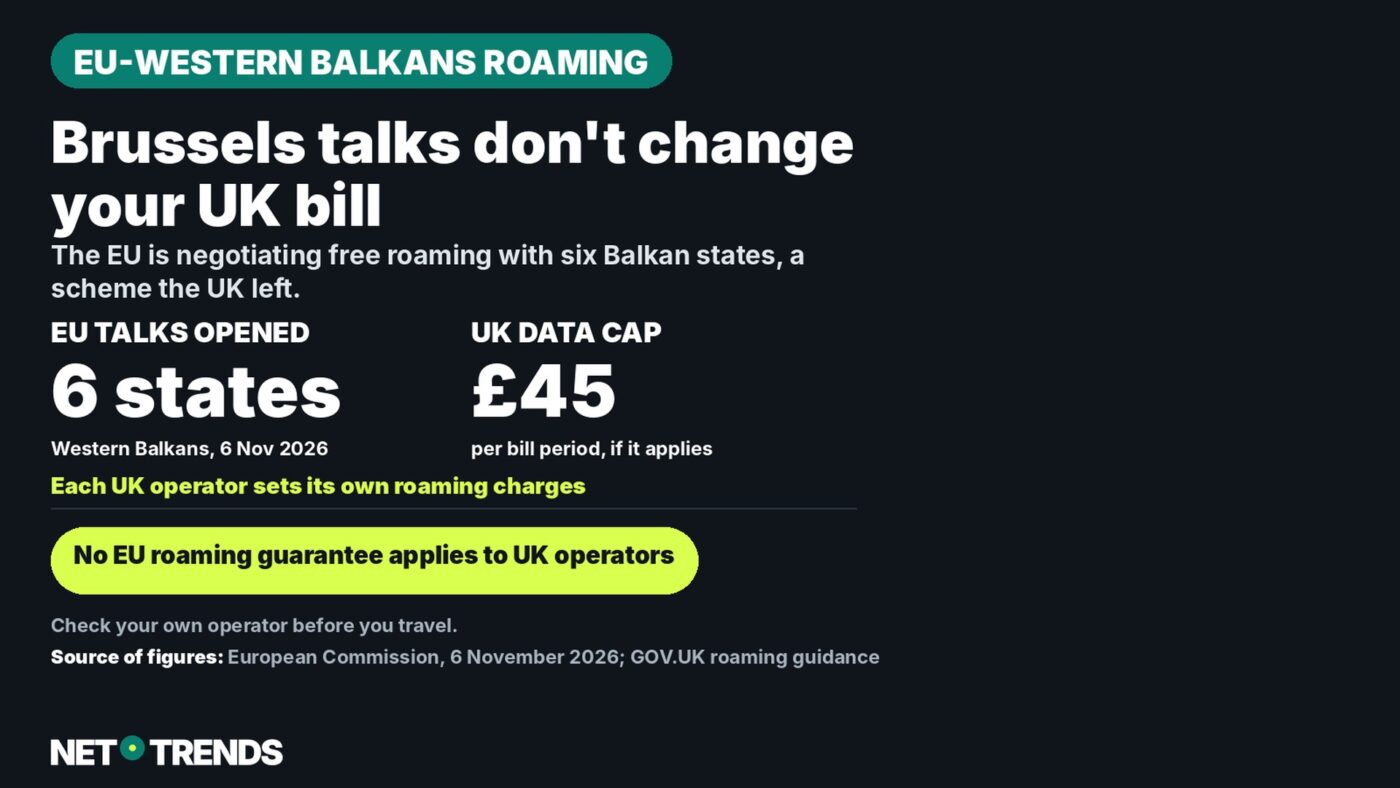
- The European Commission opened bilateral negotiations on 6 November 2026 to extend “Roam Like at Home” to six Western Balkan partners.
- The scheme has no bearing on UK mobile bills: Britain left the EU’s roaming area after Brexit, and there is no legal guarantee of surcharge-free roaming for UK operators anywhere in the EU, let alone the Western Balkans.
- UK travellers must still check their own operator’s policy for both EU and Western Balkan destinations before they go.
Brussels wants to let people travel between the EU and the Western Balkans without roaming surcharges on calls, texts and data. The European Commission has now opened formal negotiations with six countries in the region. For UK travellers, the news changes nothing: Britain’s own roaming rules have been set separately, operator by operator, since the end of the Brexit transition period in 2021.
That matters because a UK traveller heading to Albania, Serbia or any of the other five countries named in the EU talks is not covered by whatever Brussels eventually agrees. What a UK number costs to use there – now and after any future EU deal – depends entirely on the policy of the UK operator supplying the SIM or eSIM.
What the EU has actually opened
The European Commission announced on 6 November 2026 that it had opened negotiations with all six Western Balkan partners. The talks follow a Council of the European Union decision from 4 June 2026 authorising the Commission to negotiate, formalised in Council Decision (EU) 2026/1329.
Each country – Albania, Bosnia and Herzegovina, Kosovo, Montenegro, North Macedonia and Serbia – gets its own bilateral agreement, tied to its existing Stabilisation and Association Agreement with the EU. That means the six processes can move at different speeds; there is no single date by which all six join at once. “Roam Like at Home” already covers Iceland, Liechtenstein and Norway, and, since 1 January 2026, Ukraine and Moldova.
Why this does not change UK roaming
The UK is not party to any of this. Since the end of the Brexit transition period, surcharge-free roaming in the EU and EEA is “no longer guaranteed” for UK mobile customers, according to GOV.UK’s own guidance for travellers. UK law keeps one protection in place regardless of destination or operator: a financial cap on mobile data use abroad, with alerts sent to customers at 80% and 100% of the limit – a safeguard against unexpected bills rather than a right to free roaming.
Several of the UK’s larger networks have said they currently have no plans to reintroduce EU roaming charges, but GOV.UK is explicit that “this could change in future” and does not commit any operator to a fixed policy. For destinations outside the EU and EEA – which includes the Western Balkans whatever the outcome of Brussels’ current talks – there has never been a UK legal guarantee of surcharge-free roaming in the first place.
What a UK traveller pays in the Western Balkans today
For now, prices in Albania, Bosnia and Herzegovina, Kosovo, Montenegro, North Macedonia and Serbia are set entirely by each UK operator’s own roaming tariff or travel add-on, exactly as for any other non-EEA destination. A deal between the EU and these six countries, once and if it is finalised, would set prices for EU and EEA customers in the region – it creates no obligation on UK operators, which are regulated separately by Ofcom and UK law, not EU roaming rules.
The only EU-adjacent framework currently touching the region is a voluntary arrangement between EU and Western Balkan mobile operators on wholesale data price caps, reported by the Regional Cooperation Council. That scheme governs prices between operators, not what any individual UK customer is charged, and UK operators are not parties to it.
Four checks before travelling to the Western Balkans
- Check your operator’s own roaming zone list: the Western Balkans are usually priced as “rest of world”, not as EU roaming – confirm this in your operator’s app or price list before you go.
- Compare a travel data pass with pay-as-you-go roaming: a bundled pass is often cheaper than per-megabyte charges, but check its validity and whether it renews automatically.
- Read the welcome text message: UK operators are required to send pricing information by text once your phone connects to a foreign network.
- Watch for accidental cross-border connection: near borders, your phone may pick up a neighbouring country’s network; manual network selection or turning off data roaming avoids surprise charges.
A local SIM or eSIM can be cheaper than a UK operator’s own rates, but it is not automatically so – check identity verification requirements, validity, data allowance and any hotspot restrictions before buying one. Saving offline maps, tickets and key documents over Wi-Fi before you travel also reduces how much mobile data you need once there.
Have your say
Have you been caught out by roaming charges on a trip to the Western Balkans, or found a good-value travel pass? Share your experience in the comments.
Frequently asked questions
Does the EU’s roaming deal with the Western Balkans apply to UK phone contracts?
No. The negotiations are between the EU and six Western Balkan countries for EU and EEA customers. UK mobile operators are not covered by EU roaming regulation and set their own charges for the region.
Is roaming in the EU still free for UK travellers?
Not guaranteed by law. GOV.UK states that surcharge-free roaming in the EU and EEA is “no longer guaranteed” since Brexit. Some UK operators still choose not to charge, but this can change, and each operator sets its own policy.
Which six countries are in the EU’s Western Balkans roaming talks?
Albania, Bosnia and Herzegovina, Kosovo, Montenegro, North Macedonia and Serbia. Each has its own separate negotiation, so they are not guaranteed to join at the same time.
What protection does a UK traveller have against a huge roaming bill?
UK law caps mobile data spending abroad, with the customer alerted at 80% and 100% of the limit, regardless of destination. It limits the size of a surprise bill; it does not make roaming free.
Sources and status
- European Commission: opening of negotiations, 6 November 2026
- Council of the European Union: authorisation of the negotiations, 4 June 2026
- Council Decision (EU) 2026/1329
- GOV.UK: guidance on using your mobile in EU and EEA countries
- Regional Cooperation Council: voluntary EU-Western Balkans wholesale roaming price information
Research and data as of: 7 November 2026.
Transparency note: AI-assisted tools were used in researching, structuring and writing this article. The sources used are listed in the article. Publication takes place only after manual editorial approval. Country edition for the United Kingdom, based on an article by Net Trends.
Share this article