Apple’s new cancel-screen discounts arrive worldwide on 4 November – and the UK’s own “easy exit” subscription law is still two months away
Key points
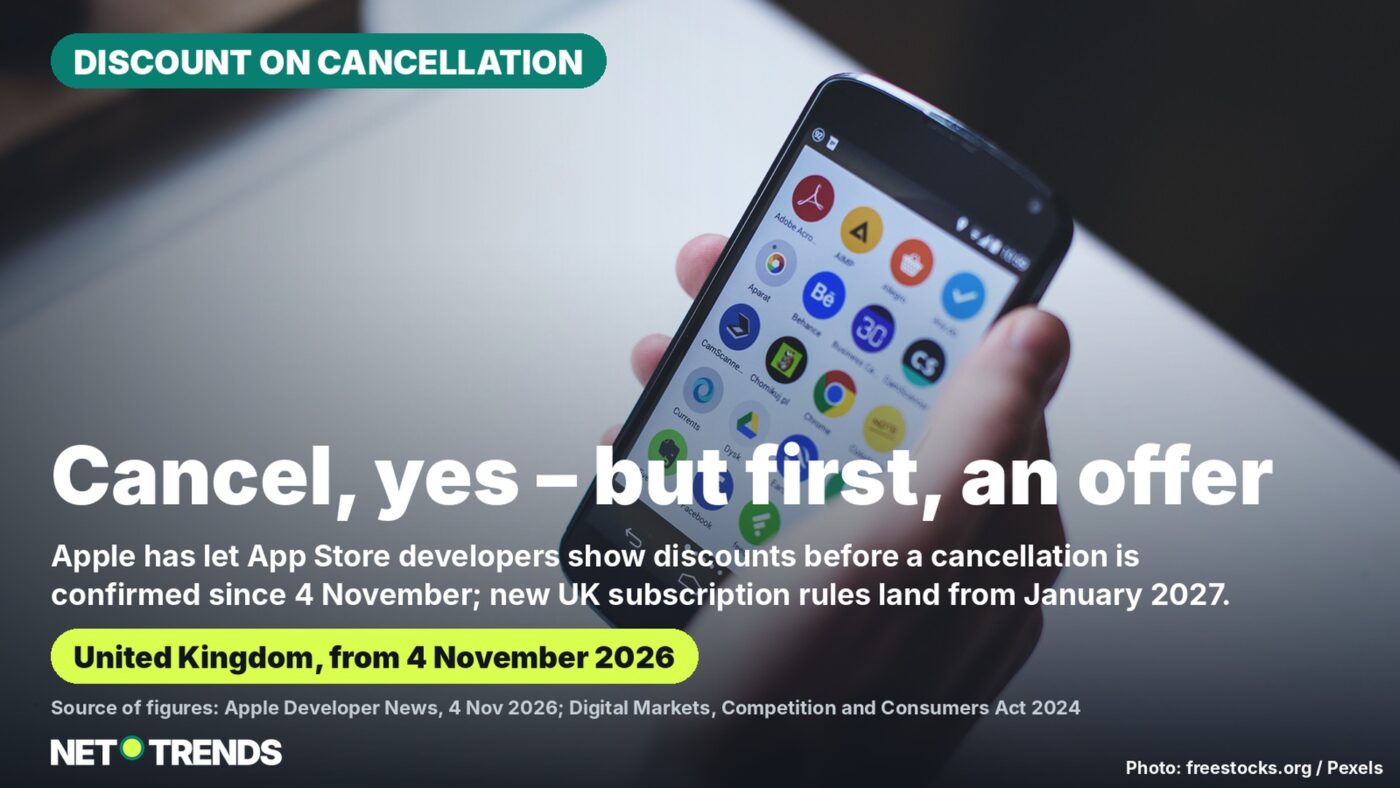
- Apple switched on “Retention Messages” for all App Store developers on 4 November 2026: anyone trying to cancel a subscription may now see a discount or an alternative plan first.
- According to Apple’s own documentation, the “Cancel Subscription” button stays on the same screen throughout – the offer does not replace or block it.
- The UK has no equivalent rule yet. New subscription-contract protections under the Digital Markets, Competition and Consumers Act 2024 (DMCCA) are not due to take effect until January 2027.
- Once in force, the DMCCA will require traders to offer a “straightforward, cost-effective and timely” way to cancel, enforced by the Competition and Markets Authority (CMA).
Apple is letting App Store developers show a discount the moment someone tries to cancel a subscription. In the UK, there is no general law yet requiring an easy cancellation path – but one is coming from January 2027.
Millions of people in the UK pay monthly for App Store subscriptions – streaming, fitness apps, cloud storage. From 4 November, cancelling one of them may come with a last-minute offer on the way out.
What Apple switched on on 4 November
According to Apple’s developer newsroom, App Store developers worldwide – including in the UK – have been able to use so-called Retention Messages since 4 November 2026. There are four message types: plain text, text with an image, a prompt to switch to a different plan, or a discount to keep the existing subscription running, sometimes at a cheaper tier.
Developers configure the messages in advance via App Store Connect, Apple’s management tool. Those who want more control can use the Retention Messaging API to decide in real time which message a given customer sees when they try to cancel – based on subscription length, plan or country. Apple says access to this real-time interface currently requires a request.
How cancellation works, according to Apple
What matters for the legal picture is the exact sequence. According to Apple’s Retention Messaging documentation, the message appears after a user taps “Cancel Subscription” on the subscription details screen. A “Confirm Cancellation” screen follows, with a “From the developer” section showing the provider’s message. Underneath, according to Apple’s own published screen examples, two buttons remain side by side: “Cancel Subscription” and “Keep Subscription”.
Apple’s documentation describes no intermediate step that users are required to confirm before the cancel button becomes available again. The feature is visible on devices running iOS 15.1, iPadOS 15.1, visionOS 1 and macOS 14 or later.
What UK law currently requires – and what changes in 2027
Unlike Germany, which has required an always-accessible “cancellation button” for online contracts since July 2022 under § 312k of its Civil Code, the UK has no directly equivalent rule in force today. That is set to change under the Digital Markets, Competition and Consumers Act 2024 (DMCCA): its subscription-contract regime was originally expected in spring 2027 but has since been brought forward to January 2027, according to legal commentary tracking the government’s implementation timetable.
Once the regime is in force, traders will have to let consumers end a contract in “a straightforward, cost-effective and timely way” that is not “unduly onerous”, allow cancellation with a single notice, confirm cancellation requests in writing, and set out the cancellation steps and contact details as key information before the contract is signed. Renewals will also come with a 14-day cooling-off period, on which traders must notify consumers on the first day.
The regulator: what the CMA will be able to do
The Competition and Markets Authority (CMA) is the lead public enforcer for the DMCCA’s consumer protection provisions, alongside local Trading Standards services. Under the wider Act, the CMA already has direct enforcement powers: it can investigate suspected breaches of consumer law, order that they stop and impose fines itself, without first going to court – a notably stronger toolkit than before the Act.
“If a consumer can sign up online, they must be able to exit online.”
Summary of the DMCCA’s subscription-contract principle, as set out in UK government consultation documents on the new regime
Because the detailed cancellation mechanics are still due to be set out in statutory guidance, businesses operating in the UK do not yet have the final rulebook – but the direction of travel, and the January 2027 date, are now clearer than they were a few months ago.
What this means for Apple’s new feature
No UK regulator has examined Apple’s Retention Messages specifically. On Apple’s own description, the “Cancel Subscription” button remains visible throughout and no extra login or confirmation step is required – which already lines up with what the DMCCA is expected to demand once it takes effect in January 2027.
Whether individual App Store developers design their own retention messages in a way that confuses or delays someone trying to cancel depends on each app’s implementation, not on Apple’s rule alone. Apple says every message goes through its own review before it can go live.
Checklist: what to look out for when cancelling an App Store subscription
- The confirmation screen still shows “Cancel Subscription” and “Keep Subscription” side by side – a discount offer does not replace the cancel button.
- Accepting an offer is optional; ignore it if you want to cancel, and tap “Cancel Subscription” directly.
- Afterwards, check under Settings → [your name] → Subscriptions that the status actually shows “Cancelled”.
- For UK subscriptions outside the App Store, keep an eye on January 2027: that is when the DMCCA’s new “easy exit” cancellation rules are due to start applying.
For UK consumers, the practical advice for now is straightforward: look closely at which button actually cancels the subscription, and do not let a discount offer distract from the decision you came to make.
Frequently asked questions
Do I have to accept a discount offer to cancel an App Store subscription?
No. According to Apple’s own documentation, the “Cancel Subscription” button stays visible and active on the same screen as the offer. Accepting an offer is entirely optional.
Does the UK already have a law like Germany’s cancellation button?
Not yet. The relevant UK rules, under the Digital Markets, Competition and Consumers Act 2024, are expected to come into force in January 2027, having been brought forward from an earlier spring 2027 target.
Who will enforce the new UK subscription rules?
The Competition and Markets Authority (CMA), together with local Trading Standards services. The CMA already holds direct powers to investigate and fine breaches of consumer law without going to court first.
Does Apple’s new feature apply to UK users?
Yes. Apple has switched on Retention Messages worldwide for all App Store developers, regardless of country.
Sources and status
Apple, Developer News: “Now available: Retention messages for subscriptions”, 4 November 2026. Apple, “Retention Messaging API” documentation (developer.apple.com, as of 6 November 2026). Digital Markets, Competition and Consumers Act 2024, legislation.gov.uk. UK government consultation on the implementation of the new subscription contracts regime, gov.uk. Baker McKenzie, “UK government accelerates DMCCA subscription reforms to January 2027”, legal update, 2026. Competition and Markets Authority, gov.uk/cma-cases. All information as of 6 November 2026.
Transparency note: AI-assisted tools were used in researching, structuring and writing this article. The sources used are listed in the article. Publication takes place only after manual editorial approval. Country edition based on an article from Net Trends, researched for the United Kingdom. Featured image: illustrative photo by freestocks.org/Pexels.
Have you already seen a retention offer when cancelling a subscription – in the App Store or elsewhere? Tell us in the comments.
Share this article